

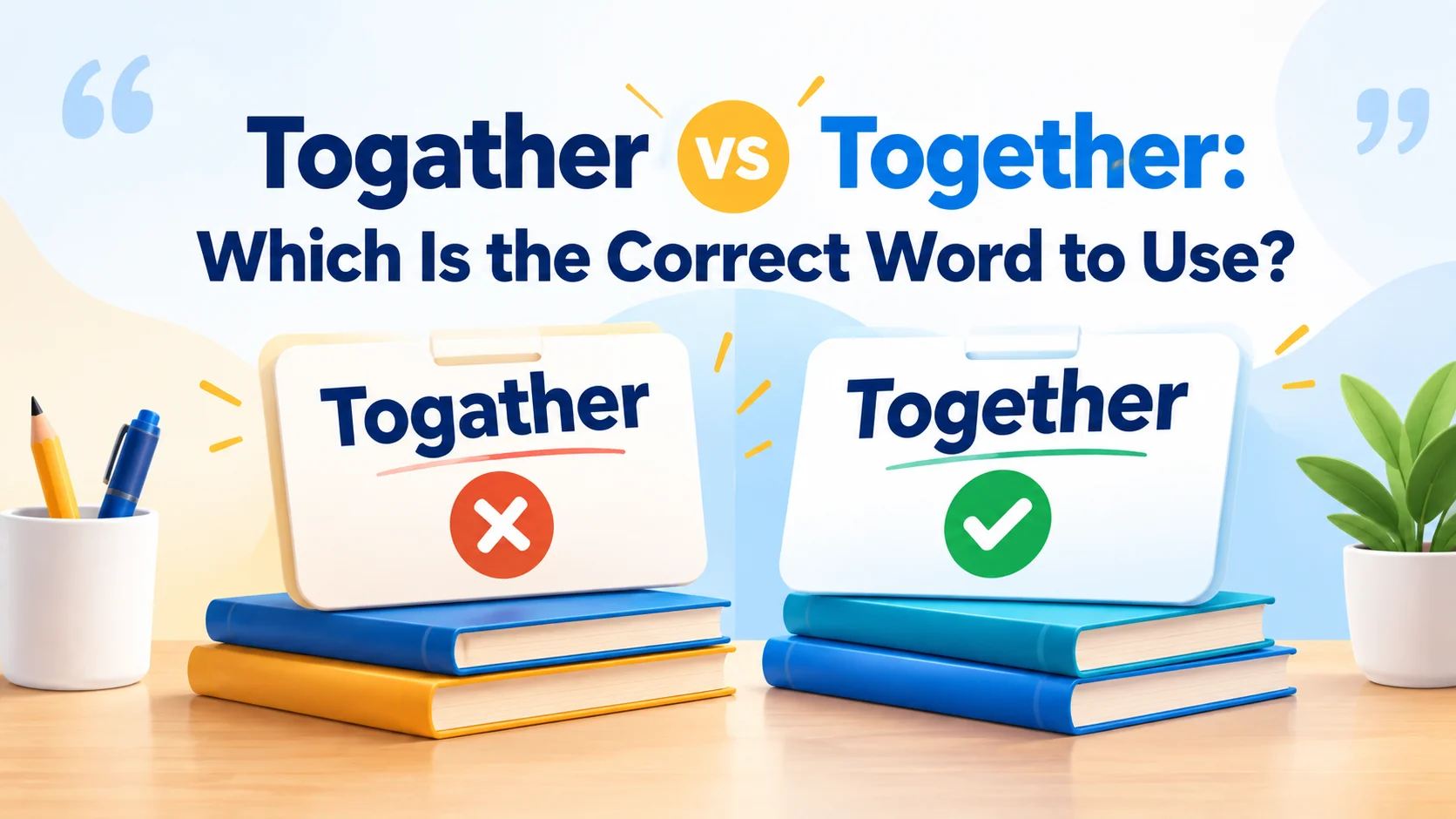
Togather vs together is a common spelling confusion, but the answer is straightforward: together is the correct standard English word. Togather is normally a misspelling, often caused by the way the word sounds or by confusion with gather. Although the two forms look remarkably similar, they do not have equal status in standard English. If you are writing an email, school assignment, article, application, or professional document, together is the spelling you should use.
The confusion becomes easier to understand once you look beyond spelling. Together has several related meanings: people can be together in the same place, objects can be put together, people can work together, or events can happen together. The word also appears in familiar expressions such as get together, come together, and put together. Learning these patterns gives you a more reliable way to recognize the correct spelling than simply trying to reproduce its pronunciation.
This guide explains why “togather” appears so often, how together differs from gather, and when to use together, all together, or altogether. You will also see practical examples, common mistakes, memory strategies, and a short self-check. By the end, the important distinction should feel automatic: together is the standard spelling, while togather is generally an error when you mean the common English adverb.
Togather vs Together: The Quick Answer
If you are wondering whether to write togather or together, choose together.
Quick rule: Use together when you mean “with each other,” “in combination,” “into one group,” or “at the same time,” depending on the context.
For example:
- Correct: We worked together on the assignment.
- Incorrect: We worked togather on the assignment.
- Correct: Put the two pieces together.
- Incorrect: Put the two pieces togather.
- Correct: They arrived together.
- Incorrect: They arrived togather.
Togather vs Together at a Glance
| Form | Standard English? | Typical meaning | Example |
| together | Yes | With others, combined, joined, or at the same time | “They studied together.” |
| togather | No, when intended as together | Usually a spelling mistake | “They studied together.” |
| gather | Yes, but different word | To collect or assemble | “The students gathered outside.” |
The important point is that togather is not simply an alternative spelling of together. If you see it in ordinary English writing, it is usually an error.
What Does “Together” Mean?
Together is a versatile English word. Its meaning changes slightly according to the sentence, but its central idea is connection, combination, proximity, or simultaneous action.
Together Means Being With Other People
The most familiar use describes people who are in the same place or participating in something as a group.
- We went to the library together.
- The whole family had dinner together.
- Sara and Mia walked home together.
- The students sat together during the presentation.
Here, together emphasizes that two or more people are associated in the same activity or situation.
Together Means Combining or Joining Things
The word can also describe objects, ideas, or pieces that have been joined.
- Put the puzzle pieces together.
- These ingredients work well together.
- The designer brought several ideas together.
- We need to put the report together before Friday.
This use is especially common when something consists of multiple parts.
Together Means Working Toward a Shared Goal
When people cooperate, together they can emphasize teamwork.
The research team worked together to solve the problem.
It does not merely mean that the researchers occupied the same room. It tells us that their actions were coordinated toward a common purpose.
You might also hear:
- “We can figure this out together.”
- “The two departments worked together.”
- “They built the project together.”
Together Can Mean at the Same Time
Sometimes together refers to simultaneous action.
- The children shouted together.
- They arrived together.
- Everyone laughed together.
- The musicians began playing together.
The precise interpretation depends on context. In “They arrived together,” it may mean they arrived as a group or at approximately the same time.
Together Can Have a Figurative Meaning
English is also used together in expressions about emotional control, organization, or personal stability.
For example:
- “She is trying to get herself together.”
- “He managed to hold it together during the difficult meeting.”
- “We need to get everything together before the event.”
In these expressions, together is not describing physical proximity. It contributes to a broader figurative meaning.
How “Together” Works Grammatically
In ordinary sentences, together is primarily used as an adverb. It usually tells us something about how an action happens or how people or things are arranged.
Consider:
The friends studied together.
The word together tells us how they studied.
She put the books together.
Here, it describes the resulting arrangement or manner of putting the books into one group.
Common Sentence Patterns With Together
You will frequently encounter patterns such as:
Subject + verb + together
The children played together.
Verb + object + together
She put the documents together.
Verb + together
The two ideas come together.
Expression + together
We need to work together.
Because together appears in so many common constructions, learning it as a complete word is more useful than trying to break its spelling apart.
Why Is “Together” Written as One Word?
The standard modern spelling is simply together.
It is not written as:
- to gether
- to-gather
- togather
This matters because gether is not functioning as an independent modern English word in together. You should learn together as one established spelling.
Writing tip: If you regularly hesitate over the spelling, memorize familiar phrases such as work together, come together, and put together. Repeated exposure makes the correct form easier to recognize.
Is “Togather” a Correct English Word?
In ordinary standard English, togather is not the correct spelling of together.
If your intended meaning is “with each other,” “combined,” or “at the same time,” write together.
Why You May See “Togather” Online
You may encounter togather in:
- Social media posts
- Comments
- Text messages
- Informal websites
- User-generated content
- Unedited documents
- Fast-typed messages
Its appearance does not mean that the spelling has become an accepted standard variant. Online writing contains many accidental spellings.
There is one important qualification: a business, website, username, project, or other proper name could intentionally use Togather as its chosen name. In that situation, the spelling is part of the name. That does not make togather the standard spelling of the ordinary English word together.
Why Do People Spell “Together” as “Togather”?
The error is understandable. It is not random.
The Influence of “Gather”
One major source of confusion is the word gather.
Compare the visual forms:
- together
- togather
- gather
The beginning of together can look as though it should contain gathering, especially because the meanings are related. People can gather together, so the two words naturally appear in the same contexts.
For example:
The crowd gathered together outside.
Seeing and hearing these words near each other can reinforce the mistaken spelling togather.
Pronunciation Does Not Clearly Reveal the Spelling
English spelling and pronunciation do not always correspond letter-for-letter.
When together is spoken naturally, its unstressed syllables can make the middle vowel sequence less obvious to a listener. Someone who has mainly encountered the word in conversation may therefore try to spell it according to the sound they perceive.
That is a general English-learning problem: hearing a word correctly does not always tell you how to spell it.
English Spelling Is Not Entirely Phonetic
A learner cannot always spell an unfamiliar English word perfectly just by saying it slowly.
This is why visual familiarity matters. With common words such as together, fluent readers usually recognize the whole spelling pattern rather than reconstructing each letter from pronunciation.
Fast Typing Can Reinforce the Error
Typing quickly creates another opportunity for togather to appear.
A writer may know perfectly well what they intended to say but accidentally type the wrong vowel sequence. If the sentence is not carefully reviewed, the typo can remain.
This is particularly easy to overlook when the surrounding sentence is grammatically correct.
Together vs. Gather: The Difference That Causes Much of the Confusion
Together and gather are related in meaning, but they are not interchangeable.
What Does “Gather” Mean?
Gather is usually a verb meaning to collect, assemble, bring together, or come together.
Examples:
- Please gather the documents.
- The students gathered in the hallway.
- She gathered information for the report.
- Dark clouds gathered overhead.
The word describes an action or process.
What Does “Together” Mean?
Together commonly describes a state, arrangement, relationship, or manner of action.
- The students worked together.
- Keep the documents together.
- The two pieces fit together.
- They traveled together.
A useful way to remember the distinction is:
Gather often describes the act of bringing things into a group.
Together often describes the things or people being joined or acting as a group.
Together and Gather Can Appear in the Same Sentence
This is where the spelling confusion becomes particularly understandable.
The students gathered together before the ceremony.
Both words are correct, but they perform different jobs:
- gathered = assembled
- together = as a group
Another example:
The volunteers gathered the supplies together.
Here, gathered describes collecting the supplies, while together describes their resulting arrangement.
Together vs. Gather: Quick Comparison
| Feature | Together | Gather |
| Usual grammatical role | Adverb | Verb |
| Core idea | Joined, combined, or with others | Collect, assemble, or come together |
| Example | “We worked together.” | “We gathered the materials.” |
| Can you describe cooperation? | Yes | Not usually by itself |
| Can you describe collecting things? | No | Yes |
Together vs. All Together vs. Altogether
These three forms are easy to confuse because they look and sound similar.
Together
Together means joined, associated, combined, or acting with others.
The children walked together.
All Together
All together is a two-word phrase. It can emphasize that everyone or everything is included, often with the idea of acting at the same time.
The audience clapped all together.
It can also refer to a complete group:
We were all together at the reunion.
The phrase is particularly useful when all adds emphasis.
Altogether
Altogether is one word with a different meaning. Depending on context, it can mean completely, entirely, or in total.
The plan was altogether different from what we expected.
Or:
The three purchases cost $75 altogether.
Compare these carefully:
| Form | Meaning | Example |
| together | Joined or with one another | “They worked together.” |
| all together | Everyone/everything collectively or at the same time | “They sang all together.” |
| altogether | Completely, entirely, or in total | “The repairs cost $500 altogether.” |
Memory check: If you can replace the expression with “in total”, altogether may be the word you need. If you mean “with one another,” together is usually the right choice.
Together vs. “To Gether”: Is It One Word?
Yes. Together is written as one word.
The form together is not the standard spelling of the word.
A common reason for this mistake is that English learners sometimes try to divide unfamiliar words into smaller pieces that look meaningful. In this case, that strategy creates a false division.
You should treat together as a complete vocabulary item, just as you would with other common words whose internal spelling is not predictable from modern word boundaries.
How to Use “Together” Correctly in Sentences
The easiest way to master together is to see how naturally it works in different situations.
Everyday Conversations
My sister and I went shopping together.
We usually eat dinner together on weekends.
Let’s meet together after class.
These examples describe people sharing an activity or being in the same situation.
School and Academic Writing
The students worked together on the experiment.
The researchers analyzed the results together.
The two ideas can be brought together in the final paragraph.
In academic contexts, together often describes collaboration, combination, or the relationship between ideas.
Workplace and Professional Writing
Our teams are working together on the project.
Please keep the invoices together.
The departments came together to discuss the proposal.
Professional writing often benefits from precise word choice because small spelling errors can distract from an otherwise clear message.
Describing Physical Objects
Keep the keys and wallet together.
The two parts fit together.
Place the matching documents together in the folder.
Here, together describes physical arrangement or connection.
Figurative and Idiomatic Uses
Some of the most useful expressions containing together are:
- get together — meet or gather socially
- work together — cooperate
- put together — assemble or combine
- come together — join or unite
- stick together — remain united
- hold together — remain intact or maintain unity
- pull together — cooperate toward a shared purpose
These expressions are worth learning as phrases because they occur frequently in everyday English.
Common “Together” Expressions You Should Know
Get Together
We should get together sometime next week.
This can mean meeting socially or assembling as a group.
Work Together
The designers and engineers worked together.
This emphasizes cooperation.
Put Together
She put together a presentation for the meeting.
This commonly means to assemble or organize something.
Come Together
Several groups came together to support the project.
The expression can describe physical joining or broader cooperation.
Stick Together
The teammates promised to stick together.
This usually suggests remaining united or supporting one another.
Hold Together
The explanation does not quite hold together.
This can refer to physical structure or the logical coherence of an idea.
Pull Together
Everyone pulled together when the deadline became difficult.
The expression emphasizes coordinated effort, especially in challenging circumstances.
Togather vs. Together Examples: Correct and Incorrect Sentences
Seeing the incorrect spelling beside the correct one can make the distinction easier to remember.
| Incorrect | Correct | Reason |
| We studied togather. | We studied together. | Together is the standard spelling. |
| They traveled togather. | They traveled together. | The word describes shared action. |
| Put the files togather. | Put the files together. | The files should be kept in one group. |
| We solved the problem togather. | We solved the problem together. | The intended meaning is collaborative action. |
| The pieces fit togather. | The pieces fit together. | The pieces connect or combine. |
How the Meaning Changes When You Use “Gather”
Compare:
We worked together.
This means we cooperated.
We gathered.
This means we assembled or came together.
Now consider:
We gathered together.
This combines both ideas: we assembled as a group.
That distinction is much more useful than simply memorizing that togather is wrong. Once you understand what each word does, you are less likely to confuse them.
Common Misspellings and Related Confusions
“Togather”
This is the most direct spelling error. When the intended word is together, replace it with together.
“To Gether”
This incorrect form is treated together as though it were made from two independent words. Standard English writes it as one word.
Together vs. Gather
The words are related but grammatically different. Gather is commonly a verb; together is commonly an adverb.
Together vs. All Together
The two-word phrase all together contains the adjective/determiner all and the adverb together. It should not automatically be changed altogether.
Together vs. Altogether
Changing the spacing changes the meaning. Altogether often means “completely” or “in total,” while together refers to joining, association, or simultaneous action.
How to Remember the Correct Spelling of “Together”
If togather keeps appearing in your writing, a simple memory strategy can help.
Use a Visual Anchor
Think of the spelling as:
TO + GETHER = TOGETHER
The important point is not that gether is an independent word. It is simply a visual aid for remembering that the middle contains -geth-, not -gath-.
Learn the Whole Word
Rather than trying to spell together from its pronunciation, recognize its complete visual pattern:
together
Frequent exposure makes this much easier.
Memorize Common Phrases
These combinations reinforce the spelling naturally:
- work together
- live together
- study together
- get together
- come together
- put together
- stay together
- stick together
The more often you encounter the correct form, the less likely you are to substitute togather.
Proofread High-Stakes Writing
A spelling mistake in a casual text is usually easy to fix. In a résumé, application, school assignment, business email, or published article, proofreading is more important.
A useful final check is simple: search the document for “togather.” If the word appears and you intended together, correct it.
A Quick Self-Check for “Togather vs. Together”
Try these before looking at the answers.
- We completed the project ___.
- The children sat ___ during the presentation.
- Please keep these documents ___.
- The two teams worked ___.
- The family traveled ___.
Answer Key
All five sentences take together:
- We completed the project together.
- The children sat together during the presentation.
- Please keep these documents together.
- The two teams worked together.
- The family traveled together.
The exercise may seem simple, but that is precisely the point. The correct spelling should become automatic in common sentence patterns.
When Correct Spelling Matters
Not every typo has the same consequence.
Academic Writing
A spelling mistake can make an assignment look less carefully edited. In formal academic work, consistent spelling supports clarity and readability.
Professional Communication
An isolated typo will not necessarily change the meaning of an email, but repeated basic spelling errors can distract the reader.
When writing professionally, a quick final review is worthwhile—especially for messages sent to clients, managers, teachers, or other external audiences.
Everyday Digital Communication
Texts and informal messages are more forgiving. People routinely make typing mistakes, and context usually makes the intended meaning obvious.
Still, if you are trying to improve your English spelling, correcting togather → together whenever you notice it is useful practice.
Conclusion:
The simplest rule is also the most useful: together is the correct standard spelling when you mean being with others, combining things, cooperating, or acting at the same time. Togather is normally a misspelling, often caused by pronunciation, fast typing, or confusion with gather. Understanding that distinction is more valuable than memorizing a correction in isolation.One final actionable tip: add together to a few familiar phrases—work together, stay together, come together, put together—and let those patterns reinforce the spelling. A common mistake to avoid is assuming that gather explains how together should be spelled. They are related in meaning, but they are different words. Once you recognize the difference, this particular spelling problem becomes much easier to eliminate from your writing.
FAQs
Q1. Is “togather” ever an acceptable spelling of “together”?
No, not as the standard spelling of the ordinary English word. Together is the accepted spelling. However, Togather could intentionally appear as part of a business name, username, title, or brand. In those cases, it is a chosen proper name rather than an alternative spelling.
Q2. Why is “togather” such a common spelling mistake?
The error is understandable because together sounds different from how its spelling might be expected from a learner’s perspective. The word gather also looks and sounds related, which can encourage the substitution of a for e. Fast typing can reinforce the mistake.
Q3. What is an easy way to remember the spelling of together?
Memorize together as a complete word rather than spelling it from pronunciation. It can also help to learn common phrases such as work together, get together, and put together. Repeatedly seeing the correct pattern makes the spelling easier to retrieve automatically.
Q4. Is “together” always an adverb?
Together is primarily an adverb in ordinary modern English usage, although its exact function depends on the construction. It can describe shared action, arrangement, simultaneous activity, or figurative states. Expressions such as “put together” and “hold together” also give the word broader idiomatic uses.
Q5. What is the difference between “together” and “altogether”?
Together generally refers to being joined, associated, or acting with others. Altogether is a separate word that can mean “completely,” “entirely,” or “in total.” For example, “They worked together” differs from “The repairs cost $400 altogether.”