

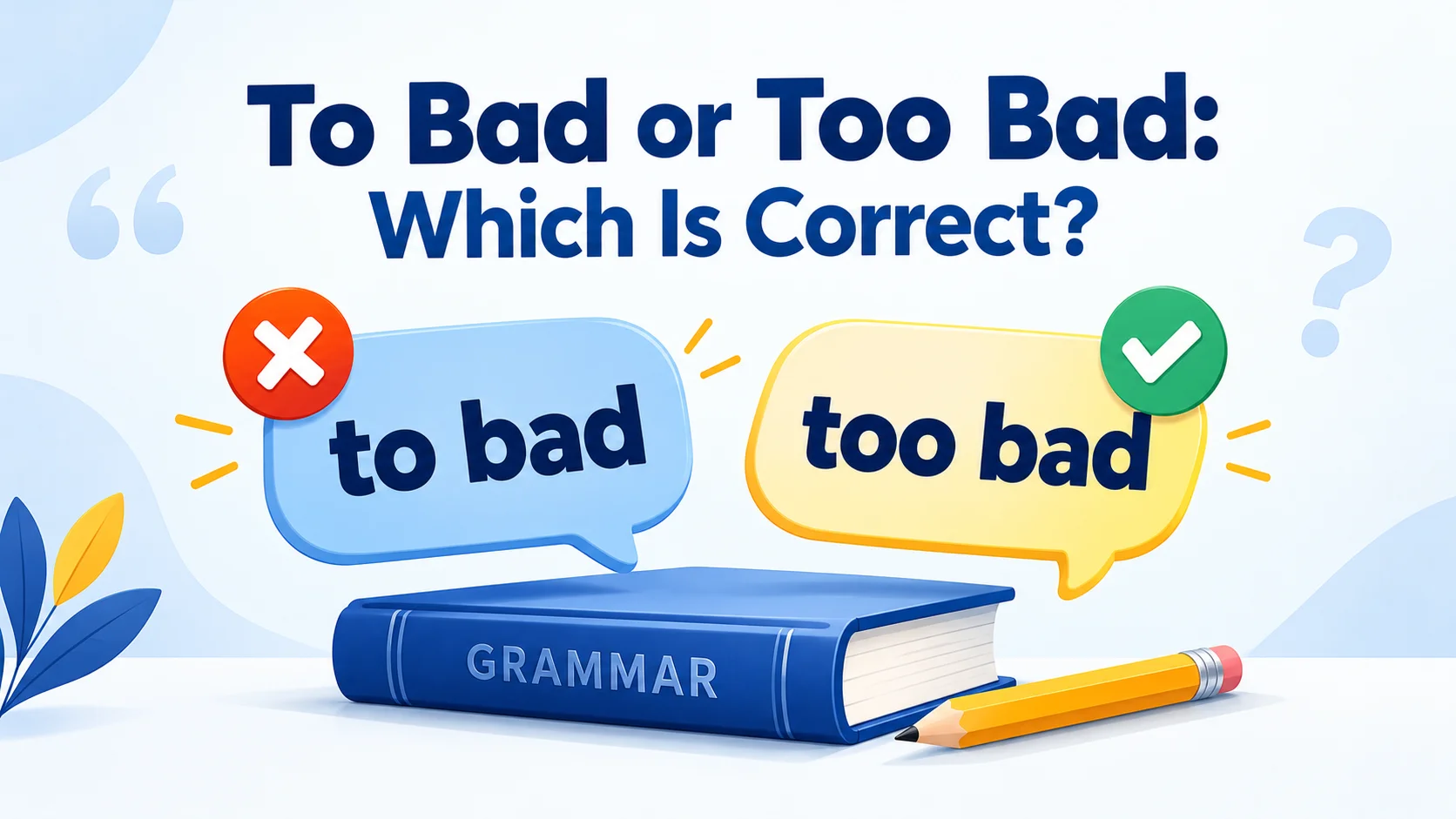
If you have ever wondered whether to write “to bad or too bad,” the correct choice is almost always “too bad” when you mean that something is unfortunate, disappointing, or excessively bad. The confusion is understandable: to and too sound identical in ordinary speech, so pronunciation alone will not help you choose the right spelling. The difference becomes clear when you look at what each word does in a sentence. Once you understand the basic rule, you can avoid this common mistake in text messages, school assignments, emails, and professional writing without second-guessing yourself.
The phrase “too bad” has more than one use. Sometimes it expresses sympathy, as in “It’s too bad you missed the concert.” In other situations, it describes something that exceeds an acceptable degree: “The damage was too bad to repair.” It can even sound dismissive when someone responds to disappointing news with a curt “Too bad.” These meanings are related, but context determines how readers interpret the phrase. Understanding that distinction helps you choose words that communicate both your intended meaning and the right tone.
In this guide, you will learn why “too bad” is correct, when to and too are appropriate, and how the phrase differs from expressions such as very bad and not too bad. You will also see practical sentence examples, everyday dialogues, common spelling errors, and alternatives for situations where too bad might sound insensitive or overly casual. A short practice exercise will help you apply the rule. By the end, you should be able to identify the correct spelling quickly and explain the grammar behind it—not merely memorize a phrase.
To Bad vs. Too Bad: The Difference at a Glance
“Too bad” is the standard expression when describing an unfortunate situation or something excessively bad. By contrast, to serve other grammatical purposes, such as introducing an infinitive verb or indicating direction. It does not replace too in this expression.
| Word or phrase | Meaning or function | Example | Correct? |
| Too bad | Unfortunate; disappointing | It’s too bad you missed the game. | Yes |
| Too bad | Excessively bad | The road was too bad to use safely. | Yes |
| To | Introduces an infinitive verb | I want to leave early. | Yes |
| To | Indicates direction or destination | We walked to school. | Yes |
| To bad | Intended to mean “unfortunate” | It’s to bad you missed the game. | No |
| Not too bad | Reasonably good or acceptable | The exam was not too bad. | Yes |
The quickest way to choose
Ask yourself what you want to communicate:
- If you mean “unfortunate” or “a shame,” write too bad.
- If you mean “excessively bad,” write too bad.
- If you are introducing an action, such as to leave, to learn, or to improve, use to.
- If you are describing a destination, such as to school or to the office, use to.
The key is to consider the word’s function in the sentence, not simply how it sounds.
What Does “Too Bad” Mean?
The phrase too bad has two closely related uses: it can describe an unfortunate situation, or it can indicate that something is bad to an excessive degree. It can also function as a short conversational response.
1. “Too bad” means unfortunate or disappointing
This is the familiar expression used when something does not happen as hoped or expected.
Examples:
- “It’s too bad that the outdoor concert was canceled.”
- “Too bad you couldn’t join us for dinner.”
- “It’s too bad the application deadline passed yesterday.”
In these sentences, too bad communicates regret about an outcome. The speaker is not necessarily saying that something is terrible; they are acknowledging that the situation is disappointing.
Usage tip: When you can replace the phrase with it’s unfortunate or it’s a shame, you probably need too bad.
2. “Too bad” means excessively bad
Here, too, has its ordinary meaning of more than is desirable, acceptable, or manageable. It modifies the adjective bad and often suggests a problem or consequence.
Consider these examples:
- “The weather was too bad to go hiking.”
- “The damage was too bad to repair economically.”
- “The traffic was too bad for us to arrive on time.”
The phrase does more than say the weather, damage, or traffic was bad. It indicates that the degree of badness prevented something or made an outcome difficult.
Notice the common structure:
too + adjective + to + verb
For example, in “The weather was too bad to travel,” the first too means excessively, while the second introduces the verb travel. Both words are correct because they perform different jobs.
3. “Too bad” as a short reaction
In conversation, a person may simply say “Too bad” or “That’s too bad” after hearing disappointing news.
Maya: The tickets sold out before I could buy any.
Leo: That’s too bad. I know you wanted to go.
Here, the phrase acknowledges Maya’s disappointment. It does not describe the tickets themselves as excessively bad.
However, the same words can sound dismissive in a different exchange:
Ari: I can’t come to the event because my plans changed.
Sam: Too bad.
Depending on the relationship and delivery, Sam’s response might sound indifferent rather than sympathetic. The words remain the same, but the tone changes their effect.
Why Is “Too Bad” Correct and “To Bad” Usually Wrong?
The spelling difference comes down to grammar. Although to and too are homophones—words that sound alike but have different meanings and functions—they are not interchangeable.
The grammar rule behind “too”
Too is an adverb. It can mean excessively or more than is appropriate. In other contexts, it means also.
Examples:
- “The coffee is too hot to drink.” (Too means excessively.)
- “The instructions are too complicated.” (Too much is more complicated than is desirable.)
- “I want to come, too.” (Too means also.)
In the phrase too bad, the word too modifies the adjective bad. The combination can express an unfortunate situation or an excessive degree, depending on the sentence.
Why “to bad” does not work in the same expression
To commonly functions as a preposition or as the marker introducing an infinitive verb.
As a preposition:
- “She drove to the station.”
- “We sent the letter to our teacher.”
Before an infinitive verb:
- “I hope to win.”
- “They decided to leave.”
In standard English, too bad does not express the meaning of too bad. In the sentence “It’s to bad that the match was canceled,” the word to has no appropriate grammatical function. The correct version is “It’s too bad that the match was canceled.”
Can “to bad” ever be correct?
The exact sequence to bad can appear in unusual contexts, but that does not make it an alternative spelling of the expression.
For instance, Bad could be a person’s name or part of a title, and might legitimately precede it in a sentence. A sentence could also be followed by a word that happens to be bad in a specialized grammatical context.
These cases depend on the surrounding sentence. For ordinary writing, if you intend to say that something is unfortunate or excessively bad, use “too bad.”
How to Use “Too Bad” Correctly in a Sentence
Different sentence patterns make the expression useful in both conversation and writing. Choosing the right structure helps your meaning sound natural.
“It’s too bad that…” to express regret
Use this pattern when referring to an event, situation, or outcome.
Structure: It is/was too bad that + clause
Examples:
- “It’s too bad that the museum closes so early.”
- “It was too bad that our team lost in the final minutes.”
- “It’s too bad that you had to cancel your appointment.”
This construction works well when you want to comment on a situation without addressing someone directly. It is common in everyday speech and informal writing.
“That’s too bad” to respond to disappointing news
This form responds to information someone has shared.
Examples:
- “My flight was delayed by four hours.” “That’s too bad.”
- “I didn’t get the scholarship.” “That’s too bad. I know you worked hard.”
- “The restaurant was closed when we arrived.” “Oh, that’s too bad.”
A few extra words can make the response warmer. For example, “I’m sorry to hear that” may communicate more empathy than a brief “That’s too bad,” particularly when the news is serious.
“Too bad!” as a standalone expression
The phrase can stand alone when the surrounding conversation makes its meaning clear.
Examples:
- “Too bad! We just missed the bus.”
- “Too bad the match was postponed.”
- “Too bad—I was hoping to see the exhibition.”
An exclamation mark can convey stronger emotion, but punctuation alone does not determine whether a response sounds sympathetic or dismissive. The relationship between speakers and the seriousness of the situation matter, too.
“Too bad to…” to describe an excessive degree
Use this structure when something is so bad that an action is difficult, impossible, or inadvisable.
Structure: too + adjective + to + verb
Examples:
- “The road was too bad to drive on safely.”
- “The damage was too bad to repair.”
- “The conditions were too bad to continue the match.”
This pattern is particularly useful for explaining consequences. The adjective describes the problem, while the infinitive identifies the action affected by it.
“Too bad for…” to identify who or what is affected
The preposition for can connect the description to a person, group, or situation.
Examples:
- “It was too bad for the visitors that the tour was canceled.”
- “The timing was too bad for our plans.”
- “It’s too bad for the team that its captain is unavailable.”
The last two examples are grammatical, though other wording may sound more natural depending on the intended meaning. For instance, “The timing was unfortunate for our plans” may be smoother in formal writing.
“Too Bad” vs. “Very Bad”: What Is the Difference?
Although both expressions contain the adjective bad, they do not communicate exactly the same thing.
Very bad intensifies a description. It tells readers that something is bad to a high degree. Too bad can also describe a high degree, but it often suggests that the degree is excessive or causes a problem. Separately, too bad is an established expression meaning unfortunate.
| Expression | Main meaning | Example | What it communicates |
| Very bad | Bad to a high degree | The service was very bad. | Strong negative judgment |
| Too bad | Excessively bad | The service was too bad to recommend. | The quality exceeded an acceptable limit |
| Too bad | Unfortunate | It’s too bad the service was unavailable. | Regret about the situation |
| Not too bad | Reasonably good or acceptable | The service was not too bad. | A restrained or mildly positive assessment |
When should you choose “very bad”?
Use very bad when you want to emphasize the severity of a problem without necessarily implying that it exceeds a limit or prevents an action.
For example:
- “The report contained very bad errors.”
- “The food tasted very bad.”
- “His performance was very bad.”
These sentences express strong criticism. They do not automatically suggest that the report was unusable, the food could not be eaten, or the performance was impossible to accept.
When is “too bad” more precise?
Choose too bad when the degree of a problem matters to what happens next.
- “The errors were too bad to ignore.”
- “The food was too bad for us to finish.”
- “The performance was too bad to qualify for the next round.”
Each sentence links the degree of badness to a consequence. That relationship is what makes it especially useful.
“Too Bad” vs. “Not Too Bad”
Adding does not change the meaning substantially. While too bad can express disappointment, “not too bad” usually means acceptable, reasonably good, or better than expected.
What does “not too bad” mean?
People often use not too bad to give a mildly positive assessment without sounding overly enthusiastic.
Examples:
- “How was your exam?” “Not too bad.”
- “The weather wasn’t too bad, so we went for a walk.”
- “The meal was not too bad for a quick lunch.”
- “I’m not feeling too bad today.”
The expression is often understated. Someone who says “The exam was not too bad” may mean it was manageable, even if it wasn’t particularly easy.
Is “not too bad” the same as “not bad”?
The expressions overlap, but their tone can differ.
- Not bad: Often a straightforward, mildly positive assessment.
- Not too bad: Often suggests that something was acceptable or less difficult than expected.
Compare:
“The interview wasn’t bad.”
This sounds like a generally positive evaluation.
“The interview wasn’t too bad.”
This may suggest that the interview was challenging but manageable.
Neither expression has a fixed emotional intensity in every situation. Tone, context, and the speaker’s habits all influence interpretation.
Common Mistakes With “To Bad” and “Too Bad”
Knowing the rule is useful, but the error can still slip into writing because the words sound identical. These are the mistakes worth checking for when proofreading.
Mistake 1: Writing “to bad” to express disappointment
Incorrect: “It’s to bad that we missed the train.”
Correct: “It’s too bad that we missed the train.”
Why: The sentence expresses regret, so the correct phrase is too bad.
Mistake 2: Writing “That’s to bad”
Incorrect: “That’s to bad about your canceled appointment.”
Correct: “That’s too bad about your canceled appointment.”
Why: The phrase is an expression of sympathy or regret. The contraction does not change the spelling rule.
Mistake 3: Confusing the two words in the same sentence
Incorrect: “The weather was to bad to play outside.”
Correct: “The weather was too bad to play outside.”
The correct sentence contains two different grammatical elements:
- Too bad: Too modifies bad to indicate an excessive degree.
- To play: To introduce the infinitive verb play.
This is a particularly useful example because it shows why you cannot replace every instance of to with too, or vice versa.
Mistake 4: Assuming “too bad” always sounds sympathetic
Consider these responses:
- “That’s too bad. I hope things improve.”
- “Too bad. You should have planned better.”
The first acknowledges disappointment and offers goodwill. The second may sound judgmental or dismissive. If you want to express sympathy, consider adding a compassionate sentence rather than relying on too bad alone.
Mistake 5: Using “too bad” when a more precise phrase would help
“Too bad” is perfectly acceptable in many everyday situations, but it may be vague in professional or academic writing.
Instead of:
“The results were too bad.”
Consider a more specific description:
“The results fell below the required standard.”
The revised sentence tells readers what was wrong and provides a clearer basis for evaluation. Use precise language when the reader needs information, not merely your reaction.
How to Remember “Too Bad” Every Time
You do not need to memorize a long grammar rule. Two simple checks will handle most situations.
Use the “unfortunate” test
If unfortunate or a shame preserves your intended meaning, use too bad.
- “It’s too bad that the shop is closed.”
- “It’s unfortunate that the shop is closed.”
Both sentences communicate regret, so too bad is appropriate.
Use the “excessively” test
When describing a degree, see whether excessively captures the meaning of too.
- “The road was too dangerous to cross.”
- “The road was excessively dangerous to cross.”
The second sentence sounds more formal, but the basic meaning is similar. This is a helpful check for the literal meaning of too.
Remember the extra “o”
Think of too as indicating more than expected or more than is desirable. This memory aid works especially well in sentences such as “too hot,” “too expensive,” and “too bad.”
It is not a complete rule for every use of too, because the word can also mean also. Nevertheless, it is an effective shortcut for this particular expression.
Proofreading tip: Search your draft for “to bad.” If you intended to express disappointment or excessive badness, change it to “too bad.” Check each occurrence in context rather than automatically replacing every instance of to.
“Too Bad” in Real-Life Conversations
The expression is common in everyday English, but using it naturally involves more than getting the spelling right. The situation and your relationship with the other person help determine whether it sounds appropriate.
Responding sympathetically to bad news
Example:
Nadia: I couldn’t attend the workshop because my bus broke down.
Hassan: That’s too bad. Did you manage to get the notes afterward?
Hassan acknowledges the disappointment and follows up with a helpful question. The additional sentence makes his response feel engaged rather than perfunctory.
Expressing disappointment without sounding rude
Imagine a colleague tells you that a planned meeting has been canceled.
You could say:
“That’s too bad. I’ll check whether we can reschedule.”
This response acknowledges the inconvenience and moves toward a solution. In contrast, a bare “Too bad” may sound indifferent, particularly in a professional exchange.
Using “too bad” sarcastically or dismissively
The phrase can also imply that the speaker does not intend to help.
Rafi: I forgot to reserve a seat, and now the event is full.
Omar: Too bad.
Depending on their relationship and delivery, Omar may sound sympathetic, teasing, or unsympathetic. Because written messages lack vocal cues, short responses can be especially easy to misinterpret.
Is “too bad” appropriate in professional writing?
It depends on the purpose and audience.
In a friendly team chat, “It’s too bad the presentation was postponed” may sound perfectly natural. In a formal client email, a phrase such as “Unfortunately, the presentation has been postponed” is usually more precise and professional.
Use too bad when a conversational tone fits. Choose a more explicit expression when the message concerns a sensitive issue, a formal decision, or an important business outcome.
Alternatives to “Too Bad”
If you want to communicate the same general idea with a different tone, choose an expression that matches the situation.
| Alternative | Best use | Example |
| That’s unfortunate. | Neutral or professional regret | That’s unfortunate; the deadline has passed. |
| What a shame. | Natural, conversational disappointment | What a shame that the event was canceled. |
| I’m sorry to hear that. | Showing sympathy | I’m sorry to hear that your trip was canceled. |
| Unfortunately, … | Formal writing and factual updates | Unfortunately, we cannot approve the request. |
| That’s disappointing. | Expressing dissatisfaction with an outcome | That’s disappointing after so much preparation. |
| It didn’t work out. | Describing an unsuccessful plan tactfully | The arrangement didn’t work out this time. |
How to choose the right alternative
Think about what the reader needs from your message:
- To show empathy: “I’m sorry to hear that.”
- To state a problem neutrally: “That’s unfortunate.”
- To express personal disappointment: “That’s disappointing.”
- To introduce a formal negative update: “Unfortunately, …”
- To keep a casual conversation: “What a shame.”
These expressions are not perfect substitutes in every sentence. For example, too bad can describe something excessively bad, while I’m sorry to hear that primarily expresses sympathy. Match the wording to the meaning you want to convey.
Practice: Choose “To” or “Too”
Test your understanding by completing the sentences below. Pay attention to meaning and sentence structure rather than relying on how the words sound.
Exercise 1: Fill in the blanks
Choose to or too for each blank.
- It’s ___ bad that the match was canceled.
- We need ___ leave before the traffic gets worse.
- The soup is ___ hot to eat right now.
- She sent the invitation ___ her teacher.
- The damage was ___ bad to repair easily.
Exercise 2: Correct the spelling mistakes
Rewrite each sentence with the correct spelling.
- “That’s to bad about your lost luggage.”
- “The weather was to bad to go camping.”
- “I want too finish the report before lunch.”
Exercise 3: Choose the best expression
Choose the most suitable option for each situation.
1. Your friend says they missed a concert they wanted to attend. Which response expresses sympathy?
- A. “That’s too bad.”
- B. “That’s to bad.”
2. You want to say that a road was excessively damaged for safe travel. Which sentence is correct?
- A. “The road was to bad to use safely.”
- B. “The road was too bad to use safely.”
3. Someone asks how your test went, and you thought it was manageable. Which response best fits?
- A. “Not too bad.”
- B. “Not to bad.”
Answer key and explanations
Show answers and explanations
Conclusion:
When deciding between to bad or too bad, focus on the meaning you want to communicate. Use too bad to express disappointment, acknowledge an unfortunate situation, or describe something that exceeds an acceptable degree. Reserve for its proper grammatical roles, such as indicating direction or introducing an infinitive verb. Remember that the two words sound alike, so proofreading by pronunciation alone will not catch the mistake. One final actionable tip: When editing your writing, search for “to bad” and check whether you intended to express regret or excessive badness. If so, correct it. A common mistake to avoid is assuming that every occurrence of to is wrong or that every use of too bad sounds sympathetic. Context matters. Choose the spelling that fits the grammar, and choose the expression that fits your audience.
FAQs
Q1. Is it “to bad” or “too bad” in American and British English?
“Too bad” is the standard expression in both American and British English when describing something unfortunate or excessively bad. There is no regional spelling difference here. Although accents and pronunciation vary, to and too are generally pronounced alike, so the correct choice depends on meaning and grammar.
Q2. Is “too bad” grammatically correct at the end of a sentence?
Yes. “Too bad” can stand alone as a short response, as in “You missed the show? Too bad.” It can also appear at the end of a longer sentence. However, when used alone, it may sound sympathetic, playful, or dismissive depending on the context and tone.
Q3. Should “too bad” be capitalized in a sentence?
Capitalize “too bad” only when capitalization rules require it, such as at the beginning of a sentence or in a title using title case. For example, write “Too bad we missed the train,” but “It’s too bad we missed the train.” The phrase itself does not require special capitalization.
Q4. Is “too bad” an idiom or a literal phrase?
It can be both. In “It’s too bad you couldn’t attend,” the phrase is idiomatic and means unfortunate. In “The damage was too bad to repair,” it has a more literal meaning: the damage was excessively severe. The surrounding sentence determines which interpretation applies.
Q5. What is the difference between “too bad” and “so bad”?
“Too bad” often suggests misfortune or an excessive degree, while “so bad” commonly intensifies a description or emphasizes a degree. Compare “It’s too bad you left” with “I wanted to see the show so bad.” The second is informal; in formal writing, “so badly” may be preferable.