

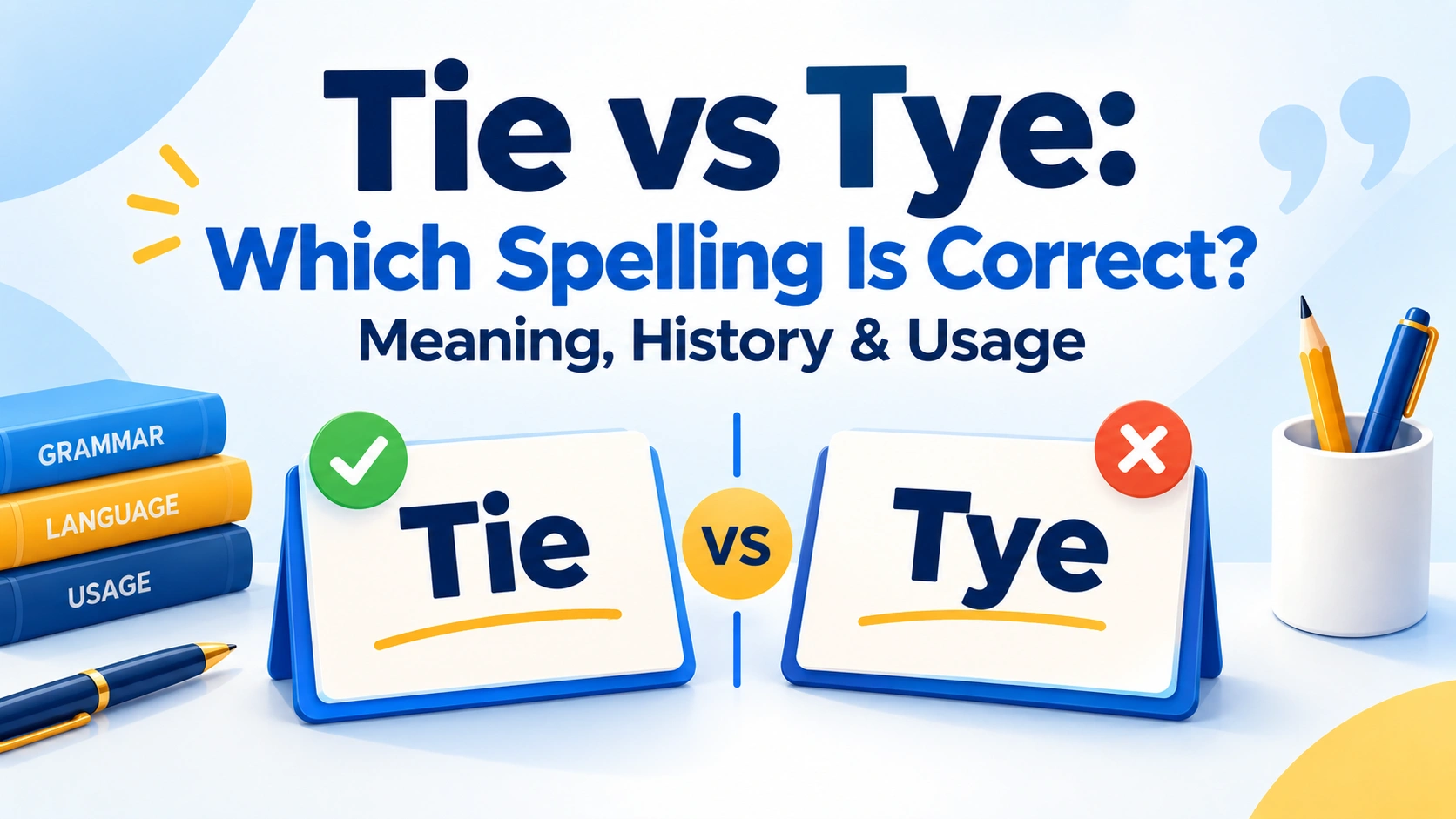
Tie vs Tye is a spelling question with a surprisingly interesting answer: tie is the standard spelling for the ordinary modern English word, while Tye survives mainly in names, place names, and certain historical or specialized contexts. The two forms can sound identical, which makes the confusion understandable, but they are not interchangeable in everyday writing. If you are writing tie your shoes, wear a tie, or the game ended in a tie, tie is the form you want. Dictionaries such as Oxford, Cambridge, and Collins all recognize tie as the established modern word.
The interesting part is that Tye is not simply a “bad spelling.” Historical English used forms related to tye, and the word also survives in English geographical names and surnames. Historical sources associate tye with an enclosed piece of land or an area of common pasture, particularly in southern and southeastern England. The surname Tye has a documented English origin connected with this older geographical term.
This guide explains tie vs tye from several angles: modern meaning, grammar, pronunciation, etymology, regional and historical usage, proper names, common spelling mistakes, and practical examples. You will also see why tye can legitimately appear in a document without being the correct spelling of the everyday verb tie, and how to decide which form belongs in your own sentence.
Tie vs Tye: The Quick Answer
If you need the answer for ordinary modern English, it is straightforward:
Use “tie” for the everyday word. Use “Tye” only when the spelling belongs to a specific name, place, historical term, or other established usage.
The difference is easiest to see in context:
| Form | Ordinary modern English? | Typical use | Example |
| tie | Yes | Fastening, clothing, connection, equal result | “Tie your shoes.” |
| Tye | No, not as a general substitute for tie | Surnames, place names, historical/specialized uses | “The family name is Tye.” |
So, if your sentence means fasten, connect, wear a necktie, or finish with the same score, choose tie. Oxford and Cambridge both list these ordinary meanings under tie.
Is “Tye” a misspelling?
Not necessarily. That distinction matters.
Tye can be a legitimate spelling, especially as a proper name or historical form. What is incorrect is treating it as a freely interchangeable modern spelling of tie.
For example:
- Correct: “Please tie the ribbon.”
- Incorrect in ordinary modern English: “Please tye the ribbon.”
- Correct as a name: “Tye is his surname.”
That small distinction prevents two opposite mistakes: calling every occurrence of Tye wrong, or assuming that tye can replace tie whenever you prefer its appearance.
What Does “Tie” Mean?
Tie is a highly productive English word. It functions as both a verb and a noun, and its meanings have expanded far beyond the physical act of making a knot.
Tie as a Verb: To Fasten or Secure
The most basic verbal meaning is to fasten or hold something using string, rope, cord, cloth, or another flexible material.
Examples:
- “Tie the package with string.”
- “She tied her shoelaces.”
- “He tied the ribbon in a bow.”
- “Tie the plant to the support.”
Oxford defines the verb in terms of attaching or holding things together with string, rope, or similar material.
The construction can vary:
- tie something — “Tie the rope.”
- tie something to something — “Tie the horse to the post.”
- tie something with something — “Tie the parcel with ribbon.”
- tie something in a knot — “Tie the cord in a knot.”
The exact preposition depends on what you are describing, so learning tie as a word is more useful than memorizing one sentence pattern.
Tie as a Noun: A Fastening or Connection
As a noun, tie can refer to something used to fasten, secure, or connect things.
For example:
- “Use a tie to hold the wires together.”
- “The bundle was secured with several ties.”
The noun also developed broader figurative meanings. A tie can be a connection, relationship, or bond between people, organizations, or countries.
That gives us expressions such as:
- family ties
- business ties
- diplomatic ties
- close ties
- emotional ties
Tie as a Piece of Clothing
A tie can also mean a necktie: the long, narrow piece of material worn around the neck with a knot at the front. Oxford and Cambridge both give this as a standard noun meaning.
Examples:
- “He wore a blue tie.”
- “Her tie matched her jacket.”
- “The invitation requested a suit and tie.”
In North American English, necktie is also common when greater specificity is useful.
Tie as an Equal Result
In games and competitions, a tie occurs when competitors finish with the same score or result.
Examples:
- “The game ended in a tie.”
- “The two players tied for first place.”
- “The score was tied at 2–2.”
Oxford identifies tie as the noun for a situation in which two or more competitors have the same score, while the verb means to have the same number of points.
One regional point is worth knowing: draw is especially common in British sports usage for an equal result, although tie is also an established English word. Context and variety of English can therefore affect which term sounds most natural.
Tie as a Connection or Relationship
The physical idea of joining things together naturally developed into the figurative idea of connection.
Consider:
“The two companies have strong business ties.”
Nothing is literally knotted. Ties means relationships or connections.
This meaning appears frequently in formal writing:
- economic ties
- political ties
- family ties
- cultural ties
- trade ties
Cambridge specifically lists ties as a personal or financial connection between people, organizations, or countries.
How “Tie” Is Used in Modern English
The versatility of tie explains why replacing it with tye creates so many obvious spelling problems.
| Context | Correct form | Example |
| Shoes | tie | “Tie your shoes before you leave.” |
| Clothing | tie | “He wore a striped tie.” |
| Package | tie | “Tie the box with string.” |
| Competition | tie | “The match ended in a tie.” |
| Relationships | tie | “They have close family ties.” |
| Ideas | tie | “The evidence ties the events together.” |
| Music | tie | “The notes are connected by a tie.” |
| Railway terminology | tie in North American usage | “The track uses concrete ties.” |
The last two examples show why tie is broader than many learners initially realize. It has established technical uses in music, railways, surveying, and other fields, in addition to everyday meanings.
What Does “Tye” Mean?
Tye has a real history in English, but it does not function as the normal modern equivalent of tie.
Its most important modern appearances fall into a few categories.
Tye as a Historical or Regional Word
Historical English sources contain forms such as tye associated with older words for land, pasture, or enclosed areas. The precise historical development is complicated because English spelling varied considerably before modern spelling conventions became established.
A historical discussion of English place names records surviving names containing -tye and associates the element with common land or related rights.
So if you encounter tye in an old document, assuming it is simply a typographical error can be misleading.
Tye in English Place Names
One of the clearest surviving uses of tye is geographical.
Historical sources describe tye as a small area of common land, particularly land associated with a village. Research on English place names and historical landscapes records Tye Green, for example, with tye explained as denoting a small common.
The element appears in English place names such as:
- Tye Green
- Tyes
- Tye Farm
- Tye Hill
Historical place-name evidence therefore helps explain why Tye still appears in modern maps and names even though ordinary writers do not normally use it as the verb tie.
Tye as a Surname
Tye is also an established surname.
The Oxford Dictionary of Family Names in Britain and Ireland describes the English surname Tye as a locative name connected with Middle English forms referring to an enclosed piece of land or common pasture. It records historical bearers of the surname from the medieval and early modern periods.
Family-name sources likewise connect the English surname with people who lived near such a piece of land or came from a place carrying the name.
That means:
“Tye” can be completely correct when it is somebody’s established surname.
Changing it to Tie would not be a spelling correction. It would be changing someone’s name.
Tye in Specialized or Historical Sources
You may also encounter tye in historical dictionaries, specialist glossaries, genealogical records, or texts discussing older forms of English.
The important editorial principle is context.
If a historical document spells something tye, preserve that spelling when the spelling itself is part of the evidence. If you are writing ordinary modern English, use the modern standard tie.
Tie vs Tye: What Is the Actual Difference?
The simplest distinction is not “one is real and one is fake.” It is standard modern word versus restricted or historical form.
| Feature | Tie | Tye |
| Standard everyday English | Yes | No |
| Common verb meaning “fasten” | Yes | No |
| Clothing | Yes | No |
| Equal competition result | Yes | No |
| Figurative relationship | Yes | No |
| Proper name | Sometimes | Yes |
| English surname | Possible, but different from the ordinary word | Yes |
| Historical English | Yes | Yes, in documented contexts |
| Place-name element | Not generally in this historical sense | Yes |
The practical rule
If you are writing a normal sentence and can replace the word with fasten, connect, necktie, or equal result, spell it tie.
If Tye appears because it is a person’s name, a place name, or a historical form, keep Tye.
That rule is more accurate than simply memorizing “tie is right, tye is wrong.”
Why Do People Confuse “Tie” and “Tye”?
They Have the Same Pronunciation
In ordinary English pronunciation, tie is pronounced /taɪ/.
A person hearing the word cannot determine from sound alone whether the writer intends tie or Tye. This is a classic spelling problem created by the difference between pronunciation and orthography.
Other examples of this general phenomenon include there/their/they’re and right/write.
English Spelling Cannot Always Be Predicted From Sound
English spelling reflects centuries of linguistic change, borrowing, historical pronunciation, and standardization. A phonetic spelling strategy therefore does not always work.
Someone who has heard tie but has never seen it written might reasonably experiment with tye. That does not make the latter the standard modern spelling.
Names Create a Special Problem
Suppose someone encounters:
“Tye lives near the village.”
Seeing Tye as a personal name can make the spelling look familiar enough to encourage generalization.
But proper names do not function as spelling templates for ordinary vocabulary.
A person can be named Tye without changing the spelling of tie your shoes.
The History and Etymology of “Tie”
The history of tie helps explain why its modern spelling is so firmly established.
Oxford traces the word to Old English tīgan for the verb and tēah for the noun, describing the origin as Germanic.
Etymological sources trace the noun through Middle English forms such as teie and tie, from an Old English word associated with a cord, band, or fastening. The verb developed from the corresponding Old English verb meaning to tie or bind.
The meanings expanded over time:
- Physical fastening — connecting or securing something.
- Restriction — something that holds or confines.
- Figurative connection — a bond or relationship.
- Clothing — a piece of material fastened around the neck.
- Equal competition — competitors connected by an identical score.
- Specialized meanings — including music and railway terminology.
This semantic development is a useful reminder that words do not necessarily acquire their modern meanings all at once. The modern tie is the result of a long history of related meanings.
The History of “Tye”
The history of tye is more closely connected with land and place names than modern speakers might expect.
Family-name research identifies Middle English forms such as tye, teghe, and teye meaning an enclosed piece of land or a large area of common pasture, tracing them to Old English forms.
This explains an important apparent contradiction:
Tye is historically meaningful, but that does not make it the modern spelling of the everyday verb tie.
The two forms have histories that overlap in older English, while modern standard English has settled on tie for the ordinary verb and noun.
Some modern surnames and geographical names preserve the older form. That is normal: proper names often preserve linguistic history that everyday vocabulary no longer does.
Is “Tye” Ever Correct?
Yes—but the context determines why.
When “Tye” Is a Proper Name
If a person, family, organization, or other named entity is officially called Tye, retain that spelling.
For example:
“Tye submitted the report.”
Here, Tye is a name, not the verb tie.
When “Tye” Appears in a Place Name
A geographical name may preserve Tye because of its historical origin.
For example:
“The village green is known as Tye Green.”
You should not change Tye to Tie simply because the two words sound alike.
When “Tye” Appears in Historical Material
If you are quoting, transcribing, or discussing an older source, tye may be historically significant.
In academic or editorial work, the best approach is to distinguish the historical spelling from the modern spelling rather than silently changing it.
When “Tye” Is Not Correct
If you simply mean:
- fasten something
- make a knot
- wear a necktie
- connect two things
- have an equal score
then tie is the correct modern spelling.
Expert rule: Don’t ask only, “Does tye exist?” Ask, “What function does this word perform in this sentence?” That immediately separates the everyday word from the historical or proper-name form.
Tie, Tied, and Tying: Related Spelling Problems
The tie/tye confusion sometimes gets mixed up with the different grammatical forms of tie.
The standard forms are:
| Form | Function | Example |
| tie | Base verb | “Tie the rope.” |
| ties | Third-person singular present / plural noun | “She ties her shoes.” |
| tied | Past tense / past participle | “He tied the package.” |
| tying | Present participle / gerund | “She is tying a ribbon.” |
Oxford gives the same core verb forms: tie, ties, tied, tying.
Why Is It “Tying,” Not “Tieing”?
This is a useful spelling rule.
When tie takes -ing, the final e is removed and y remains:
tie → tying
So:
- Correct: tying
- Incorrect: tieing
This is a completely different issue from tie vs tye. The y in tying does not mean that tye is an alternative spelling of tie.
Common Mistakes With Tie and Tye
Mistake 1: “Tye Your Shoes”
❌ “Tye your shoes.”
✅ “Tie your shoes.”
The verb meaning “fasten with laces” is tie. Cambridge specifically gives tie your shoelaces as a standard use.
Mistake 2: “He Wore a Tye”
❌ “He wore a red tye.”
✅ “He wore a red tie.”
The clothing noun is tie.
Mistake 3: Assuming Both Spellings Are Interchangeable
This is the most important conceptual mistake.
The fact that Tye exists in names and historical sources does not mean:
tie = tye
in ordinary modern English.
They may look like variants in some historical contexts, but contemporary usage gives them different practical roles.
Mistake 4: “Tye” Because It Looks More Phonetic
English spelling is not a system where every sound must be represented by the most intuitive letters.
If you already know the ordinary word, use the established spelling tie.
Mistake 5: Changing a Person’s Name
❌ “His name is Tie.”
if the person’s established name is Tye.
Names deserve their own spelling rules. Always reproduce a person’s established name accurately.
Tie vs Tye in Professional and Academic Writing
In professional writing, the best approach is simple: use the standard vocabulary spelling and preserve proper names exactly.
Workplace Writing
Use tie for ordinary meanings:
“The proposal ties the budget changes to the new timetable.”
“The event requires a suit and tie.”
Avoid unusual spellings simply because they seem plausible.
Academic Writing
Academic writing adds another consideration: historical accuracy.
If your paper discusses an old place name, surname, manuscript, or linguistic form, Tye may be exactly the spelling you need. In that situation, changing it to Tie could erase useful historical information.
Editorial Writing
Editors should distinguish between:
- correcting an ordinary spelling error, and
- altering an established proper name.
Those are not the same task.
If an author writes tye when they mean tie, correction is appropriate in ordinary prose. If the author writes Tye as someone’s surname, correction would be an error.
Practical Examples: Tie vs Tye
Correct Uses of “Tie”
Fastening
“Tie the two ends of the cord together.”
Shoes
“She stopped to tie her shoelaces.”
Clothing
“He chose a dark blue tie for the interview.”
Competition
“The final score was a tie.”
Relationship
“The two communities have strong cultural ties.”
Figurative connection
“The evidence ties the two events together.”
Correct Uses of “Tye”
Surname
“Tye was listed as the author’s family name.”
Place name
“The historical map identifies the area as Tye Green.”
Historical reference
“The researcher examined older records containing the form tye.”
The last example should be understood as a discussion of historical language, not evidence that tye is the preferred spelling in modern everyday prose.
Related Expressions With “Tie”
Once you know the standard spelling, several common expressions become easier to recognize.
✅Tie Up
Tie up can mean physically fastening something, but it also has figurative meanings.
- “Tie up the package.”
- “I’m tied up with work.”
- “The ship tied up at the dock.”
Tie In
To tie in means to connect or relate one thing to another.
“The new evidence ties in with the earlier findings.”
Tie-Breaker
A tie-breaker resolves an equal result in a competition or game.
“The final round served as a tie-breaker.”
Tie Together
This means to connect separate elements.
“The final paragraph ties the main arguments together.”
Tie the Knot
This idiom means to get married.
The phrase illustrates how a literal physical action can develop into a figurative expression.
How to Remember Tie vs Tye
A reliable memory trick is to divide the words by function rather than appearance.
The Everyday Rule
If you are talking about:
- shoes
- knots
- ribbons
- neckwear
- equal scores
- relationships
- connections
use a tie.
The Name-and-Place Rule
If you encounter Tye, ask whether it is:
- a person’s name,
- a surname,
- a place name,
- or a historical term.
If so, its unusual spelling may be intentional.
Memory shortcut: Tie is the everyday word. Tye is the form you investigate for context.
Tie vs Tye: A Simple Decision Checklist
When you are unsure, run through these questions:
| Question | If yes, use/check |
| Do I mean “fasten” or “make a knot”? | tie |
| Do I mean a necktie? | tie |
| Do I mean an equal score? | tie |
| Do I mean a relationship or connection? | tie |
| Am I writing someone’s established name? | Check the exact spelling |
| Am I writing a place name? | Preserve the established name |
| Am I discussing an old document or historical word? | Check the historical source |
| Am I simply choosing between tie and tye for ordinary prose? | tie |
This approach is more dependable than relying on how familiar a spelling looks.
Conclusion
The difference between tie vs tye becomes straightforward once you separate ordinary vocabulary from historical and proper-name usage. For modern English, tie is the spelling you should use for fastening, neckwear, equal scores, relationships, and connections. Major learner dictionaries recognize these meanings and the standard forms ties, tied, and tying.Tye, meanwhile, has a legitimate but narrower history. It survives in surnames, English place names, and historical or specialized contexts, with historical sources connecting the term to land and common pasture.One final actionable tip: when writing ordinary English, choose a tie without hesitation. A common mistake to avoid is assuming that every occurrence of Tye is a spelling error—names and historical forms deserve their original spelling. When in doubt, let the sentence’s meaning and context decide.
FAQs
Q1. Is “tye” a correct spelling of “tie”?
Tye is not the standard modern spelling of the everyday word tie. However, it is a legitimate form in certain contexts, including surnames, place names, and historical usage. Therefore, calling every occurrence of Tye a mistake would be inaccurate; context determines whether the spelling is appropriate.
Q2. Are “tie” and “tye” pronounced the same?
In the relevant English uses, tie is pronounced /taɪ/, and Tye commonly has the same pronunciation. That makes them easy to confuse when heard aloud. The distinction therefore depends on spelling and context, not simply pronunciation.
Q3. Is “Tye” an old spelling of “tie”?
There is historical overlap between forms resembling tye and tie, but the relationship is more complicated than treating tye as a simple obsolete spelling. Historical English used several forms, while modern standard English settled on tie for the common word. Tye also developed independent place-name and surname associations.
Q4. Why is someone’s surname spelled “Tye”?
The English surname Tye has a documented geographical origin. Family-name research connects it with Middle English forms referring to an enclosed piece of land or common pasture, and historical records show the surname in England for centuries. The surname’s spelling should therefore be preserved rather than “corrected” to Tie.
Q5. Should I write “tying” or “tieing”?
The correct modern spelling is tying. It is the -ing form of tie: tie → tying. This spelling issue is separate from tie vs tye. The presence of y in tying does not make tye an alternative spelling of the base verb.