

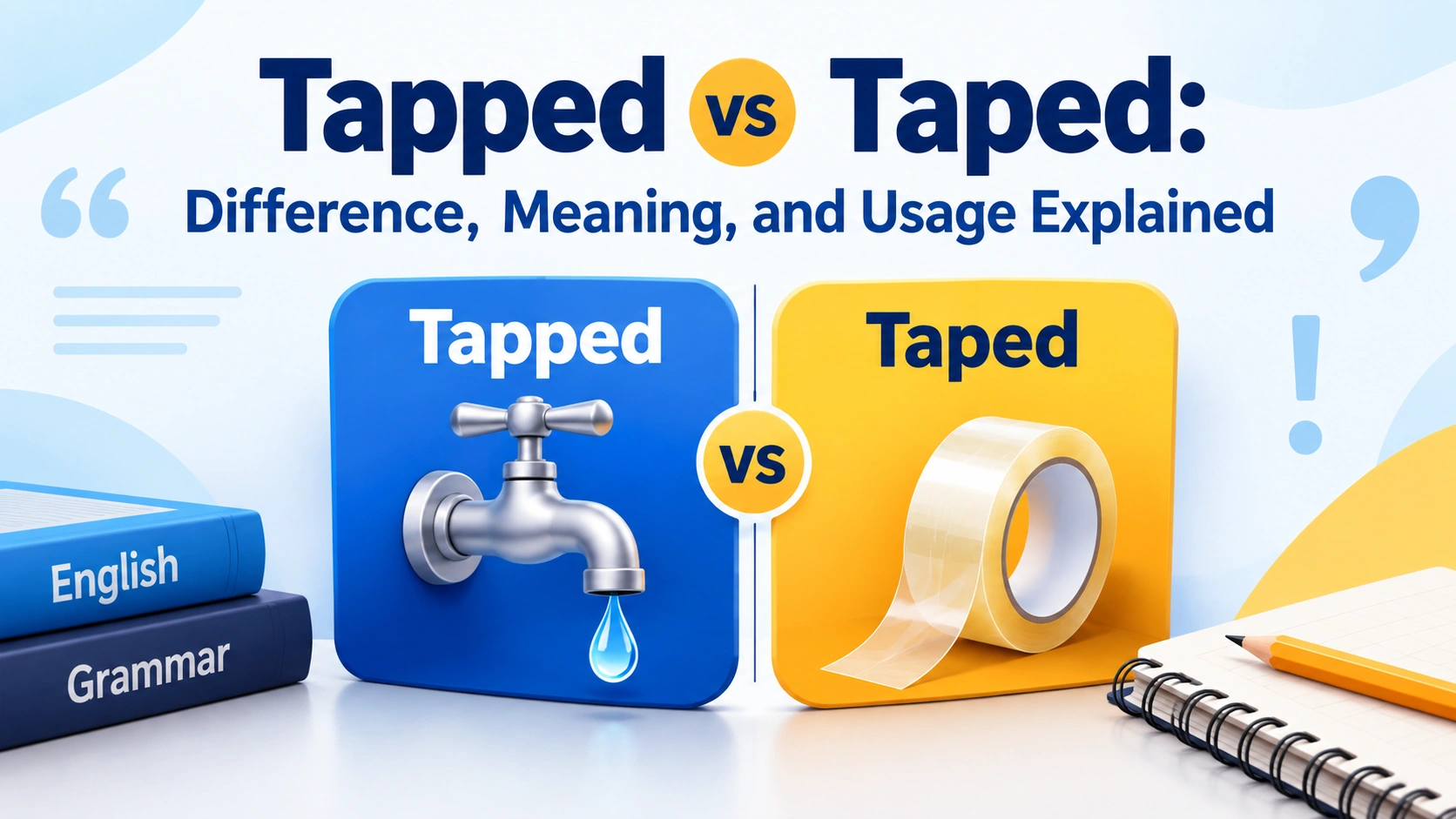
Tapped vs taped can be confusing because the two words look almost identical on the page, yet they come from different verbs and describe very different actions. Tapped is the past tense and past participle of tap, while taped comes from tape. One can describe a light touch, a touchscreen action, the use of an available resource, or the selection of someone for a role. The other usually involves using tape to attach something or recording something.
The confusion becomes easier to solve once you stop treating these as two spelling variations of the same word. The important question is: What is the base verb? If the action is tapped, the past form is tapped. If the action is tape, the past form is taped. That distinction also explains why tap doubles its final consonant while tape simply adds -d.
This guide breaks down tapped vs taped through meaning, grammar, spelling, pronunciation, common expressions, technology-related usage, and real-world examples. You will also see where learners commonly make mistakes, why phrases such as tap into cannot be replaced with tape into, and how a simple context test can help you choose the correct word almost instantly.
Tapped vs Taped: The Quick Answer
The easiest way to remember the difference is to look at the verbs they come from:
- Tapped = past tense/past participle of tap
- Taped = past tense/past participle of tape
Tap can mean to touch or hit something lightly, touch a screen, make use of an available resource, secretly monitor a telephone, or choose someone for a particular role.
Tape can mean to attach or fasten something with adhesive tape or to make a recording.
| Word | Base verb | Core idea | Example |
| Tapped | tap | touched, lightly struck, accessed, or selected | She tapped the screen. |
| Taped | tape | attached with tape or recorded | She taped the note to the door. |
A useful rule is:
If you can replace the action with “touch,” “lightly hit,” “access,” or “choose,” think tapped. If you can replace it with “attach with tape” or “record,” think taped.
That rule will solve most everyday cases.
What Does “Tapped” Mean?
Tapped is the past tense and past participle of tap. The verb has several meanings, so its exact interpretation depends on the context.
Tapped Means Touched or Hit Lightly
The most familiar meaning involves a quick, light touch or hit.
For example:
- He tapped me on the shoulder.
- She tapped the glass with her finger.
- The rain tapped against the window.
- He tapped his foot to the music.
The action is normally lighter and shorter than hit, punch, or strike. It can also be repeated.
Consider the difference:
- He hit the door. — This suggests a stronger action.
- He tapped the door. — This suggests a light knock or touch.
This distinction matters because writers sometimes choose tapped when they want to communicate a gentle, deliberate action rather than force.
Tapped Means Used a Touchscreen
In modern English, tapping is extremely common in technology-related instructions.
When you touch a phone or tablet screen to activate a command, you tap it.
Examples:
- I tapped the icon to open the app.
- She tapped the notification.
- He tapped the button twice.
- Tap the menu, then select Settings.
This is different from taping. You are interacting with the screen by touching it; you are not attaching anything to it with adhesive tape.
The distinction is especially important in user interfaces, tutorials, app instructions, and technical writing.
Tapped Means Made Use of an Available Resource
Tap also has a figurative meaning: to make use of something that already exists or is available.
You might tap:
- knowledge
- expertise
- experience
- talent
- resources
- information
- potential
- funding
- energy supplies
For example:
- The company tapped its employees’ expertise.
- The researchers tapped a valuable source of data.
- The project tapped into years of local experience.
Here, there is no physical touching involved. The word has developed a figurative sense of accessing or drawing from a supply.
Tapped Means Selected for a Job or Role
In another common usage, especially in North American English, someone can be tapped for a position or tapped to perform a particular task.
For example:
- She was tapped for the leadership role.
- He was tapped to manage the new project.
- The coach tapped him to lead the team.
In this construction, tapped means chosen or selected, not physically touched.
This is one reason context is more useful than spelling alone when deciding what tapped means.
Tapped Can Refer to a Monitored Telephone
There is also a specialized meaning of tap associated with telephone surveillance. If a telephone is tapped, equipment has been placed or used so that conversations can be secretly listened to.
For example:
- The phone was believed to be tapped.
This meaning is distinct from everyday touchscreen or physical-touch uses, but it is an established dictionary sense of the verb.
What Does “Taped” Mean?
Taped is the past tense and past participle of tape. It has two especially common meanings: attaching something with tape and recording something.
Taped Means Attached With Tape
When you use adhesive tape to fasten one object to another, you can say that you taped it.
Examples:
- She taped the photograph to the wall.
- He taped the note to the door.
- We taped the broken pieces together.
- They taped the package shut.
The physical presence or use of tape is the key clue.
Compare:
She tapped the poster.
This means she touched or lightly hit the poster.
She taped the poster to the wall.
This means she used tape to attach it to the wall.
Those sentences may look similar, but the actions are completely different.
Taped Means Recorded
Taped can also mean recorded, particularly in connection with audio or video.
Examples include:
- The interview was taped earlier.
- The program was taped in front of a live audience.
- They taped the conversation for later review.
This meaning comes from the historical use of recording tape. Modern recordings are often digital, but tape remains an established vocabulary for recording.
That is why expressions such as taped interview, taped program, and taped conversation can still appear even when no physical tape is involved.
Taped Can Also Describe Something Fastened or Secured
The word often appears with particles and prepositions:
- taped up — secured or fastened with tape
- taped together — joined using tape
- taped shut — closed with tape
- taped to — attached to another surface using tape
Examples:
- The box was taped up securely.
- The papers were taped together.
- The envelope was taped shut.
- A warning was taped to the door.
These combinations make the intended meaning particularly easy to identify.
Tapped vs Taped: Key Differences at a Glance
| Feature | Tapped | Taped |
| Base verb | tap | tape |
| Pronunciation | /tæpt/ | /teɪpt/ |
| Basic physical meaning | Touch or hit lightly | Attach using tape |
| Technology | Touch a screen | Record audio/video |
| Figurative use | Access a resource or choose someone | Usually connected to recording or attachment |
| Common phrase | tap into | tape up |
| Example | He tapped the screen. | He taped the label to the box. |
| Spelling pattern | tap + ped | tape + d |
The most reliable distinction is not the number of letters or the sound of the ending. It is the meaning of the base verb.
Why Is “Tap” Spelled “Tapped”?
One of the biggest spelling questions is why tap becomes tapped rather than taped.
The answer lies in English spelling conventions for certain short verbs.
The verb tap ends in a single consonant preceded by a short vowel. When the past-tense ending -ed is added, the final consonant is doubled:
tap → tapped
You can see the same general pattern in:
- stop → stopped
- plan → planned
- drop → dropped
- admit → admitted
The doubling helps preserve the pronunciation of the original short-vowel pattern.
Tapped vs Tapping
The same spelling principle appears with the -ing form:
- tap → tapping
- stop → stopping
- plan → planning
So if you know that the correct past form is tapped, you can also recognize tapping as its present participle.
Why Is “Tape” Spelled “Taped”?
The verb tape behaves differently because it ends in a silent e.
Its past form is:
tape → taped
The final e remains, and -d is added.
Compare:
- hope → hoped
- save → saved
- move → moved
- use → used
- tape → taped
The spelling therefore gives you a useful clue:
- tap → tapped
- tape → taped
This is not an arbitrary difference. The two forms come from different base verbs with different spelling patterns.
An Important Related Difference: Taping vs Tapping
Learners sometimes also confuse the present participles:
- tapping = touching or hitting lightly
- taping = attaching with tape or recording
For example:
- She was tapping on the window.
- She was taping the package.
Notice that taping has only one p. The silent e of tape is dropped before -ing:
tape → taping
By contrast:
tap → tapping
This makes the relationship between tapped/taped and tapping/taping much easier to understand.
Tapped vs Taped: Pronunciation Difference
The two words are not pronounced the same.
- tapped = /tæpt/
- taped = /teɪpt/
The vowel is the major difference:
- tapped contains the vowel sound found in cat.
- taped contains the long vowel sound found in day.
The final -ed is pronounced /t/ in both words.
So although the written forms look similar, the vowel sound clearly distinguishes them in careful speech.
A Simple Listening Test
If you hear someone say the word and are unsure which spelling to use, focus on the vowel:
- A short /æ/ sound points to tap → tapped.
- The /eɪ/ sound points to tape → taped.
Of course, context remains the safest guide. A writer should choose the spelling based on the intended verb, not merely on how the word sounds.
Tapped vs Taped in Everyday Sentences
The following examples show how quickly the meaning changes.
Examples of “Tapped”
- Maya tapped me on the shoulder.
- He tapped the glass with his finger.
- I tapped the screen to continue.
- She tapped the link in the message.
- The company tapped its existing expertise.
- The manager tapped Daniel for the assignment.
- They tapped into a valuable source of information.
Examples of “Taped”
- Maya taped the picture to the wall.
- He taped the torn page together.
- She taped the box shut.
- They taped the wires together.
- The interview was taped yesterday.
- The television program was taped before the broadcast.
The surrounding words often make the answer obvious. On the shoulder, the screen, and into a resource strongly suggest tapped. To the wall, together, shut, and the interview point toward taped.
Tapped vs Taped: The Phrases That Cause the Most Confusion
“Tapped on” vs “Taped on”
These expressions describe entirely different actions.
Tapped on generally means touched or struck lightly.
He tapped on the window.
Taped on means attached something using tape.
She taped a notice on the window.
The preposition alone does not determine the answer. Look at the verb’s meaning and the object being acted upon.
“Tapped into” vs “Taped into”
Tap into is a well-established phrasal verb meaning to access or make use of something.
Examples:
- The team tapped into its previous experience.
- The organization tapped into a new source of funding.
- She tapped into her creativity.
Taped into does not normally carry this meaning. If you mean accessed or made use of, use tapped into.
This is one of the most important distinctions for professional and academic writing because tap into is frequently used with abstract nouns such as knowledge, expertise, resources, and potential.
“Tapped for” vs “Taped for”
Tapped for means selected for a particular role or purpose:
She was tapped for the position.
Taped for usually means something was recorded or, depending on context, attached with tape for a particular purpose.
The phrase immediately following the verb can therefore reveal which meaning is intended.
Common Mistakes With Tapped and Taped
Mistake 1: Writing “Taped” for a Light Touch
Incorrect:
He taped me on the shoulder.
If the person merely touched your shoulder lightly, the correct word is:
He tapped me on the shoulder.
A useful question is: Was adhesive tape involved? If not, taped is probably not what you want.
Mistake 2: Writing “Tapped” When Something Was Attached
Incorrect:
She tapped the note to the door.
Correct:
She taped the note to the door.
The note is being attached, so taped is the appropriate verb.
Mistake 3: Confusing “Tapped Into” With “Taped Into”
Incorrect:
The company taped into its employees’ knowledge.
Correct:
The company tapped into its employees’ knowledge.
Here, tap into means make use of.
Mistake 4: Choosing the Word From Spelling Alone
Some writers see tapped and taped as nearly identical spellings and try to memorize them as a pair. That approach is less reliable than remembering their base verbs.
Instead, mentally restore the base form:
- tapped → tap
- taped → tape
Then ask what that verb means in the sentence.
How to Choose Between Tapped and Taped
When proofreading, use this short decision process.
| Ask yourself | If the answer is yes | Choose |
| Did someone touch or lightly hit something? | Physical contact | tapped |
| Did someone touch a phone or tablet screen? | Screen interaction | tapped |
| Did someone access an existing resource? | Figurative access | tapped |
| Was someone selected for a role? | Choice or appointment | tapped |
| Was adhesive tape used? | Attachment or fastening | taped |
| Was something recorded? | Audio/video recording | taped |
| Was something taped up, shut, or together? | Physical fastening | taped |
This method works better than trying to remember isolated example sentences because it identifies the underlying action.
A Practical Editing Trick: Remove the “-ed”
When you’re proofreading your own writing, temporarily remove -ed.
Suppose you wrote:
The manager taped her to lead the project.
Remove the ending:
The manager tapped her to lead the project.
That sounds wrong because the intended verb is tap, not tape:
The manager tapped her to lead the project.
Now consider:
They tapped the package shut.
Remove -ed:
They tap the package shut.
That describes touching rather than fastening. If the intended meaning is to secure the package with adhesive tape, the correct form is:
They taped the package shut.
This simple base-verb test is particularly useful when editing quickly.
Tapped and Taped in Professional Writing
The distinction matters more in formal writing than it might seem.
A spelling error can change the meaning of a sentence completely:
The researcher tapped into historical records.
This says the researcher made use of the records.
Compare:
The researcher taped historical records.
That suggests the researcher physically attached or recorded something using tape, which is a completely different action.
In business writing, journalism, technical documentation, and academic prose, verbs such as tap into, tap expertise, and tap resources often express abstract access to knowledge or capabilities. Using taped instead can make the sentence appear careless or nonsensical.
Expert Tip
When writing about knowledge, experience, talent, resources, or potential, check whether the intended expression is tapping into. When writing about physical adhesive tape or recording, tape is usually the relevant verb.
A Mini Case Study: Why Context Solves the Problem
Imagine reading this sentence:
The producer ___ the interview before the event.
Both spellings might initially catch your eye, but the noun interview provides a strong clue.
An interview can be taped, meaning recorded.
Now change the sentence:
The producer ___ the microphone before the event.
The answer is no longer obvious from the object alone. A producer could physically tap a microphone, but could also tape something to it depending on the situation.
That illustrates an important point: grammar and vocabulary questions are often solved by context rather than spelling rules alone.
If the sentence describes an action, ask what actually happened. Did the person touch something? Attach something? Record something? Select someone? Access a resource?
The intended action determines the verb.
Tapped vs Taped: Common Misconceptions
Myth: Tapped and Taped Are Just Different Spellings of the Same Word
They are not. They are past forms of two different verbs.
- tap → tapped
- tape → taped
Their meanings overlap very little in ordinary use.
Myth: Taped Always Means Something Was Recorded
Not necessarily.
Taped can mean attached with tape:
The label was taped to the box.
It can also mean recorded:
The interview was taped.
The surrounding context determines which meaning applies.
Myth: Tapped Only Means “Touched”
Not in modern English.
Tapping can involve physical contact, but tap also has established meanings related to technology, accessing resources, selecting people, telephone monitoring, and other specialized contexts.
Myth: If a Word Sounds Similar, Its Spelling Can Be Guessed From Pronunciation
Pronunciation helps, but English spelling is not always predictable enough to rely on sound alone. With tapped and taped, identifying the base verb and intended meaning is much safer.
Quick Practice: Tapped or Taped?
Choose the correct word in each sentence.
- She ___ the icon to open the file.
- He ___ the photograph to the wall.
- The manager ___ Priya for the leadership role.
- We ___ the package shut.
- The researcher ___ into the team’s previous experience.
- Someone ___ on the window.
- The interview was ___ earlier that day.
- He ___ the table with his finger.
Answers
- tapped — touchscreen action
- taped — attachment
- tapped — selected for a role
- taped — secured with tape
- tapped — accessed a resource
- tapped — touched or knocked lightly
- taped — recorded
- tapped — touched or struck lightly
The pattern is consistent: identify the action first, then choose the spelling.
Conclusion:
The easiest way to master tapped vs taped is to stop memorizing the two words as a confusing spelling pair. Start with the base verbs: tap describes actions such as a light touch, a touchscreen interaction, accessing a resource, or selecting someone; tape describes attaching something with tape or recording it. Once you identify the action, the spelling usually follows naturally.One final actionable tip: when you’re unsure, remove -ed and ask whether the sentence needs tap or tape. That quick test is more dependable than guessing from pronunciation.A common mistake to avoid is using taped when you mean tapped into. In professional writing especially, the difference can completely change your meaning.
FAQs
Q1. What is the main difference between tapped and taped?
Tapped is the past form of tap and can mean touched lightly, used a touchscreen, accessed a resource, or selected someone. Taped is the past form of tape and generally means attached something with tape or recorded something. The correct choice depends on the intended base verb and context.
Q2. Is it “tapped on the shoulder” or “taped on the shoulder”?
For a light touch, the correct expression is “tapped on the shoulder.” For example, She tapped me on the shoulder to get my attention. Taped would suggest using adhesive tape, so it would not normally make sense in this expression.
Q3. Is it “tapped into” or “taped into”?
The standard expression is “tapped into” when you mean accessed, used, or drew upon something. You can tap into knowledge, expertise, experience, creativity, resources, or potential. Taped into does not normally express this figurative meaning.
Q4. Why is tap spelled tapped but tape spelled taped?
The verbs follow different spelling patterns. Tap becomes tapped by doubling its final consonant before -ed. Tape ends in silent e, so its past form is formed by adding -d: tape → taped. The different spellings reflect their different base forms.
Q5. Are tapped and taped pronounced the same?
No. Tapped and taped have different vowel sounds. Tapped is pronounced /tæpt/, while taped is /teɪpt/. The final consonant sound is similar, but the vowel distinguishes them. When spelling from sound, however, it is still safer to consider the meaning and base verb.