

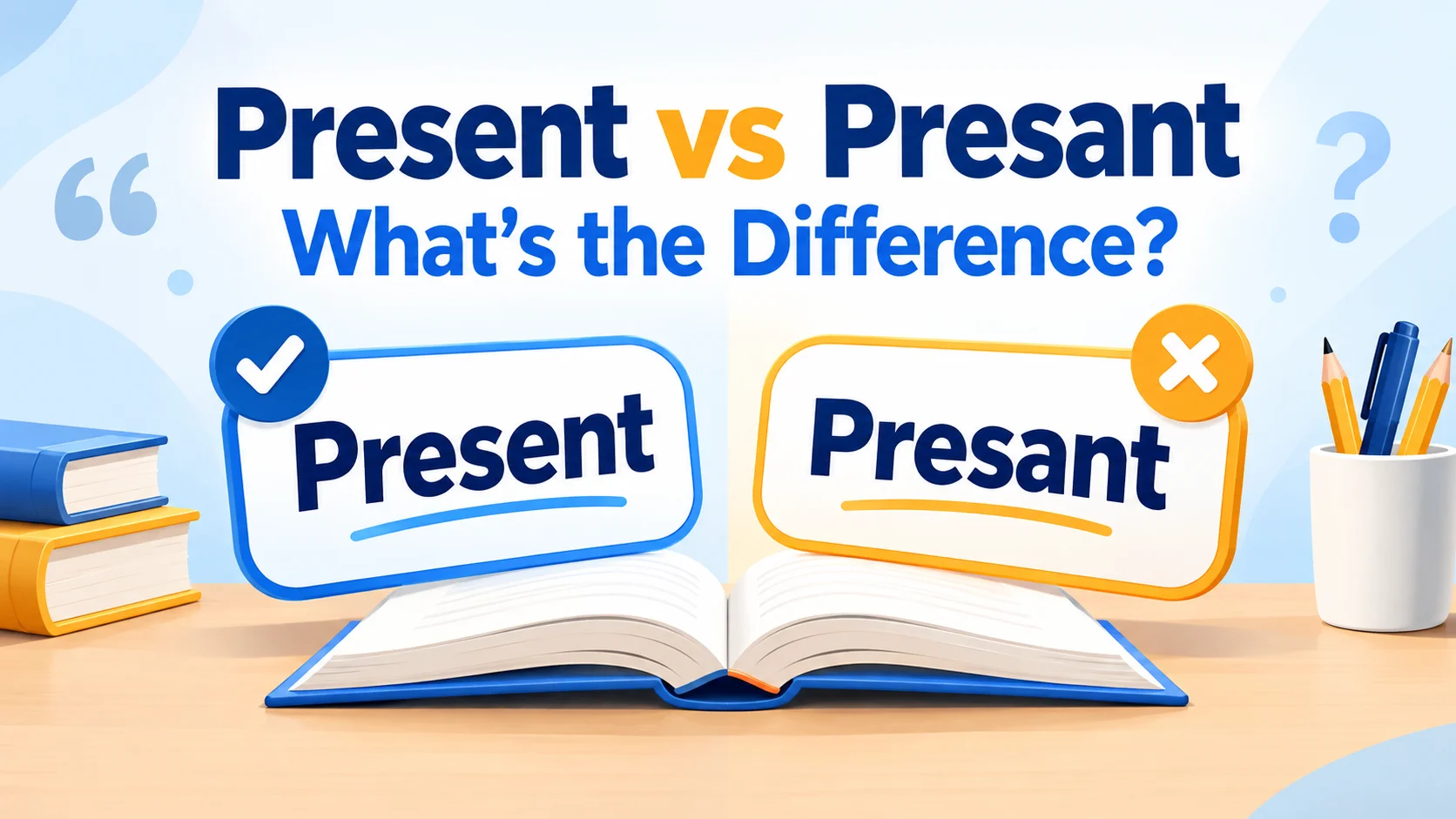
Present vs Presant is a spelling comparison with a straightforward answer: present is the correct standard English spelling, while presant is a misspelling in ordinary English usage. If you have ever typed a sentence about a birthday gift, a current situation, or attending a meeting and wondered which spelling to use, the distinction is worth learning. Although the two forms may look similar, only one is appropriate for standard written English. Understanding the correct spelling will help you write more confidently in emails, school assignments, workplace documents, and everyday messages without second-guessing yourself.
The confusion usually begins with pronunciation. When people say present naturally, its unstressed vowel can sound less distinct than the spelling suggests. Someone hearing the word may therefore assume that presant is an acceptable alternative. English spelling, however, does not always follow the way a word sounds. The correct form remains present, whether you are describing something happening now, confirming that someone is in attendance, talking about a gift, or explaining information to an audience. Recognizing these different meanings makes the spelling easier to remember and the word easier to use accurately.
In this guide, you will learn why present is correct, what the word means as a noun, adjective, and verb, and how its pronunciation changes with its grammatical role. You will also see practical sentence examples, a comparison table, common spelling mistakes, and distinctions between related words such as presence, presents, and presentation. By the end, you will have a reliable way to identify the correct spelling in different contexts. More importantly, you will understand the reasoning behind the rule rather than simply memorizing that one spelling is right and the other is wrong.
Present vs. Presant: Which Spelling Is Correct?
Present is the correct spelling in standard English. Presant is a spelling error and should not be used as an alternative in ordinary writing.
The correct spelling stays the same regardless of whether present refers to a gift, the current time, someone’s attendance, or the act of showing or delivering something.
Consider these examples:
- Correct: I bought a birthday present for my sister.
- Incorrect: I bought a birthday presant for my sister.
- Correct: All the students were present during the examination.
- Incorrect: All the students were presant during the examination.
- Correct: We will present our findings tomorrow.
- Incorrect: We will presant our findings tomorrow.
The same rule applies in text messages, essays, business correspondence, and formal reports. Informal writing may contain spelling errors without preventing readers from understanding the intended meaning, but that does not make the incorrect form standard.
Is Presant a Real Word?
In ordinary modern English, presant is not a standard alternative spelling of present. If you encounter it in a message, document, or online discussion, it is generally a typo or a spelling mistake.
There is no need to choose between the two forms according to tone, audience, or grammatical function. Unlike words that have legitimate British and American spelling variants, present and presant do not represent two accepted regional spellings.
Remember: If you mean a gift, something happening now, attendance, or the act of presenting something, write a present.
What Does Present Mean?
The word present has several meanings, and its grammatical role helps determine which one applies. It can function as a noun, adjective, or verb. Understanding these uses is more helpful than memorizing a single definition because the word appears in many everyday situations.
Present as a Noun: A Gift or the Current Moment
As a noun, present has two common meanings.
1. A gift
A present is something given to another person, usually to mark an occasion or express appreciation.
Examples:
- My parents gave me a birthday present.
- She wrapped the present in silver paper.
- The children opened their presents after dinner.
In this sense, a present is interchangeable with a gift in many everyday situations.
2. The current moment
The noun present can also refer to the time we are living in now, as opposed to the past or the future.
Examples:
- We should focus on the present rather than worry about distant possibilities.
- The past cannot be changed, but the present offers new choices.
- Historians study the past to help us understand the present.
Notice that the meaning changes with context, but the spelling does not.
Present as an Adjective: Current, Existing, or in Attendance
An adjective describes a person, thing, or situation. Present has two especially useful adjective meanings.
1. Existing or happening now
When present describes a current situation, it refers to something that exists or applies at this time.
Examples:
- The present economic situation requires careful planning.
- Our present arrangements will remain in place until June.
- The present version of the software has several improvements.
Here, present is close in meaning to current or existing.
2. Being in a particular place
The word can also describe someone who is physically there or otherwise in attendance.
Examples:
- Every team member was present at the meeting.
- The teacher asked whether all the students were present.
- Only three witnesses were present when the agreement was signed.
This meaning is particularly common in classrooms, meetings, examinations, and official records.
Present as a Verb: To Give, Show, or Introduce
As a verb, present describes an action. Its meaning depends on what is being presented and to whom.
1. To give or award something
- The principal will present the certificates after the ceremony.
- The organization plans to present an award to the winning team.
- They will present the donation to the community center.
2. To show or explain information
- The researchers will present their findings at the conference.
- Maya needs to present her project to the class.
- The manager will present the quarterly results tomorrow.
3. To introduce someone formally
- The host will present the guest speaker before the lecture.
- Allow me to present our new team leader.
In each example, present is an action word. The spelling remains unchanged even though the pronunciation differs from the noun and adjective forms.
Present in Grammar: What Does Present Tense Mean?
In grammar, present appears in terms such as present simple, present continuous, and present perfect. These labels describe verb forms used for different purposes, including habits, ongoing activities, and situations connected to the current time.
Examples:
- Present simple: She works from home.
- Present continuous: She is working from home today.
- Present perfect: She has worked here for five years.
The word present in these grammatical terms does not mean presant. It is the same correctly spelled word used in other contexts.
One important distinction: the present tense does not always describe an action occurring at this exact second. For example, “The train leaves at six” uses the present simple to describe a scheduled future event.
Present vs. Presant: Examples in Everyday English
The quickest way to build confidence is to see the correct spelling in different sentence structures.
| Context | Correct example | Why present is correct |
| Gift | I bought a present for my cousin. | It names something given to another person. |
| Current time | We should focus on the present. | It refers to the current moment. |
| Current situation | The present arrangement works well. | It means the existing arrangement. |
| Attendance | Everyone was present at the workshop. | It means everyone was there. |
| Presentation | He will present the results tomorrow. | It describes the act of showing information. |
| Award | The coach will present the trophy. | It describes giving or awarding something. |
| Grammar | This sentence uses the present tense. | It refers to a grammatical tense. |
Correct and Incorrect Sentences
Compare these pairs to see how a single spelling error affects an otherwise understandable sentence.
Example 1: A birthday gift
- Correct: I chose a thoughtful present for my friend.
- Incorrect: I chose a thoughtful presant for my friend.
✅Example 2: Attendance at school
- Correct: Liam was present for the science lesson.
- Incorrect: Liam was presant for the science lesson.
✅Example 3: A workplace meeting
- Correct: Please be present at the meeting by 9 a.m.
- Incorrect: Please be presant at the meeting by 9 a.m.
Example 4: Sharing information
- Correct: The analyst will present the data on Friday.
- Incorrect: The analyst will presant the data on Friday.
Example 5: Describing a current situation
- Correct: We need to address the present problem before planning the future.
- Incorrect: We need to address the presant problem before planning the future.
These examples illustrate an important principle: the meaning of the sentence can help you recognize the intended word, but meaning alone does not make an incorrect spelling acceptable.
Why Do People Spell Present as Presant?
People usually write presant because they are relying on how the word sounds rather than how it is conventionally spelled. Several factors can contribute to this mistake.
1. The Unstressed Vowel Can Be Difficult to Hear
In the noun and adjective forms, present is commonly pronounced with the first syllable stressed: PREZ-uhnt. The vowel in the second syllable is reduced in ordinary speech.
A reduced vowel can sound similar to the unstressed vowel in other words, making it difficult for listeners to determine whether the spelling contains e or a.
For example, the endings in different, important, and assistant do not all follow one simple spelling rule that learners can apply by sound alone.
Practical tip: When pronunciation does not clearly reveal the spelling, rely on the written form you have learned rather than attempting to spell the word entirely by ear.
2. English Spelling Is Not Always Phonetic
English uses many spelling patterns inherited from different historical periods and languages. Consequently, the same sound can be represented by different letters in different words.
This is why hearing a word correctly does not guarantee that you can spell it correctly without prior knowledge.
For present, the solution is straightforward: learn the standard spelling as a complete word. You do not need to discover a universal rule that explains every word ending in -ent or -ant.
3. The Endings -Ent and -Ant Can Cause Confusion
The letter combinations -ent and -ant appear in many English words. Their similarity can encourage spelling mistakes, particularly when the final vowel is unstressed.
Compare these correctly spelled words:
- Present
- Different
- Excellent
- Important
- Assistant
- Pleasant
The examples do not all follow the same ending pattern, which is precisely why visual familiarity and word-specific learning are useful.
Do not assume that changing -ent to -ant is acceptable simply because the resulting word looks plausible.
4. Fast Typing Can Introduce Errors
Someone who knows the correct spelling may still type presant accidentally. This can happen when writing quickly, using a small mobile keyboard, or failing to proofread.
Autocorrect is helpful, but it is not infallible. Spellcheck tools may also overlook an error if a word is recognized as a name, appears in a specialized dictionary, or is not flagged by the software.
Best practice: Proofread important writing after finishing the sentence or document. Do not assume that an unmarked word is necessarily correct.
5. Language Learning Can Reinforce the Mistake
Learners sometimes memorize words through listening before they become familiar with their written forms. If they repeatedly associate a sound with an incorrect spelling, that spelling can become a habit.
The most effective correction is to connect spelling, meaning, and an example sentence.
For instance, remember the sentence “I bought a present.” Seeing the word in a familiar context makes it easier to recognize later than studying the isolated spelling alone.
How to Pronounce Present Correctly
The pronunciation of present depends on its grammatical function. The noun and adjective usually have one stress pattern, while the verb typically has another.
| Form | Pronunciation guide | Example |
| Noun | PREZ-uhnt | I bought a present. |
| Adjective meaning current | PREZ-uhnt | The present situation is unusual. |
| Adjective meaning in attendance | PREZ-uhnt | All members are present. |
| Verb | pri-ZENT | I will present my findings. |
These simplified pronunciation guides are intended to show stress, not to replace a full phonetic transcription.
Why Does Stress Change?
English has words whose stress changes when they function as different parts of speech. Present is a familiar example.
As a noun or adjective, the stress usually falls on the first syllable: PREZ-uhnt.
As a verb, the stress usually falls on the second syllable: pri-ZENT.
Listen to the difference in these sentences:
- “The PREZ-hunt was beautifully wrapped.”
- “I will pri-ZENT the report.”
The shift in stress helps listeners identify the intended grammatical role. It does not change the spelling.
Is Presant Pronounced Differently?
Not in any standard, established way that makes it a separate English word. Because presant is generally a misspelling, it has no distinct standard pronunciation that learners need to memorize.
Someone who writes presant may simply be attempting to represent the sound of present. The appropriate correction is to use the standard spelling and learn its normal pronunciation in context.
Present vs. Presant: A Quick Comparison
The following table brings the central differences together.
| Feature | Present | Presant |
| Standard English spelling | Yes | No |
| Accepted spelling variant | Yes, the standard form | No |
| Can mean a gift | Yes | No |
| Can mean current or existing | Yes | No |
| Can mean being in attendance | Yes | No |
| Can function as a verb | Yes | No |
| Appropriate in formal writing | Yes | No |
| Recommended for learners | Learn and use it | Recognize as a likely error |
The comparison is simple because this is not a case of two legitimate words with different meanings. It is a distinction between the standard spelling and a common spelling error.
Should You Use Present in Formal and Informal Writing?
Yes. Use present in both formal and informal contexts.
In a text message, a reader may understand what you mean if you type presant. However, using the correct spelling is still preferable. In professional emails, school assignments, applications, reports, and published content, spelling errors can distract from the message or make the writing appear insufficiently checked.
The audience may affect the level of formality in your writing, but it does not change the standard spelling.
Common Mistakes to Avoid When Using Present
Although the present/presant distinction is easy to resolve, several related mistakes deserve attention.
Mistake 1: Writing Presant When Referring to a Gift
Incorrect: “Thank you for the lovely present.”
Correct: “Thank you for the lovely present.”
A useful memory aid is to connect the word with a familiar phrase such as “birthday present.” Repeated exposure to the correct spelling in common expressions helps reinforce it.
Mistake 2: Confusing Present With Presence
Present and presence are related in meaning, but they do not serve the same grammatical function.
- Present: All the students were present.
- Presence: The teacher recorded the students’ presence.
In the first sentence, present describes the students’ attendance. In the second, presence is a noun referring to the state or fact of being there.
Choosing between these words requires attention to sentence structure, not simply spelling.
Mistake 3: Confusing Present With Presents
Presents can be the plural of the noun present or the third-person singular form of the verb present.
Examples:
- She received three presents. — Plural noun.
- He presents the news every evening. — Verb.
The final s changes the grammatical form, but the base word remains present.
Mistake 4: Confusing Present With Presentation
A presentation is an act of presenting information or the organized display of that information to an audience.
Examples:
- I will present the proposal tomorrow.
- My presentation includes five slides.
The words belong to the same word family, but they cannot always replace one another. Use the verb present for the action and presentation for the event, process, or organized material.
Mistake 5: Assuming the Present Tense Always Means Right Now
The grammatical term present tense does not necessarily describe something happening at the exact moment of speaking.
For example, “She walks to school every day” uses the present simple to describe a habit. “The flight departs at noon” uses it for a scheduled future event.
This distinction matters when learning grammar, but it does not affect the spelling of present.
Present, Presence, Presents, and Presentation: What’s the Difference?
These related forms share a common word family, but each has its own grammatical role.
| Word | Part of speech | Main meaning | Example |
| Present | Noun, adjective, or verb | Gift, current, in attendance, or show/give | I will present the award. |
| Presence | Noun | The state or fact of being somewhere | Her presence reassured the team. |
| Presents | Plural noun or verb | More than one gift, or gives/shows | He presents the prizes. |
| Presentation | Noun | The act of presenting or a prepared display | Her presentation was clear. |
| Presently | Adverb | Soon in some usage; currently in other usage | The manager will be with you presently. |
Present vs. Presence
Use present when describing someone’s attendance or the current state of something. Use presence when referring to the fact, state, or quality of being present.
Compare:
- The doctor was present during the consultation.
- The doctor’s presence helped the patient feel reassured.
The first sentence describes attendance; the second names that attendance or state of being there.
Present vs. Presents
The singular noun present refers to one gift, while presents generally refers to more than one gift.
However, the word presents can also be a verb.
- One present was waiting on the table.
- Several presents were waiting on the table.
- The host presents the award each year.
The surrounding sentence reveals which grammatical function applies.
Present vs. Presentation
Use present when describing the action of showing, explaining, or formally giving something. Use presentation when referring to the process, event, or organized material.
- The student will present the research.
- The student’s presentation explains the research.
A presentation may include slides, spoken explanations, demonstrations, or other material. The verb present describes what the student does.
Present vs. Presently
Presently has more than one established usage. In some contexts, particularly in American English, it means currently. In other contexts, it means soon or in a short while. The intended meaning can depend on region and context.
Examples:
- The director is presently unavailable. — Currently unavailable.
- The speaker will arrive presently. — Expected to arrive soon.
Because this adverb can be ambiguous, a clearer alternative such as currently or soon may be preferable in professional writing.
How to Remember the Correct Spelling of Present
You do not need to memorize a long list of spelling rules to avoid this mistake. A few practical habits are enough.
1. Connect Present With Presentation
Both words contain the spelling present at the beginning.
Remembering a familiar sentence such as “I will present my presentation tomorrow” can reinforce the correct letter sequence. The sentence is slightly repetitive, but it makes the shared spelling visible.
2. Use a Familiar Gift Example
Think of the sentence “I bought a present for my friend.”
Because gifts are a common meaning of present, this simple example can serve as a mental reference whenever you hesitate between present and presant.
3. Learn the Word Visually
Read the correct spelling, write it in a sentence, and review it later. This creates a stronger association than repeatedly guessing which vowel belongs in the unstressed syllable.
A useful practice routine is:
- Read the word present.
- Say it aloud.
- Write a sentence using it.
- Check the spelling.
- Repeat with a different meaning of the word.
This approach reinforces spelling and vocabulary together.
4. Use a Dictionary When You Are Unsure
For unfamiliar words, consult a reputable dictionary rather than relying on pronunciation alone. Dictionaries provide standard spellings, definitions, grammatical information, and pronunciation guides.
Spellcheckers are also useful, but a dictionary is particularly helpful when you want to understand why a word is correct or distinguish between similar forms.
Expert tip: Do not spend time inventing a complicated rule for a single common spelling. Learn the word, recognize it in context, and use reliable reference tools when necessary.
A Five-Question Practice Quiz: Present or Presant?
Choose the correct spelling for each sentence before checking the answers.
- I bought a birthday ______ for my brother.
- All participants must be ______ before the session begins.
- The manager will ______ the new plan on Monday.
- We should focus on ______ rather than worry about the distant future.
- She prepared a short ______ for the school assembly.
Answers and Explanations
- Present — It is a noun meaning a gift.
- Present — It is an adjective describing attendance.
- Present — It is a verb meaning to show or explain something.
- Present — It is a noun referring to the current moment.
- Presentation — This noun refers to the prepared talk or display, rather than the act of presenting alone.
Every answer reinforces the same core spelling rule: present is correct, while presant is not a standard alternative.
Conclusion:
The distinction between present vs. presant is simple once you separate pronunciation from spelling. Present is the standard English form, whether you are talking about a gift, the current moment, someone’s attendance, or the act of presenting information. Presant is a misspelling, not an alternative to use in formal or informal writing. Learning the word’s different grammatical roles also helps you distinguish it from related terms such as presence, presents, and presentation.One final actionable tip: Save a familiar example, such as “I bought a present,” and use it as a quick spelling reference whenever you hesitate. A common mistake to avoid is choosing a spelling solely because it seems to match the way a word sounds. English spelling often requires familiarity with the written form. Remember the correct pattern, check unfamiliar words when necessary, and let accuracy become a natural part of your writing.
FAQs
Q1. Is Presant Ever Correct in English?
In ordinary modern English, presant is not an accepted alternative spelling of present. You may encounter it as a typo, a learner’s spelling error, or a nonstandard form in a particular context. For standard writing, including schoolwork and professional communication, use present.
Q2. Why Does Present Sound Like Presant?
The unstressed vowel in the noun and adjective forms of present is often reduced in natural speech. This makes it less distinct to some listeners. English spelling cannot always be predicted from sound alone, so learning the written form and recognizing it in context are reliable ways to avoid the mistake.
Q3. Is Present a Noun, Verb, or Adjective?
Present can function as all three. as a noun, it can mean a gift or the current moment. As an adjective, it can mean current or in attendance. As a verb, it can mean to give, show, introduce, or explain something. Sentence structure determines its role.
Q4. Is There a Difference Between Present and Present Tense?
Present is an ordinary English word with several meanings, while present tense is a grammatical term for verb forms associated with particular uses, including habits and current situations. Present-tense forms can also describe schedules and other future events, depending on the construction and context.
Q5. How Can I Check Whether I Have Spelled Present Correctly?
Look for the standard letter sequence p-r-e-s-e-n-t. If you are uncertain, check a reputable dictionary or use a spellchecker, then review the sentence to confirm that you have chosen the right word. Proofreading is particularly valuable in formal documents, where small errors can distract readers.