

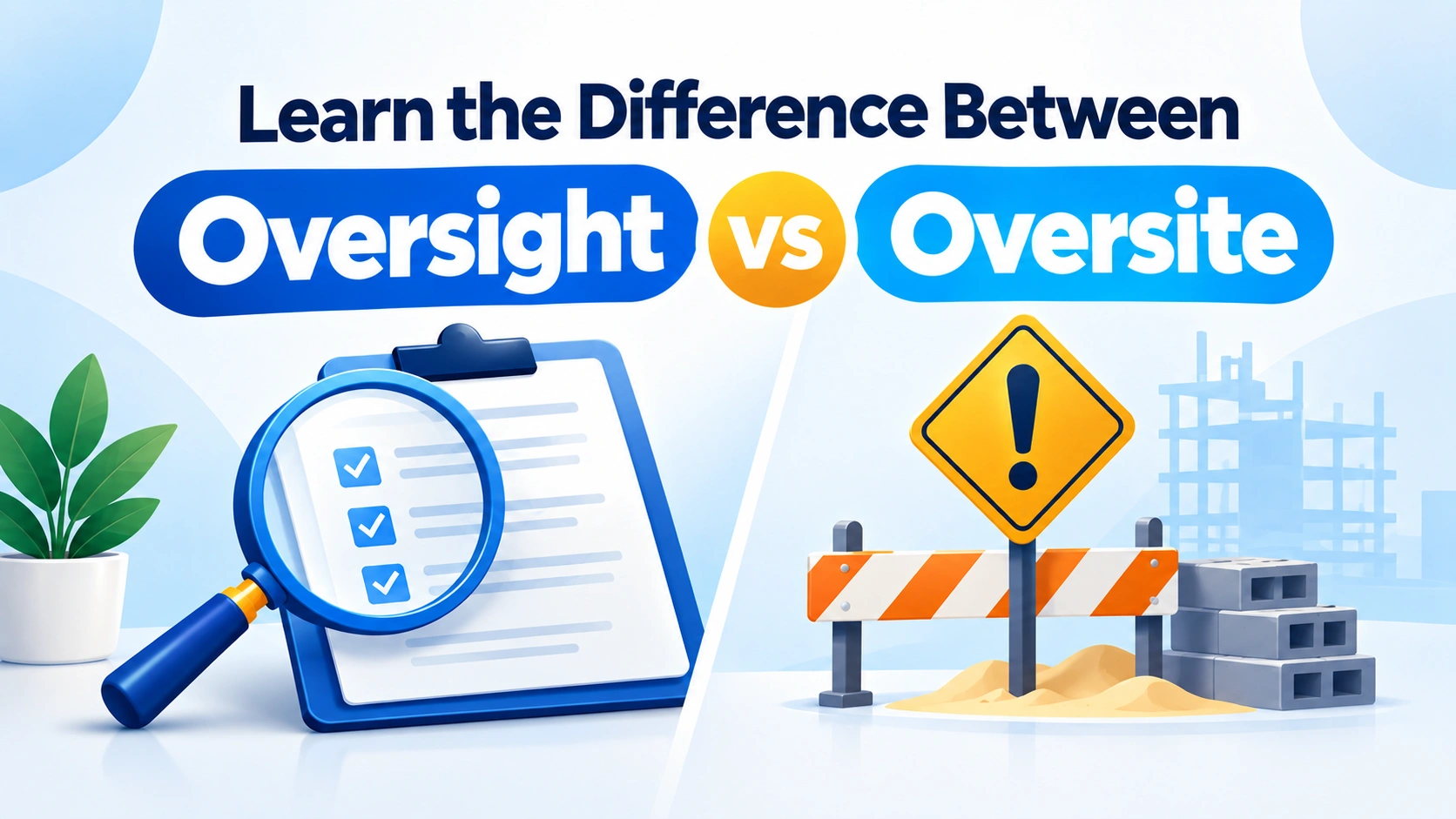
Oversight vs oversite can be confusing because the two words look almost identical and are pronounced similarly, yet they do not normally belong to the same vocabulary. Oversight is the standard English word used for supervision, monitoring, or a mistake caused by failing to notice something. Oversite, by contrast, is a specialized construction term referring to a layer or slab associated with the ground beneath a building floor.
The tricky part is that oversight itself has two seemingly opposite meanings. A company can operate under strict oversight, meaning someone is responsible for monitoring it. But an oversight can also be a mistake caused by something being missed. Cambridge Dictionary recognizes both senses: oversight can mean responsibility for making sure an activity is done correctly, or a mistake resulting from failing to notice something.
That distinction matters far beyond spelling. You may encounter government oversight, regulatory oversight, financial oversight, clinical oversight, and project oversight in professional writing. In another sentence, you might read about “an unfortunate oversight.” Meanwhile, construction documents may use oversite concrete or an oversite slab for a physical building component. This guide explains how to recognize each meaning, choose the correct spelling, avoid common mistakes, and understand why context is more useful than memorizing a single rule.
Oversight vs Oversite: The Quick Answer
If you are writing an ordinary sentence about supervision, monitoring, responsibility, or a mistake, the word you almost certainly need is oversight.
If you are reading or writing specialized construction terminology involving a layer of concrete or similar work over prepared ground beneath a floor, oversite may be the intended term. Construction references use oversite and oversite concrete for this specialized purpose.
| Word | Main meaning | Typical context | Example |
| Oversight | Supervision or responsibility for monitoring something | Business, government, law, healthcare, projects | “The agency provides regulatory oversight.” |
| Oversight | A mistake caused by failing to notice something | Everyday, professional, academic writing | “Leaving out the date was an oversight.” |
| Oversite | Specialized construction terminology relating to a layer or slab over prepared ground | Building and construction | “The workers prepared the oversite before the floor was installed.” |
The easiest rule to remember
Oversight = supervision or something missed.
Oversite = specialized construction terminology.
Do not substitute oversite for oversight simply because the sentence is about something being “over a site.” In general English, that spelling is not the normal choice.
What Does “Oversight” Mean?
Oversight is a noun with two established meanings. Which meaning applies depends entirely on context.
1. Oversight means supervision or monitoring
In its first major sense, oversight means responsibility for watching, managing, or monitoring an activity to make sure it is carried out properly.
Cambridge defines this sense as responsibility for a job or activity and for making sure it is done correctly. Its Business English definition extends the idea to systems or actions intended to control an activity and ensure that it is carried out correctly and legally.
Examples:
- The board provides oversight of the company’s finances.
- The project requires independent oversight.
- The committee has responsibility for regulatory oversight.
- The hospital introduced additional clinical oversight.
- The department operates under government oversight.
Here, oversight is not a mistake. It is a form of supervision, accountability, or monitoring.
Cambridge also lists oversight as a synonym of supervision in the relevant sense.
2. Oversight means an accidental mistake or omission
The second meaning is almost the opposite.
An oversight can be a mistake that happens because someone failed to notice something, forgot something, or unintentionally left something undone. Cambridge identifies this as a separate noun sense.
For example:
- Forgetting to attach the file was an oversight.
- The missing signature was an unfortunate oversight.
- We apologize for the oversight in the report.
- The error occurred because of an oversight during planning.
This meaning is especially useful when the speaker wants to describe a mistake without necessarily suggesting deliberate wrongdoing.
How do you know which meaning is intended?
Look at the words surrounding oversight.
If you see phrases such as:
- government oversight
- regulatory oversight
- financial oversight
- independent oversight
- oversight of a project
The meaning is generally supervision or responsibility.
If you see:
- an oversight
- a minor oversight
- an unfortunate oversight
- because of an oversight
- a costly oversight
The meaning is generally a missed detail or mistake.
That contextual distinction is much more reliable than trying to interpret the word literally.
Why Does “Oversight” Have Two Very Different Meanings?
This is one of the most interesting features of the word.
The supervision sense is closely related to the verb oversee, which means to watch or organize an activity to make sure it is done correctly. Cambridge gives examples involving managers, projects, negotiations, research, government, and financial responsibilities.
The relationship is straightforward:
- oversee → the action of supervising
- oversight → the responsibility or system of supervision
- overseer → a person responsible for supervising
For example:
The director oversees the project.
The noun version can become:
The director provides oversight of the project.
The other sense of oversight developed around the idea of failing to see or notice something that should have been noticed. Modern English therefore uses the same spelling for two distinct concepts.
This is why a sentence such as:
“The committee’s oversight prevented errors.”
could theoretically require context to understand whether oversight means supervision or something else. Usually, the surrounding wording makes the intended meaning clear.
Oversight is not the same as “overseeing”
This distinction is important for grammar.
Oversee is a verb:
The manager will oversee the renovation.
Oversight is a noun:
The manager will provide oversight of the renovation.
A common error is to write oversight when the sentence requires a verb.
Is “Oversite” a Real Word?
Yes, oversite is used as a real specialized construction term, but that does not make it a general alternative spelling of oversight.
Construction sources use oversite for a layer associated with prepared ground beneath a building’s ground floor. Wiktionary records an English construction sense for a layer of concrete underneath a ground floor, while construction references use related expressions such as oversite concrete and oversite slab.
That means the safest way to understand the distinction is:
- Oversight is an established general-English noun with two major meanings.
- Oversite is a specialized construction term.
- Oversite is not a general synonym for oversight.
What is oversite concrete?
Oversite concrete refers to concrete laid as part of the ground-floor construction over prepared ground within a building footprint. Construction references describe it as a layer associated with the ground-floor build-up, although its precise position and function can vary according to the construction system and specification.
The term is therefore tied to a physical site and building process, not to supervision.
For example:
The contractor completed the oversite concrete before continuing with the ground-floor construction.
That sentence has nothing to do with management or an accidental mistake.
Oversight vs Oversite: The Core Difference
The spelling difference is only one letter, but the semantic difference is substantial.
| Feature | Oversight | Oversite |
| Part of speech | Noun | Noun; also used adjectivally in technical compounds |
| General English? | Yes | No, mainly specialized |
| Supervision meaning? | Yes | No |
| Mistake meaning? | Yes | No |
| Construction use? | Yes, for supervision of construction | Yes, as a construction term |
| Example | “The project requires oversight.” | “The crew installed the oversite.” |
| Common everyday word? | Yes | No |
| Related to oversee? | Yes | No |
| Related to a physical site? | Not in its normal meaning | Yes |
The key distinction
Think of the final part of each spelling:
over + sight → oversight
over + site → oversite
The words may look related, but their meanings are different.
Oversight vs Oversite in Construction
Construction is where the distinction becomes especially important because both words can legitimately appear in the same document.
Construction oversight
In construction management, oversight retains its ordinary meaning of supervision or monitoring.
For example:
The project manager is responsible for construction oversight.
Here, the project manager is supervising the work.
Other examples include:
- quality oversight
- safety oversight
- financial oversight
- contractor oversight
- project oversight
- regulatory oversight
In all of these, oversight means supervision or control, not a physical layer of concrete.
Construction oversite
Oversite, on the other hand, refers to a physical construction element.
A construction glossary may use oversite or oversite slab for concrete laid over prepared ground as part of a ground-floor construction.
So compare:
The engineer provided oversight of the construction project.
versus:
The builders prepared the oversite before continuing with the floor.
The first sentence concerns people and responsibility.
The second concerns building work and materials.
Why professionals need the distinction
In construction documentation, confusing the two can create genuine ambiguity.
A statement such as:
“The contractor completed the oversight.”
does not clearly describe a physical construction stage.
If the intended meaning is the concrete or ground-floor layer, oversite may be the appropriate technical term.
If the intended meaning is supervision, oversight is correct.
Oversight in Business, Management, and Corporate Governance
In professional writing, oversight frequently describes a responsibility that is broader than simply checking whether someone completed a task.
A manager may have oversight of:
- operations
- budgets
- compliance
- projects
- quality
- risk
- contractors
- internal processes
For example:
The finance committee provides oversight of the annual budget.
This suggests responsibility for monitoring the process rather than necessarily performing every financial task personally.
Oversight vs management
These concepts overlap, but they are not always interchangeable.
Management often involves directly organizing resources, people, priorities, and activities.
Oversight emphasizes monitoring, accountability, review, or making sure the activity is being conducted appropriately.
A board may provide oversight without managing the company’s day-to-day operations.
That distinction becomes particularly useful in corporate governance:
The board provides oversight of management.
Here, the board does not necessarily run daily operations. Its role is to monitor and hold the operation accountable.
Practical writing tip
When describing governance, accountability, monitoring, or review, oversight is often more precise than simply saying management.
Oversight in Government, Law, and Regulation
The word is also common in government and legal contexts.
Cambridge’s Business English definition specifically includes law, government, and management, describing oversight as systems or actions that control an activity and ensure that it is carried out correctly and legally.
Common expressions include:
- government oversight
- regulatory oversight
- congressional oversight
- independent oversight
- civilian oversight
- public oversight
For example:
The industry operates under regulatory oversight.
Here, oversight refers to institutional monitoring rather than an accidental error.
Oversight is not automatically the same as enforcement
This distinction is worth remembering.
Oversight can involve monitoring and accountability.
Enforcement concerns making sure rules are obeyed, often through formal action when they are not.
A regulatory body may exercise oversight over an industry while other mechanisms handle specific enforcement actions.
Similarly, auditing, investigation, inspection, and oversight can overlap without meaning exactly the same thing.
Choosing the precise term makes professional writing clearer.
Oversight in Healthcare, Technology, and AI
The supervision sense of oversight appears in many specialized fields.
Healthcare oversight
A healthcare organization may have oversight of:
- clinical processes
- patient-safety systems
- research
- professional standards
- compliance
- quality assurance
For example:
The committee provides oversight of the clinical research program.
The meaning is clearly supervision and accountability.
Human oversight in technology
Technology discussions also use expressions such as human oversight to describe human monitoring or involvement in an automated or technical process.
For example:
The system operates with human oversight.
This means people remain responsible for monitoring or reviewing the process.
It does not mean the system has made a mistake.
That distinction is useful because the same word can still carry its normal supervision meaning even when the subject is highly technical.
How to Use “Oversight” in a Sentence
The most useful way to learn oversight is through its common sentence patterns.
Oversight meaning supervision
Common structures include:
- oversight of + noun
- under the oversight of + person/group
- provide oversight of + activity
- exercise oversight over + activity
- regulatory oversight of + industry
Examples:
The committee has oversight of the program.
The project operates under independent oversight.
The board provides oversight of financial reporting.
The agency strengthened its regulatory oversight.
Oversight meaning a mistake
Common structures include:
- an oversight
- a minor oversight
- an unfortunate oversight
- because of an oversight
- due to an oversight
- an oversight in + document/process
Examples:
Forgetting the attachment was an oversight.
The missing information was a minor oversight.
The problem resulted from an oversight during planning.
We apologize for the oversight.
Notice that the article often provides an important clue. If someone says “an oversight”, the intended meaning is usually a particular mistake.
Common Oversight Collocations and Phrases
Collocations can help you recognize the intended meaning quickly.
| Supervision / responsibility | Mistake / omission |
| government oversight | an oversight |
| regulatory oversight | a minor oversight |
| financial oversight | an unfortunate oversight |
| independent oversight | a costly oversight |
| corporate oversight | a serious oversight |
| project oversight | an accidental oversight |
| clinical oversight | an oversight in the report |
| managerial oversight | an oversight during planning |
| congressional oversight | because of an oversight |
These patterns are useful for both reading and writing.
Cambridge’s corpus examples include combinations such as independent oversight and congressional oversight, while its dictionary treats the mistake sense separately.
Common Mistakes With Oversight and Oversite
Mistake 1: Using “oversite” as a spelling of “oversight”
Incorrect in ordinary contexts:
The company needs better oversite of its operations.
Better:
The company needs better oversight of its operations.
The subject is management and monitoring, so oversight is required.
Mistake 2: Writing “oversite” when describing a mistake
Incorrect:
Forgetting the deadline was an oversite.
Correct:
Forgetting the deadline was an oversight.
The word means a mistake caused by failing to notice or remember something.
Mistake 3: Assuming oversight always means supervision
This is one of the most important errors.
“The omission was an oversight.”
Here, oversight does not mean supervision. It means the omission was an accidental mistake.
Mistake 4: Assuming oversite is always a typo
In ordinary writing, seeing oversite may indeed indicate a spelling error. But in a construction document, it can be a legitimate technical term.
The surrounding vocabulary provides the clue.
If you see concrete, slab, ground floor, prepared ground, foundation walls, or flooring, the construction meaning becomes plausible.
Mistake 5: Treating the two words as interchangeable
They are not.
Oversight → supervision or a missed detail
Oversite → specialized construction terminology
That distinction is enough to prevent most errors.
Oversight vs Oversite: Real-World Examples
| Situation | Correct wording | Meaning |
| A company monitors its finances | “Financial oversight” | Supervision |
| A regulator monitors an industry | “Regulatory oversight” | Monitoring/control |
| A document contains a missed detail | “The omission was an oversight” | Mistake |
| A manager supervises a project | “Project oversight” | Responsibility |
| Workers prepare a ground-floor layer | “Oversite concrete” | Construction term |
| A contractor supervises subcontractors | “Contractor oversight” | Supervision |
| A report accidentally leaves out a figure | “An oversight in the report” | Mistake |
| A builder works on a ground-floor slab | “Oversite slab” | Construction term |
One industry, two words
Consider a building project.
The client requested independent oversight of the construction.
This describes supervision.
Later:
The contractor completed the oversite before continuing with the ground-floor work.
This describes a physical construction element.
Both terms can therefore appear in the same project without having related meanings.
Oversight Synonyms: Choose the Right Alternative
There is no single synonym that works for both meanings of oversight.
When oversight means supervision
Depending on context, alternatives include:
- supervision
- monitoring
- management
- governance
- control
- review
- superintendence
- stewardship
The best choice depends on the relationship being described.
For example, governance may be more appropriate for institutional decision-making, while supervision may be more appropriate when someone directly watches an activity.
When oversight means a mistake
Possible alternatives include:
- mistake
- error
- omission
- lapse
- slip
- inadvertent error
Cambridge’s thesaurus includes mistake, error, omission, blunder, slip, and related terms for the mistake sense.
Why “omission” is sometimes better
An omission specifically emphasizes something that was left out.
An oversight emphasizes that the omission happened because it was not noticed or remembered.
Compare:
The report contained an omission.
This tells us something was missing.
The omission was an oversight.
This tells us why it was missing.
That small difference can make professional writing more precise.
Grammar and Word Forms of “Oversight”
Oversight is a noun
You generally use oversight as a noun:
The project requires oversight.
It was an oversight.
It does not function as the ordinary verb meaning “to supervise.”
Oversight vs oversee
| Word | Part of speech | Example |
| oversee | Verb | “She will oversee the project.” |
| oversight | Noun | “She provides oversight of the project.” |
| overseer | Noun | “The overseer monitors the work.” |
The verb oversee has irregular forms:
- oversee
- oversees
- overseeing
- oversaw
- overseen
Cambridge confirms oversaw as the past tense and overseen as the past participle.
Is oversight countable?
The grammar changes according to meaning.
When oversight means supervision or responsibility, it is generally treated as an uncountable concept:
The project requires careful oversight.
When it means an individual mistake, it can be countable:
The report contained two oversights.
This distinction is another useful clue when reading the word.
Why “Oversight” Can Sound Confusing Even When It Is Correct
Pronunciation is part of the confusion.
Cambridge gives oversight as approximately /ˈoʊ.vɚ.saɪt/ in US English and /ˈəʊ.və.saɪt/ in UK English.
The ending therefore sounds like “sight”, which makes the spelling oversight logical once you recognize the word.
But oversite uses site, which has the same pronunciation as sight.
That creates a classic homophone-like spelling problem:
- sight
- site
The sound alone cannot tell you which spelling is intended.
Context is the solution
If someone says:
“The company needs stronger oversight.”
you need the context to know that oversight means monitoring.
If a construction worker says:
“The oversite needs to be completed.”
The technical setting signals the specialized construction word.
When two spellings sound alike, meaning and context must determine spelling.
How to Remember Oversight vs Oversite
A simple memory device can make the distinction easier.
Think “SIGHT” for oversight
Oversight contains sight.
Connect it with the idea of seeing, noticing, or watching:
- watching over something → oversight
- failing to notice something → an oversight
That covers both major meanings.
Think “SITE” for oversite
Oversite contains sites.
Think:
building site → oversite
When you encounter oversite in legitimate technical usage, it is associated with construction and physical ground/floor work.
The one-line memory rule
Oversight is about watching or missing; oversite is about a building site.
It is not a perfect linguistic explanation of the words’ histories, but it is an effective practical spelling aid.
A Practical Editing Checklist for Writers
Before publishing or submitting a document, use this four-step check.
1. Identify the meaning
Ask:
Am I talking about supervision, a mistake, or a physical construction element?
- Supervision → oversight
- Mistake → oversight
- Construction term → possibly oversite
2. Look at nearby words
Words such as government, regulatory, financial, project, management, board, compliance, or monitoring strongly point toward oversight.
Words such as concrete, slab, ground floor, foundation, flooring, or prepared ground may indicate the construction term oversite.
3. Check the audience
A general audience may not recognize oversite immediately. If you are writing for non-specialists, explain the technical term when it first appears.
For example:
The contractor installed the oversite concrete, a ground-floor construction layer laid over prepared ground.
That is clearer than assuming every reader knows the trade vocabulary.
4. Do not rely on spell-check alone
Automated spell-checkers may recognize both forms or fail to understand the intended meaning.
A technically valid word can still be wrong in context.
Oversight vs Other Commonly Confused Words
Oversight vs supervision
These can be synonyms when oversight means monitoring. However, oversight can also describe broader institutional responsibility, while supervision often emphasizes directly watching a person or activity.
Oversight vs omission
An omission is something left out.
An oversight is often an omission or mistake caused by failing to notice something.
So omission describes what happened, while oversight can explain the accidental nature of what happened.
Oversight vs error
Error is a broad term for something incorrect.
Oversight is narrower when used in its mistake sense because it suggests something was missed or overlooked.
Oversight vs oversee
These are not interchangeable parts of speech.
The manager oversees the work.
The manager provides oversight of the work.
Oversight vs oversite
This is the spelling distinction at the heart of the article:
Oversight = supervision or an accidental omission.
Oversite = specialized construction terminology.
Mini Case Studies: How One Letter Changes the Meaning
Case study 1: Corporate governance
Suppose a company’s board monitors how executives handle financial reporting.
The appropriate sentence is:
The board provides financial oversight.
The word describes responsibility and monitoring.
Writing financial oversite would incorrectly replace a standard business term with a specialized construction spelling.
Case study 2: A missed detail
Imagine that an employee sends a report without an attachment.
You could write:
Forgetting the attachment was an oversight.
Here, oversight means an unintentional mistake caused by failing to notice or remember something.
Case study 3: Building work
Now imagine workers preparing the ground-floor construction of a building.
A construction specification may refer to:
oversite concrete
Here, oversite refers to a physical building component rather than supervision or an error. Construction references describe oversite concrete as a layer used in ground-floor construction over prepared ground.
These three examples show why spelling alone is not enough. Meaning determines the word.
Conclusion:
The easiest way to master oversight vs oversite is to stop treating them as competing spellings of the same word. Oversight is the standard general-English term: it can mean supervision and accountability, or it can mean an accidental mistake caused by something being missed. Oversite has a much narrower role in specialized construction vocabulary, particularly in terms such as oversite concrete and oversite slab.One final actionable tip: before choosing the spelling, identify what the noun refers to—a responsibility, a missed detail, or a construction element. A common mistake to avoid is assuming that oversite is simply an alternative spelling of oversight. When in doubt, read the surrounding words. If the sentence is about supervision or an error, oversight is almost certainly the word you need. The spelling becomes much easier once the meaning is clear.
FAQs
Q1. Is “oversite” a correct English word?
Yes, oversite is used as a specialized construction term, particularly for a layer or slab associated with ground-floor construction. It is not, however, the ordinary spelling of oversight. In everyday business, academic, or general writing, use oversight unless the construction context specifically calls for oversite.
Q2. Is “oversight” always a mistake?
No. Oversight has two major meanings. It can mean supervision or responsibility for monitoring an activity, but it can also mean an accidental mistake caused by failing to notice something. Context determines which meaning applies. Cambridge recognizes both senses as distinct dictionary definitions.
Q3. Is oversight the same as supervision?
Sometimes, but not in every context. Oversight can mean supervision, monitoring, or institutional responsibility, and Cambridge lists it as a synonym of supervision in the relevant sense. But oversight also has the separate meaning of an accidental mistake, which supervision does not.
Q4. What is oversite concrete?
Oversite concrete is a construction term for concrete used as part of a ground-floor build-up over prepared ground. Its exact role and arrangement depend on the construction design. It should not be confused with oversight, which concerns supervision or an accidental omission.
Q5. How can I remember oversight vs oversite?
Use the spelling as a memory aid: oversight contains “sight,” linking it to seeing, watching, or failing to notice something. Oversite contains “site,” which points toward a physical building site. In ordinary writing, choose oversight; reserve oversite for appropriate technical construction contexts.