

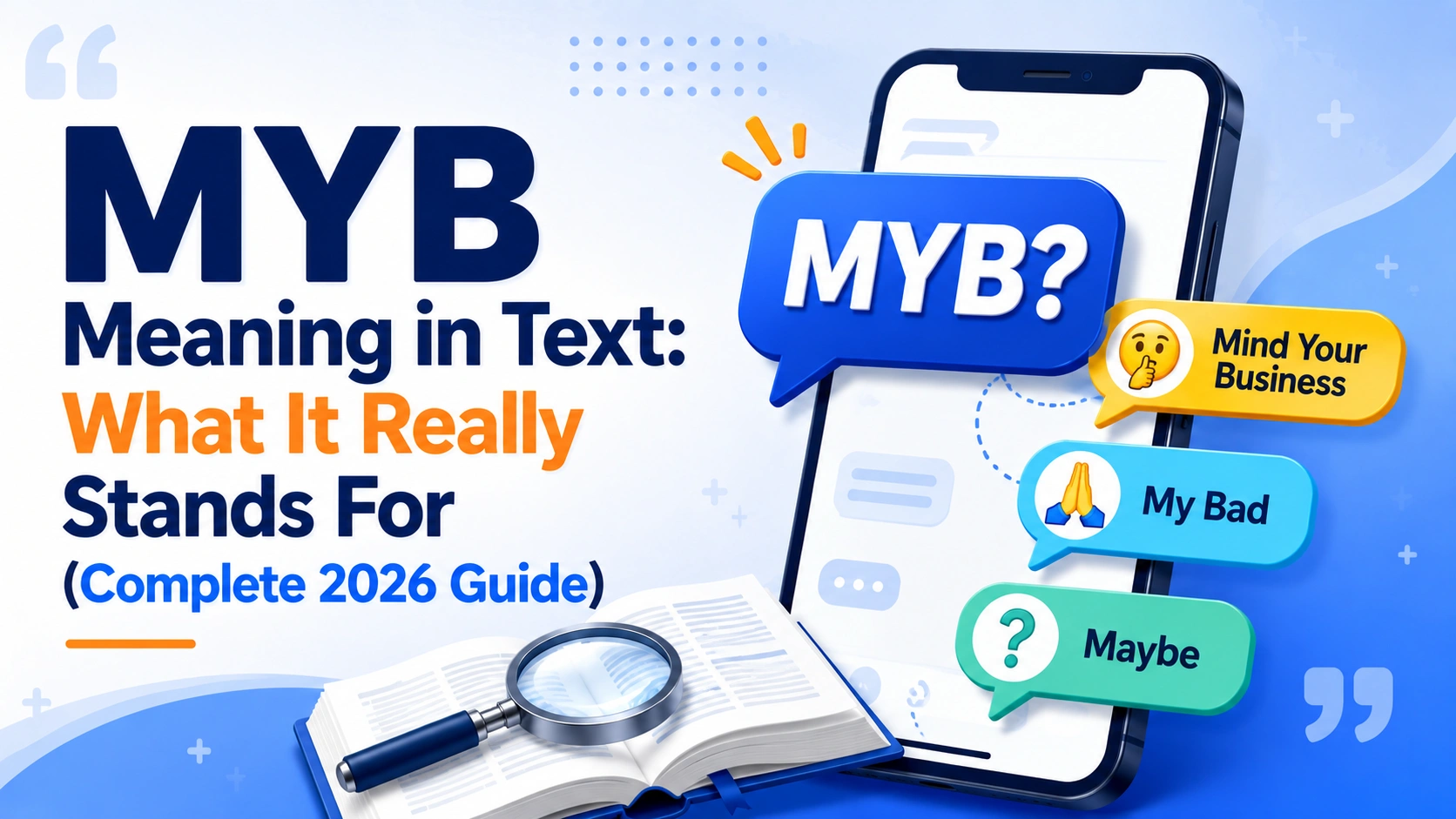
MYB meaning in text depends heavily on context. In casual online conversations, MYB can mean “Mind Your Business,” “My Bad,” or “Maybe,” and those interpretations can lead to completely different readings of the same three letters. Some current slang references also document less common expansions, which makes context especially important.
If someone replies “MYB 😂” after you ask a personal question, they may be telling you to “Mind Your Business” in a joking or slightly sassy way. If they write “myb, forgot to send it,” the intended meaning is much more likely “My Bad.” And if someone answers “myb” to a question about future plans, they may simply mean “Maybe.” The same abbreviation can therefore function as a boundary-setting response, a quick apology, or an expression of uncertainty.
This guide explains what MYB means, how to identify the intended meaning, how tone changes its interpretation, where it appears online, how it compares with similar abbreviations, and how to respond naturally. Rather than treating MYB as a fixed acronym with one universal definition, we’ll use the surrounding sentence, punctuation, emojis, and conversational situation to determine what the sender most likely intended.
MYB Meaning in Text: The Quick Answer
There is no single interpretation that works for every MYB message.
The three meanings worth knowing are:
| MYB | Meaning | Typical use | Tone |
| Mind Your Business | Stay out of my personal affairs | Responding to intrusive questions | Direct, playful, or defensive |
| My Bad | That was my mistake / Sorry | Admitting a minor mistake | Casual, apologetic |
| Maybe | Possibly / I’m not sure | Giving an uncertain answer | Neutral, hesitant |
Current online references disagree about which interpretation should be considered the single “main” meaning. Some identify “Mind Your Business” as the leading slang interpretation, while others describe “My Bad” or “Maybe” as common in casual texting. That disagreement is itself useful: MYB cannot reliably be decoded without context.
Quick rule: Don’t ask “What does MYB always mean?” Ask “What does MYB mean in this particular sentence?”
The Three Main Meanings of MYB
1. MYB = “Mind Your Business”
This is one of the most recognizable slang interpretations of MYB.
When someone uses it this way, they’re essentially saying:
- “Mind your business.”
- “Stay out of it.”
- “That’s private.”
- “It’s none of your concern.”
For example:
A: “Who were you texting last night?”
B: “MYB 😂”
The 😂 changes the feel considerably. Between friends, this may be playful teasing rather than a serious reprimand.
Without the emoji, however:
“MYB.”
can sound much more abrupt.
Some sources also describe MYB as a shortened form related to the older expression MYOB (“Mind Your Own Business”).
2. MYB = “My Bad”
MYB can also represent “My Bad,” an informal way to acknowledge a small mistake.
Examples:
“myb, I sent the wrong file.”
“Oh, myb. I thought you said Friday.”
“myb bro, didn’t see your message.”
In these cases, the abbreviation is functioning as a quick casual apology or admission of fault.
This interpretation is particularly easy to recognize when MYB appears next to an action or mistake:
“myb, I forgot to reply.”
There, “Mind Your Business” makes no grammatical sense. “My Bad” clearly fits.
Current slang references explicitly document this use.
3. MYB = “Maybe”
A third interpretation is “Maybe.”
Here, MYB expresses uncertainty or possibility:
A: “Are you coming tonight?”
B: “myb, not sure yet.”
In this context, MYB is not an apology and certainly isn’t telling someone to stay out of their affairs. It’s simply a shortened, informal version of “maybe.”
This usage is documented by several slang references, although sources differ over how common it is.
How to Tell Which MYB Meaning Someone Intended
The fastest way to decode MYB is to look at what comes immediately before and after it.
Step 1: Look at the Previous Message
Suppose someone asks:
“Why were you talking about me?”
and receives:
“MYB.”
Mind Your Business is the obvious interpretation.
Now change the conversation:
“You forgot to attach the document.”
“MYB, I’ll send it now.”
Now My Bad clearly fits.
Change it again:
“Are you free tomorrow?”
“MYB.”
Maybe it is the natural interpretation.
Step 2: Look at What Comes After MYB
The words following the abbreviation often reveal its meaning.
Apology context:
“MYB, I didn’t notice your message.”
Uncertainty context:
“MYB I’ll go, depending on the weather.”
Boundary-setting context:
“MYB, why are you asking?”
The surrounding grammar effectively tells you which expansion makes sense.
Step 3: Consider the Tone
Ask whether the person sounds:
- apologetic;
- uncertain;
- annoyed;
- playful;
- defensive;
- curious.
This narrows the possibilities considerably.
Step 4: Check the Punctuation and Emoji
Compare:
“MYB 😂”
with:
“MYB.”
and:
“MYB??”
They contain the same letters, but they don’t necessarily communicate the same attitude.
Step 5: Consider the Relationship
A close friend can say:
“MYB 😂”
without causing much concern.
A stranger saying:
“MYB.”
after you ask a normal question may come across as dismissive.
Context is more reliable than capitalization.
MYB Meaning Based on Real Conversation Context
When Someone Is Asking a Personal Question
A: “Who were you with last night?”
B: “MYB 😭”
Likely meaning: Mind Your Business.
The emoji may turn an otherwise sharp response into playful banter.
When Someone Makes a Mistake
A: “You sent me the wrong address.”
B: “MYB, sending the right one now.”
Likely meaning: My Bad.
When Someone Is Unsure About Plans
A: “Are you coming to the party?”
B: “MYB.”
Likely meaning: Maybe.
When Someone Is Being Playful
A: “You definitely cheated in that game.”
B: “MYB 😂”
Depending on the surrounding conversation, this could mean “Mind Your Business” or be a playful response whose exact expansion isn’t important to the participants.
When Someone Is Defensive
A: “You never helped with the project.”
B: “MYB? I did half of it.”
Here, Mind Your Business might not fit as naturally as a more conversational “What are you talking about?” In other words, don’t force an acronym expansion simply because three letters resemble one.
This is an important lesson with slang: sometimes the surrounding sentence matters more than the acronym’s supposed full form.
Is MYB Rude?
MYB is not automatically rude. Its tone depends mainly on which meaning is intended.
“Mind Your Business” Can Be Sharp
If someone writes:
“MYB.”
after an intrusive question, it may clearly mean:
“Mind your business.”
That’s a boundary-setting statement and can sound dismissive.
It Can Also Be Playful
Between close friends:
“Why do you care who I follow? MYB 😂”
may be nothing more than joking.
The relationship and previous tone matter.
“My Bad” Is Usually Softer
When MYB means “My Bad,” it normally carries an apologetic tone:
“MYB, I misunderstood.”
That’s considerably different from telling someone to stay out of your business.
“Maybe” Is Usually Neutral
When MYB means “Maybe,” it typically communicates uncertainty:
“MYB I’ll join later.”
However, a one-word “myb” can sometimes feel vague if the other person needs a definite answer.
MYB Examples in Different Settings
MYB Between Friends
Friend: “Why did you delete that photo?”
You: “MYB 😂”
Likely: Mind Your Business, probably playfully.
MYB in a Family Chat
Sibling: “You forgot to call Dad.”
You: “MYB, I’ll call him now.”
Likely: My Bad.
MYB in a Group Chat
Friend: “Who’s coming Saturday?”
You: “MYB, depends when I finish work.”
Likely: Maybe.
MYB in a Gaming Chat
Teammate: “You missed the target.”
Player: “MYB.”
Likely: My Bad.
The context of gaming makes a quick acknowledgment of an error particularly natural.
MYB on Social Media
Comment: “Why do you care what they do?”
Reply: “MYB 😂”
Likely: Mind Your Business.
Social media can make the phrase more confrontational because short replies lack the vocal cues available in face-to-face conversation.
MYB in a Dating Conversation
A: “Are you free this weekend?”
B: “MYB, I’ll know tomorrow.”
Likely: Maybe.
But:
A: “Why are you asking who I was with?”
B: “MYB 😭”
likely means Mind Your Business.
The dating context doesn’t create a special romantic definition for MYB. The surrounding sentence determines the meaning.
MYB Across Social Media and Messaging
It is tempting to create a separate definition for MYB on every platform, but that’s usually unnecessary.
The platform may influence how frequently people encounter an abbreviation, but it doesn’t automatically change the meaning.
Text Messages
Private texting gives the sender plenty of room to use informal shorthand.
MYB may mean:
- My Bad;
- Maybe;
- Mind Your Business.
Instagram and Social Media Comments
The Mind Your Business interpretation can be particularly noticeable in replies to personal or intrusive comments.
For example:
“Why don’t you ever post about your family?”
“MYB 😅”
Snapchat and Fast Messaging
Short forms can be useful when people are sending quick replies. A message such as:
“myb”
could mean maybe, especially when it answers a yes/no question.
But the context still determines the interpretation.
Discord and Gaming Chats
Gaming conversations often reward brevity. A player acknowledging a mistake might type:
“myb”
meaning “my bad.”
Group Chats
Group chats introduce another complication: who is the message addressing?
If someone writes:
“MYB”
after another person’s personal question, it may be directed at that individual rather than the entire group.
MYB vs. MYOB: Are They the Same?
They’re related, but not identical.
| Abbreviation | Meaning | Main difference |
| MYB | Mind Your Business | Shorter form; context-dependent |
| MYOB | Mind Your Own Business | More explicit boundary-setting phrase |
| WYM | What Do You Mean? | Requests clarification |
| MB | My Bad | Direct shorthand for an apology |
| IDK | I Don’t Know | Expresses lack of knowledge |
MYOB is more immediately recognizable as “Mind Your Own Business.”
MYB is more ambiguous because it can also mean My Bad or Maybe.
MYB vs. MB: “My Bad” Confusion
This is an especially useful distinction.
MB is commonly used as shorthand for “My Bad.”
So:
“mb, forgot to tell you.”
is easier to decode than:
“myb, I forgot to tell you.”
Both may be understood as an apology, but MYB has competing interpretations.
If your goal is clarity, “my bad” or “mb” may be less ambiguous than MYB.
MYB vs. “Maybe”
MYB can be confused with maybe because some users shorten the word by removing vowels.
Consider:
“Are you going?”
“myb.”
This can naturally be read as:
“Maybe.”
But:
“Sorry, myb I forgot.”
could be read as “My bad” depending on the rest of the sentence.
If you’re writing for someone who might not know your shorthand, simply typing “maybe” is clearer.
MYB and Professional Communication
In most professional settings, it’s better to avoid MYB because the abbreviation is ambiguous.
Imagine receiving this message from a colleague:
“MYB.”
You might reasonably wonder:
- Do they mean “my bad”?
- Are they telling me to mind my business?
- Do they mean “maybe”?
That ambiguity is unnecessary in workplace communication.
Better Professional Alternatives
If you mean My Bad:
“Sorry about that.”
“My mistake.”
If you mean Maybe:
“Possibly.”
“I’m not sure yet.”
If you mean Mind Your Business:
“I’d prefer to keep that private.”
“That’s personal, so I’d rather not discuss it.”
The last alternatives are especially useful because they establish a boundary without sounding needlessly hostile.
When You Should Use MYB
MYB can work when the communication is informal and the recipient is likely to understand the intended meaning.
Good Situations
Use it when:
- you’re chatting casually with friends;
- you’re in an informal group chat;
- you’re responding quickly;
- the context makes the meaning obvious;
- The people involved already use similar shorthand.
Better to Avoid It When
Avoid it when:
- you’re writing a formal email;
- you’re communicating with a teacher or supervisor;
- the conversation concerns an important misunderstanding;
- the recipient may not know texting slang;
- the message could reasonably have multiple interpretations.
Practical rule: If misunderstanding the message would create a problem, don’t rely on MYB.
Common MYB Mistakes
Assuming MYB Always Means “Mind Your Business”
This is one of the biggest errors.
Current references document multiple interpretations, including Mind Your Business, My Bad, and Maybe.
Assuming It Always Means “My Bad”
The reverse mistake is just as problematic.
If someone says:
“MYB, why are you asking?”
they may be using Mind Your Business, not apologizing.
Treating It as a Standard English Word
MYB is informal shorthand. It isn’t appropriate for every form of writing.
Assuming Tone From Capitalization
MYB versus myb doesn’t reliably tell you whether someone is angry, apologetic, or uncertain.
The sentence around it is much more informative.
Overinterpreting One Short Message
If someone sends:
“myb”
don’t immediately conclude that they’re angry, dismissive, flirting, or apologizing.
Look at the conversation as a whole.
How to Reply to “MYB”
Your best reply depends on what the sender meant.
If MYB Means “Mind Your Business”
If the person is joking:
“Okay okay 😂”
If you genuinely need clarification:
“Fair enough—I was just asking.”
If the tone is tense:
“No problem. I won’t pry.”
There’s no need to turn a short slang response into a bigger argument.
If MYB Means “My Bad”
A simple acknowledgment works:
“No worries.”
“All good.”
“It’s fine.”
If MYB Means “Maybe”
If you need a definite answer:
“No problem. Let me know when you know.”
If you’re making plans:
“Okay, just tell me by tomorrow.”
This avoids pressuring someone for an immediate commitment.
A Simple MYB Reply Decision Table
| If MYB probably means… | What the sender is doing | A natural reply |
| Mind Your Business | Setting a boundary | “Fair enough.” |
| Mind Your Business + joking | Teasing | “😂 Okay, okay.” |
| My Bad | Admitting a mistake | “No worries.” |
| Maybe | Expressing uncertainty | “Sure, let me know.” |
| Unclear | Ambiguous shorthand | “Do you mean ‘my bad’ or ‘maybe’?” |
The final option is perfectly reasonable when context genuinely doesn’t resolve the ambiguity.
Less Common Meanings and Why You Should Be Careful
Online acronym lists can contain many expansions for the same letters. Some sources list uses such as “Move Your Body” or other specialized interpretations.
That does not mean these are equally common in ordinary texting.
A useful distinction is:
Common everyday meanings → worth learning.
Specialized or community-specific meanings → interpret only when the surrounding topic supports them.
For example, if MYB appears in a fitness conversation, an unusual expansion connected with movement could theoretically make sense. But you shouldn’t automatically select an obscure definition just because an acronym website lists it.
Context should narrow the possibilities; a list of definitions should not override the context.
How MYB Differs From Similar Texting Shortcuts
| Expression | Meaning | What it does |
| MYB | Mind Your Business / My Bad / Maybe | Context-dependent |
| MYOB | Mind Your Own Business | Sets a boundary |
| MB | My Bad | Acknowledges a mistake |
| WYM | What Do You Mean? | Requests clarification |
| WYD | What Are You Doing? | Asks about someone’s activity |
| WYA | Where Are You At? | Asks someone’s location |
| IDK | I Don’t Know | Expresses uncertainty/lack of knowledge |
| TBH | To Be Honest | Introduces an honest opinion |
The key difference is function. MYB isn’t simply another generic reaction abbreviation; its interpretation changes according to the sentence.
The Grammar of MYB
MYB isn’t a standard English grammatical construction. It’s a digital shorthand, so users don’t necessarily apply conventional sentence rules to it.
For example:
“myb I’ll go”
can function as:
“Maybe I’ll go.”
Whereas:
“myb, I forgot”
can function as:
“My bad, I forgot.”
This is why trying to analyze MYB as though it were an ordinary English word can be misleading.
Its meaning comes from abbreviation + context + conversational convention.
Regional and Generational Differences
Slang doesn’t spread uniformly across English-speaking communities.
One person may immediately understand:
“MYB 😂”
while another may interpret it as a typo.
Exposure to texting culture, social media, gaming communities, and particular friend groups can all affect recognition.
Don’t Assume Everyone Uses the Same Meaning
Someone familiar with MYB as “Maybe” may initially misread a message intended as “Mind Your Business.”
That’s not necessarily anyone’s fault. The abbreviation itself is ambiguous.
Why Context Is More Reliable Than Demographics
It is tempting to say that one generation or platform “owns” a slang term. Real usage is more complicated.
People borrow expressions across communities, platforms, and age groups. The actual conversation is usually a better clue than assumptions about who is typing.
A Five-Second MYB Interpretation Test
When you see MYB, use this quick process:
1. Read the previous message
What was being discussed?
2. Try “My Bad”
Does an apology make sense?
“You forgot the meeting.”
“MYB.”
Yes.
3. Try “Maybe”
Does uncertainty make sense?
“Are you coming?”
“MYB.”
Yes.
4. Try “Mind Your Business”
Does someone appear to be asking about something private?
“Who were you with?”
“MYB.”
Yes.
5. Check the tone
Look for:
- emojis;
- punctuation;
- jokes;
- conflict;
- relationship between the speakers.
Usually, one interpretation will fit substantially better than the others.
MYB Quick Reference Guide
| Message | Most likely reading |
| “MYB, forgot to send it.” | My Bad |
| “Are you coming? — MYB.” | Maybe |
| “Why are you asking? MYB 😂” | Mind Your Business |
| “MYB, I’ll check.” | My Bad or Maybe; context needed |
| “MYB 😭” | Often Mind Your Business in playful context |
| “MYB.” after an accusation | Potentially Mind Your Business or another context-dependent reaction |
| “myb, I’m not sure.” | Maybe |
| “oh myb!” | My Bad |
Conclusion:
Understanding MYB meaning in text requires more than memorizing a single expansion. In contemporary online communication, MYB can mean “Mind Your Business,” “My Bad,” or “Maybe,” with the surrounding conversation determining which interpretation makes sense. The distinction matters because those meanings range from setting a personal boundary to apologizing for a mistake or simply expressing uncertainty. One final actionable tip: read the message immediately before MYB, then test which expansion fits naturally into the conversation. If two meanings still seem possible, ask rather than guess. A common mistake to avoid is assuming that capitalization, age, platform, or one slang dictionary can tell you the intended meaning by itself. With ambiguous texting language, context is the real decoder.
FAQs
Q1. What does MYB mean in text?
MYB has several meanings in texting, with common interpretations including “Mind Your Business,” “My Bad,” and “Maybe.” The intended meaning depends on the surrounding message. If MYB follows a mistake, it probably means “My Bad”; if it answers a plan, “Maybe” may fit better.
Q2. Is MYB a rude abbreviation?
It can be, but it isn’t always rude. When MYB means “Mind Your Business,” it may sound blunt or defensive, especially without an emoji. Between friends, however, it can be playful. When MYB means “My Bad” or “Maybe,” it generally carries a much softer meaning.
Q3. Does MYB mean “My Bad” or “Mind Your Business”?
It can mean either. The surrounding sentence determines which interpretation makes sense. “MYB, I forgot” strongly suggests “My Bad,” while “Why do you care? MYB” suggests “Mind Your Business.” Don’t choose an expansion without considering the conversation.
Q4. Can MYB mean “Maybe”?
Yes. Some users use MYB as a shortened form of “maybe,” particularly in very casual messaging. For example, “Are you coming?” followed by “myb” can mean “maybe.” Because this use is less universally recognized, writing “maybe” is clearer when ambiguity matters.
Q5. Should I use MYB at work?
Generally, avoid MYB in professional communication because its multiple meanings can create unnecessary confusion. Use “My mistake,” “Possibly,” or “Could you clarify?” depending on what you mean. Clear wording is especially important when communicating with people who may not share your texting vocabulary.