

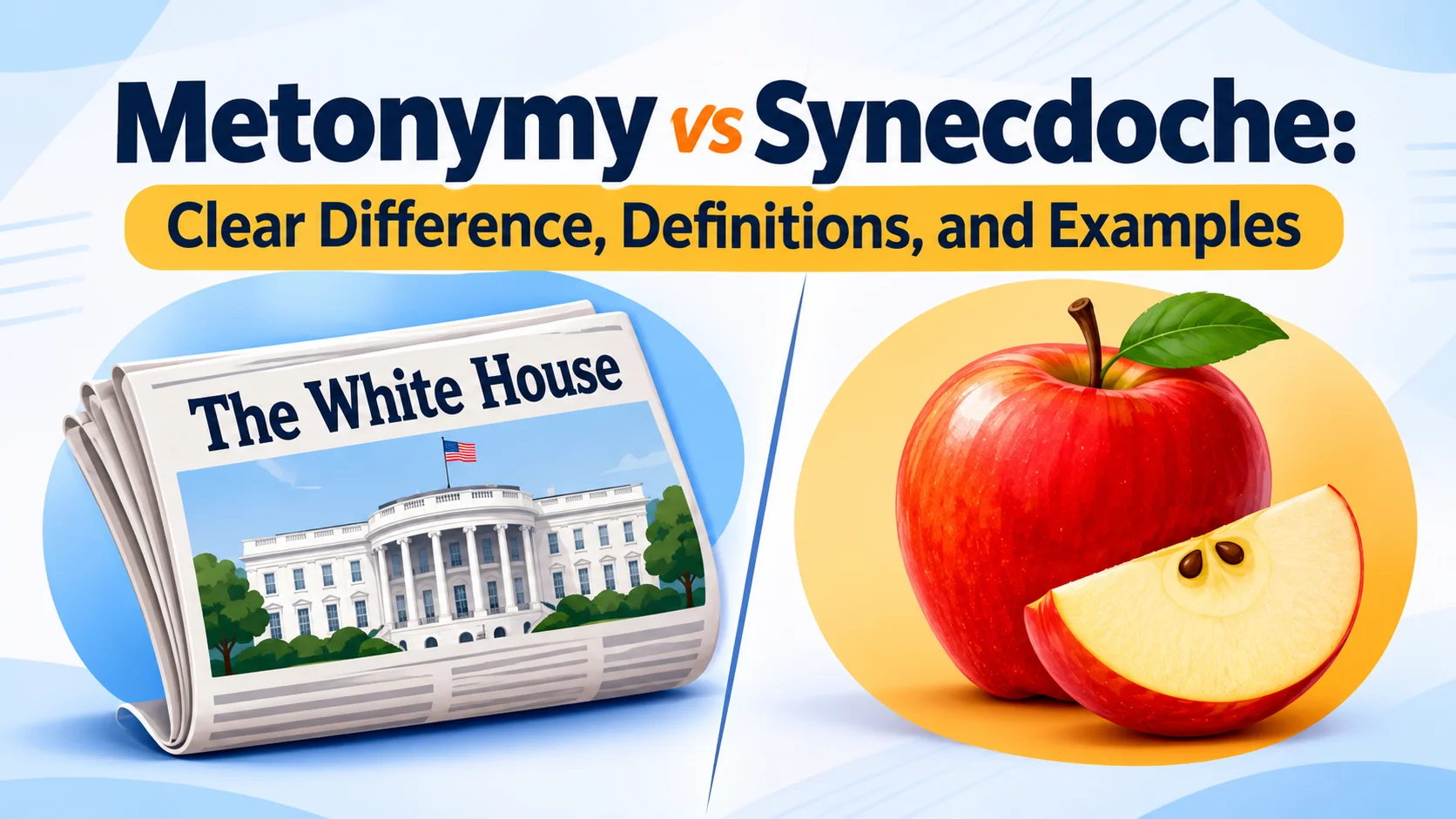
Metonymy and synecdoche are two closely related figures of speech that allow writers to express ideas without directly naming the people, objects, or concepts they mean. Although they may look similar in a sentence, they work through different relationships. Metonymy uses association, replacing something with a related name or concept, whereas synecdoche uses a part or whole to represent something larger or smaller. Understanding this distinction makes it easier to recognize figurative language in everyday conversations, newspaper headlines, advertisements, poetry, and literature.
The confusion often begins with examples that appear straightforward. When someone says, “The White House issued a statement,” the building represents the presidential administration. When someone says, “We need more hands,” the body part represents the workers. Both expressions use indirect references, but the connection between the words and their intended meanings is different. One depends on an established association; the other depends on a part-and-whole relationship. Recognizing that difference is the key to identifying each device correctly.
In this guide, you’ll learn the definitions of metonymy and synecdoche, how each figure of speech works, and how to distinguish them using practical examples. We’ll also examine their uses in everyday language, professional communication, and literature, explain whether synecdoche is a type of metonymy, and compare both devices with metaphor. By the end, you’ll have a straightforward method for identifying these rhetorical devices and understanding how writers use them to make language more concise, expressive, and meaningful.
What Is Metonymy? Definition, Meaning, and Examples
Metonymy is a figure of speech in which a word or expression is replaced by another term closely associated with the intended subject.
The replacement does not have to be a physical part of the thing being described. Instead, the two terms share a recognizable connection, such as a relationship between a place and an institution, an object and an activity, or a symbol and an idea.
For example:
“The White House announced a new policy.”
The White House is a building, but the expression refers to the US presidential administration or the officials speaking on its behalf. The building is associated with the institution, so its name stands in for the people or organization connected with it.
Metonymy makes communication more compact. Rather than naming an institution or explaining a complicated relationship, a speaker can use a familiar associated term that readers already understand.
How Does Metonymy Work?
Metonymy works through association rather than physical resemblance or a part-to-whole relationship.
To understand it, identify two things:
- The word or expression actually used.
- The person, institution, object, or concept that the expression represents.
The relationship between them should be recognizable from context.
Consider these examples:
- “The crown approved the proposal.” The crown represents royal authority or the monarchy.
- “Hollywood is changing its approach to filmmaking.” Hollywood represents the American film industry.
- “The press questioned the minister.” The press represents journalists or news organizations.
- “She enjoys reading Shakespeare.” Shakespeare represents the author’s literary works.
In each example, the substitute has a meaningful connection with the intended subject. However, it is not necessarily a physical component of that subject.
Common Types of Metonymy With Examples
Metonymy can appear in several forms. The following categories help explain the different associations writers commonly use.
1. Place for an Institution or Organization
A location can represent an organization, government, or industry associated with it.
Examples:
- Washington announced new measures. (The US government or its officials.)
- Hollywood welcomed a new generation of filmmakers. (The film industry.)
- Wall Street reacted to the financial announcement. (The financial sector or investment community.)
This form is especially common in journalism because it provides a recognizable shorthand for institutions and groups.
2. Symbol for an Idea or Authority
An object associated with an idea can represent that idea.
Examples:
- The crown represents royal authority.
- The scepter symbolizes sovereignty.
- The flag represents a nation or its national identity.
- The sword can represent military power or armed conflict.
For example, “The crown made its decision” uses the crown as a reference to the monarchy rather than an actual decorative object.
3. Object for an Activity or Concept
An object can represent the activity or idea commonly associated with it.
Examples:
- The pen represents writing or communication.
- The sword represents military force.
- The microphone can represent public speaking or broadcasting.
Consider the expression:
“The pen is mightier than the sword.”
The pen represents written communication and ideas, while the sword represents physical force. The statement contrasts the influence of communication with the power of violence.
4. Container for Its Contents
Sometimes the name of a container refers to what it holds.
Examples:
- “She drank the entire glass.” (The liquid inside the glass.)
- “The restaurant served two plates of pasta.” (The food on the plates.)
- “He ordered another cup.” (The drink contained in the cup.)
These expressions are familiar in everyday speech because the container and its contents are closely connected.
5. Author or Creator for Their Work
A creator’s name can represent something they produced.
Examples:
- “I’m reading Shakespeare this semester.” (Shakespeare’s literary works.)
- “The museum purchased a Picasso.” (A painting created by Picasso.)
- “She listens to Mozart while studying.” (Mozart’s musical compositions.)
The person’s name identifies the work through the relationship between the creator and the creation.
Metonymy Examples in Everyday Language
Metonymy is not limited to poetry or formal literature. People use it naturally in conversations, news reports, and professional settings.
| Example | Intended meaning | Why it is metonymy |
| The press reported the incident. | Journalists or news organizations | The press is associated with journalism. |
| Hollywood announced a new project. | The film industry | Hollywood is associated with filmmaking. |
| The crown rejected the proposal. | Royal authority | The crown symbolizes monarchy. |
| Wall Street welcomed the announcement. | Financial markets or investors | Wall Street is associated with finance. |
| She is studying Shakespeare. | Shakespeare’s works | The author is associated with his writing. |
| The kitchen needs another pair of hands. | Another worker | This example is synecdoche rather than metonymy. |
The final example is important because it illustrates a common classification problem. Although hands is associated with workers, it is also a physical part of their bodies. Therefore, it is generally classified as synecdoche.
What Is Synecdoche? Definition, Meaning, and Examples
Synecdoche is a figure of speech in which a part represents the whole or the whole represents one of its parts.
Unlike metonymy, which relies on a broader association, synecdoche depends on a direct part-to-whole or whole-to-part relationship.
For example:
“All hands on deck!”
Here, hands represents the sailors or crew members who are needed. Hands are physical parts of the people being referred to, so this is an example of synecdoche.
Writers use this device to emphasize a particular feature, create vivid descriptions, and communicate ideas economically.
How Does Synecdoche Work?
Synecdoche works by allowing one part of something to stand for the complete entity, or by using the name of the whole to refer to a specific part.
There are two principal forms:
- Part for whole: A component represents the complete person, object, or group.
- Whole for part: The complete entity represents one of its components.
For instance:
- “We need more heads in the research department.” Here, heads represent people.
- “The school won the championship.” In an appropriate context, the school represents its sports team.
The important factor is the relationship between the two. The substitute must represent something of which it is a part or a whole that includes the intended subject.
Main Types of Synecdoche With Examples
1. A Part Representing the Whole (Pars Pro Toto)
Pars pro toto is a Latin expression meaning “a part for the whole.”
This is one of the most recognizable forms of synecdoche. A particular feature or component represents an entire person, object, or group.
Examples:
- “We need more hands in the workshop.” (Hands represent workers.)
- “Nice wheels!” (Wheels represent a car.)
- “There are several new faces in the office.” (Faces represent people.)
- “All eyes turned toward the speaker.” (Eyes represent the people watching.)
- “The company needs more brains for this project.” (Brains represent intelligent or skilled people.)
The writer selects a recognizable part because it communicates the larger meaning efficiently.
2. The Whole Representing a Part (Totum Pro Parte)
Totum pro parte means “the whole for a part.”
In this form, the name of an entire entity represents a specific component or group within it.
Examples:
- “The school won the football tournament.” (The school’s team won.)
- “The city celebrated the championship.” (The city’s residents celebrated.)
- “The country welcomed the visiting athletes.” (The people or officials representing the country welcomed them.)
- “The company received the award.” (The company team or representatives received it.)
The context makes the intended part clear. For example, a school building does not physically play a football match; its team represents the school in the competition.
3. Material Representing an Object
Sometimes a material name is used to refer to an object made from that material.
Examples:
- “The soldiers carried steel into battle.” (Steel weapons or equipment.)
- “The collection includes several beautiful pieces of silver.” (Silver objects or silverware.)
- “The workshop displayed its finest leather.” (Leather goods, depending on context.)
Important distinction: Material-for-object expressions are not always classified consistently. Some rhetorical traditions treat them as synecdoche when the material is understood as an essential component of the object; others classify them as metonymy because the connection is based on association. For a clear example of synecdoche, a direct part-for-whole expression such as hands for workers is less ambiguous.
Synecdoche Examples in Everyday Language
Synecdoche appears frequently in ordinary communication, particularly when speakers want to describe people or objects through recognizable features.
| Example | Intended meaning | Part or whole relationship |
| We need more hands. | More workers | Hands are parts of people. |
| There are new faces here. | New people | Faces are parts of people. |
| Nice wheels! | A nice car | Wheels are parts of a car. |
| All eyes were on the stage. | Everyone was watching | Eyes are parts of people. |
| The ranch has fifty head of cattle. | Fifty cattle | Head is used as a count for whole animals. |
| The school won the competition. | The school’s team won | The institution represents a participating part. |
These expressions work because the relationship is familiar enough for readers to understand without additional explanation.
Metonymy vs. Synecdoche: Key Differences Explained
The central difference between metonymy and synecdoche lies in the relationship between the expression and what it represents.
Metonymy uses association. Synecdoche uses a part-whole relationship.
This distinction is more reliable than trying to memorize long lists of examples.
For instance:
- “The White House issued a statement.” The building is associated with the presidential administration. This is metonymy.
- “All hands are needed.” Hands are parts of the people being requested. This is synecdoche.
Both examples replace a direct reference with another expression, but the connection is different.
Metonymy vs. Synecdoche Comparison Table
| Feature | Metonymy | Synecdoche |
| Definition | Uses an associated term to represent something | Uses a part or whole to represent something |
| Main relationship | Association or connection | Part-to-whole or whole-to-part |
| Type of substitution | Related concept, place, symbol, or object | Physical or conceptual component or complete entity |
| Main purpose | Creates indirect reference | Highlights a part or represents a whole |
| Example | The White House announced a decision. | All hands on deck. |
| Intended meaning | The administration announced a decision. | All crew members are needed. |
| Common settings | Journalism, politics, literature, conversation | Literature, conversation, descriptive writing |
| Identifying clue | The substitute is associated with the subject | The substitute is part of, or includes, the subject |
What Makes Metonymy Different From Synecdoche?
Consider two expressions involving a workplace:
Example 1: “The suits approved the proposal.”
Here, suits refers to business executives or corporate decision-makers. The clothing is associated with the people who wear it. It is not a physical part of those people, so this is generally classified as metonymy.
Example 2: “We need more hands on this project.”
Here, hands refers to workers. Hands are actual parts of the workers’ bodies, so this is synecdoche.
The distinction becomes clearer when you ask what connects the substitute to its intended meaning.
- A suit is associated with a business professional.
- A hand is physically part of a worker.
That is the fundamental difference.
How to Identify Metonymy vs. Synecdoche: A Simple Test
You do not need to memorize every rhetorical example to distinguish these devices. A two-step test will help you classify most straightforward expressions.
Step 1: Apply the Part-and-Whole Test
Ask yourself:
Is the word being used to represent something that it is physically or conceptually part of?
If the answer is yes, the expression is likely synecdoche.
Example:
“We need more heads in the planning department.”
- Literal word: Heads.
- Intended meaning: People.
- Relationship: A head is part of a person.
- Classification: Synecdoche.
Step 2: Apply the Association Test
If the substitute is connected to the intended subject but is not a part of it, the expression is generally metonymy.
Example:
“Hollywood is preparing for another award season.”
- Literal word: Hollywood.
- Intended meaning: The film industry.
- Relationship: Hollywood is associated with filmmaking.
- Classification: Metonymy.
Quick Decision Table
| Ask yourself | Likely figure of speech |
| Does a body part represent a person? | Synecdoche |
| Does an object component represent the complete object? | Synecdoche |
| Does an institution’s location represent the institution? | Metonymy |
| Does a symbol represent an associated idea? | Metonymy |
| Does an author’s name represent their work? | Metonymy |
| Does the expression depend on resemblance rather than association or part-whole representation? | Possibly metaphor |
Expert tip: Do not classify an expression based only on the words it contains. Examine the relationship between the literal expression and its intended meaning. Context can change how an expression should be interpreted.
Test Your Understanding With Five Examples
Try identifying each figure of speech before reading the explanations.
- “The crown announced a new policy.”
- “We need more hands for the construction project.”
- “Wall Street reacted to the announcement.”
- “All eyes were watching the performance.”
- “The school celebrated its victory.”
Answers:
- Metonymy: The crown represents royal authority.
- Synecdoche: Hands represent workers.
- Metonymy: Wall Street represents the financial community.
- Synecdoche: Eyes represent the people watching.
- Synecdoche (in the intended context): The school represents its sports team.
Real-Life Uses of Metonymy and Synecdoche Beyond Literature
Neither device belongs exclusively to poetry or academic writing. Both appear in everyday language because they allow people to communicate complex ideas through familiar references.
Metonymy in News Headlines and Journalism
Journalists frequently use metonymy to make headlines shorter and more recognizable.
Examples:
- “Washington responds to international criticism.”
- “Wall Street reacts to the latest financial report.”
- “Hollywood prepares for a major film release.”
- “The press questions the government’s decision.”
In each case, the named location, institution, or associated group represents a larger organization or community.
This approach is useful when the audience already understands the connection. However, journalists should avoid expressions that might obscure who actually took an action.
For example, “Washington announced new measures” is concise, but it may be less precise than naming the specific government department responsible.
Synecdoche in Everyday Conversations
People often use synecdoche without recognizing it as a rhetorical device.
Examples:
- “We need another pair of hands.”
- “There are too many mouths to feed.”
- “The company is looking for fresh faces.”
- “All eyes were on the presenter.”
- “The team needs stronger legs for the final match.”
These expressions make conversations natural and economical. They also allow speakers to emphasize a particular human feature, need, or ability.
Metonymy and Synecdoche in Business and Professional Writing
Both devices can make professional communication more concise, but they should be used thoughtfully.
Metonymy examples:
- “Management rejected the proposal.”
- “The board approved the budget.”
- “The press covered the announcement.”
Synecdoche examples:
- “We need more hands during the busy season.”
- “The department is looking for fresh faces.”
- “The project requires additional skilled minds.”
In business writing, the main consideration is clarity. Expressions such as more hands may work well in an informal meeting, but a formal report may benefit from the more precise phrase additional employees.
Use figurative expressions when they improve communication, not simply to make ordinary sentences sound more elaborate.
Metonymy and Synecdoche in Advertising and Marketing
Advertising often relies on familiar associations and recognizable features to communicate quickly.
For example:
- A crown may represent luxury, prestige, or authority. This can be metonymic when the symbol stands for the associated idea.
- A steering wheel may represent driving or the driving experience. This can function as synecdoche when the component represents the whole activity or vehicle.
- A hand may represent human craftsmanship or manual work. Its classification depends on whether it represents a person, an activity, or an associated concept.
The important point is that not every product symbol or visual reference automatically qualifies as metonymy or synecdoche. The actual relationship determines the classification.
Metonymy vs. Synecdoche in Literature and Creative Writing
Writers use both figures of speech to create imagery, emphasize ideas, and communicate meaning indirectly.
Although their mechanisms differ, both can make a passage more memorable than a straightforward literal description.
How Writers Use Metonymy to Create Meaning
Metonymy allows writers to represent complicated subjects through familiar associated concepts.
For example:
“The throne had little patience for dissent.”
The throne represents royal authority or the monarchy. Rather than describing the ruler and the institution directly, the writer uses an object associated with political power.
This technique can serve several literary purposes:
- Political commentary: A location can represent an entire government.
- Symbolic expression: An object can represent an abstract concept.
- Characterization: A profession or possession can indirectly identify a character.
- Thematic development: Repeated associations can reinforce ideas about authority, wealth, or social class.
Metonymy is particularly effective when the association carries cultural or historical significance.
How Writers Use Synecdoche to Make Descriptions More Powerful
Synecdoche allows a writer to focus on one recognizable part while implying the larger person or object.
For example:
“Two tired faces appeared at the doorway.”
The word faces represents the people entering the room. The description also directs attention toward their visible expressions, making the scene more specific.
Another example:
“Every hand reached for the final piece of bread.”
Here, hand represents a person participating in the action.
Writers use synecdoche to:
- Focus attention on a significant physical feature.
- Make descriptions more compact.
- Suggest a person’s presence without naming them directly.
- Emphasize collective action.
- Create vivid imagery in poetry and prose.
How Metonymy and Synecdoche Affect Tone and Imagery
The two devices can influence how readers perceive a scene.
Compare these descriptions:
| Direct expression | Figurative expression | Device |
| The government announced a decision. | The White House announced a decision. | Metonymy |
| The workers gathered around the machine. | The hands gathered around the machine. | Synecdoche |
| The royal authority rejected the proposal. | The crown rejected the proposal. | Metonymy |
| Everyone watched the performance. | All eyes watched the performance. | Synecdoche |
The figurative versions are generally shorter and can create a stronger image.
However, direct language may be preferable when precision is essential. Technical reports, legal documents, and instructional materials should not sacrifice clarity for rhetorical effect.
When Should Writers Use Metonymy or Synecdoche?
Choose the device according to the relationship you want to emphasize.
Use metonymy when:
- An associated institution or place communicates the subject clearly.
- A symbol can represent a familiar idea.
- You want to avoid repeatedly naming an organization.
- The association adds cultural or literary significance.
Use synecdoche when:
- A physical feature can represent an entire person.
- A component can identify a larger object.
- A group can be represented by one of its parts.
- You want to emphasize a particular feature of a person, object, or scene.
Avoid either device when readers might misunderstand the intended reference.
Is Synecdoche a Type of Metonymy?
This is one of the most interesting questions in rhetorical terminology.
Synecdoche is sometimes classified as a specialized type of metonymy, but many traditional explanations treat the two as distinct figures of speech.
The reason is that both involve using one expression to represent something else through an existing relationship.
However, their relationships are not identical:
- Metonymy relies on association.
- Synecdoche relies specifically on a part-whole relationship.
For example:
“The crown announced the decision.”
This is metonymy because a crown is associated with monarchy and royal authority.
“All hands are needed.”
This is synecdoche because hands are parts of the people being requested.
Why Do Some Sources Classify Synecdoche as Metonymy?
Some rhetorical traditions use a broader definition of metonymy that includes different forms of substitution based on relationships between concepts.
Under this approach, synecdoche can be considered a narrower form of metonymy because a part and its whole are closely related.
Other textbooks distinguish them because their mechanisms are sufficiently different to deserve separate categories.
Neither classification should be presented as the only universally accepted approach. The terminology can vary between rhetorical traditions and scholarly discussions.
Practical recommendation: When analyzing a text, identify the actual relationship first. ✅If a part represents the whole, call it synecdoche under the conventional distinction. If an associated concept represents something else, call it metonymy. If a source uses a broader classification, explain that terminology rather than treating the difference as a factual disagreement.
Metonymy vs. Synecdoche vs. Metaphor: Understanding the Difference
Metonymy and synecdoche are sometimes confused with metaphor because all three are figures of speech that communicate something beyond literal meaning.
However, metaphor works differently.
A metaphor describes one thing in terms of another based on an implied comparison or resemblance.
For example:
“Time is a thief.”
Time does not literally steal possessions. The metaphor compares time to a thief because both can be associated with something being taken away.
Metonymy vs. Metaphor
Consider these examples:
- Metonymy: “The crown announced a new law.” The crown represents royal authority.
- Metaphor: “The crown of the mountain touched the clouds.” Here, crown describes the mountain’s highest part through resemblance to a crown.
The first depends on association with political authority. The second depends on visual resemblance.
Synecdoche vs. Metaphor
Compare these sentences:
- Synecdoche: “All hands are needed.” Hands represent people.
- Metaphor: “The classroom was a zoo.” The classroom is compared to a zoo to suggest noise or disorder.
The first uses a physical part to represent the whole person. The second makes an imaginative comparison.
Three-Way Comparison Table
| Feature | Metonymy | Synecdoche | Metaphor |
| Main mechanism | Association | Part-whole relationship | Comparison or resemblance |
| Main purpose | Indirect reference | Representation through a part or whole | Imaginative comparison |
| Example | The White House responded. | All hands on deck. | Her voice was music. |
| Intended meaning | The administration responded. | All crew members are needed. | Her voice sounded beautiful. |
| Key identifying question | What is associated with the subject? | What part or whole is being represented? | What two things are being compared? |
A useful way to remember the distinction is to examine the connection rather than the appearance of the sentence.
Common Mistakes and Misconceptions About Metonymy and Synecdoche
Even readers who understand the basic definitions can confuse these devices when analyzing unfamiliar expressions.
Here are the most common mistakes and how to avoid them.
| Mistake | Correct understanding |
| Treating every indirect reference as synecdoche | Synecdoche specifically involves a part-whole relationship. |
| Assuming every associated object is synecdoche | Association alone generally indicates metonymy. |
| Confusing a symbol with a physical component | A symbol can represent something through metonymy. |
| Assuming synecdoche and metonymy are completely unrelated | Some rhetorical traditions classify synecdoche as a subtype of metonymy. |
| Treating every figurative expression as metaphor | Metaphor relies on comparison or resemblance. |
| Ignoring context when identifying a device | The intended meaning determines the classification. |
| Assuming a body-part reference is always synecdoche | It depends on what the body part represents in context. |
A Few Particularly Confusing Examples
“The suits made the decision.”
This is metonymy because suits represent business professionals through their clothing and professional association.
“We need more heads in the office.”
This is synecdoche because heads represent people.
“The school welcomed the new students.”
This is generally a straightforward institutional reference rather than automatically a figure of speech. However, if school specifically represents its staff or administration, it may function metonymically. The context matters.
“The wheels were parked outside.”
If wheels means an entire car, it is synecdoche because wheels are components of the vehicle.
The lesson is simple: identify the intended meaning before assigning the rhetorical label.
Practice Quiz: Can You Identify Metonymy and Synecdoche?
Test your understanding with the following examples. Decide whether each sentence contains metonymy, synecdoche, or metaphor.
Test Your Understanding
- “The White House released a statement.”
- “We need more hands in the workshop.”
- “The pen is mightier than the sword.”
- “The city celebrated the championship.”
- “The suits rejected the proposal.”
- “She has a heart of stone.”
- “All eyes turned toward the stage.”
- “Hollywood is preparing for another award season.”
- “The farm has fifty head of cattle.”
- “The classroom was a zoo.”
Answers and Explanations
| No. | Answer | Explanation |
| 1 | Metonymy | The White House represents the presidential administration. |
| 2 | Synecdoche | Hands represent workers. |
| 3 | Metonymy | Pen represents writing, while sword represents military force. |
| 4 | Synecdoche (in the intended context) | The city represents its residents. |
| 5 | Metonymy | Suits represent business professionals. |
| 6 | Metaphor | A heart of stone compares someone emotionally unfeeling to stone. |
| 7 | Synecdoche | Eyes represent the people watching. |
| 8 | Metonymy | Hollywood represents the film industry. |
| 9 | Synecdoche | Head is used as a part to count whole animals. |
| 10 | Metaphor | The classroom is compared to a zoo. |
Notice that the distinction is not always determined by the literal words. The context and intended reference matter, particularly in examples involving institutions and collective groups.
Conclusion:
Understanding metonymy vs. synecdoche becomes much easier when you focus on the relationship behind each expression. Metonymy connects a word to something associated with it, while synecdoche represents a whole through one of its parts or a part through the whole. Although some rhetorical traditions group synecdoche under metonymy, recognizing their conventional distinction makes literary analysis clearer. One final actionable tip: Whenever you encounter an indirect expression, identify what the substitute represents before deciding which figure of speech it uses. A common mistake to avoid is labeling every figurative reference as metonymy or synecdoche without examining its context. The more carefully you notice these relationships, the more effectively you’ll understand how writers create meaning through language.
FAQs
Q1. What is the main difference between metonymy and synecdoche?
Metonymy replaces something with a term associated with it, while synecdoche uses a part to represent the whole or the whole to represent a part. For example, the crown represents royal authority through association, whereas hands can represent workers through a part-whole relationship.
Q2. Is synecdoche a type of metonymy?
In some rhetorical classifications, synecdoche is considered a specialized form of metonymy because both involve substitution through related concepts. However, many educational resources distinguish them. The conventional distinction identifies association as metonymy and part-whole representation as synecdoche.
Q3. What is the easiest way to remember metonymy and synecdoche?
Remember two words: association and part. If the substitute is associated with the subject, think metonymy. If it represents a physical or conceptual part of the subject, think synecdoche. This simple test helps classify most familiar examples.
Q4. Can one expression be both metonymy and synecdoche?
An expression can receive overlapping classifications depending on the rhetorical framework being used. Synecdoche is sometimes treated as a subtype of metonymy. For accurate analysis, identify the specific relationship and explain the classification adopted by your textbook or reference.
Q5. What is the difference between metonymy, synecdoche, and metaphor?
Metonymy uses association, synecdoche uses a part-whole relationship, and metaphor uses comparison or resemblance. For example, the crown can represent monarchy, hands can represent workers, and time is a thief compares time to a thief.