

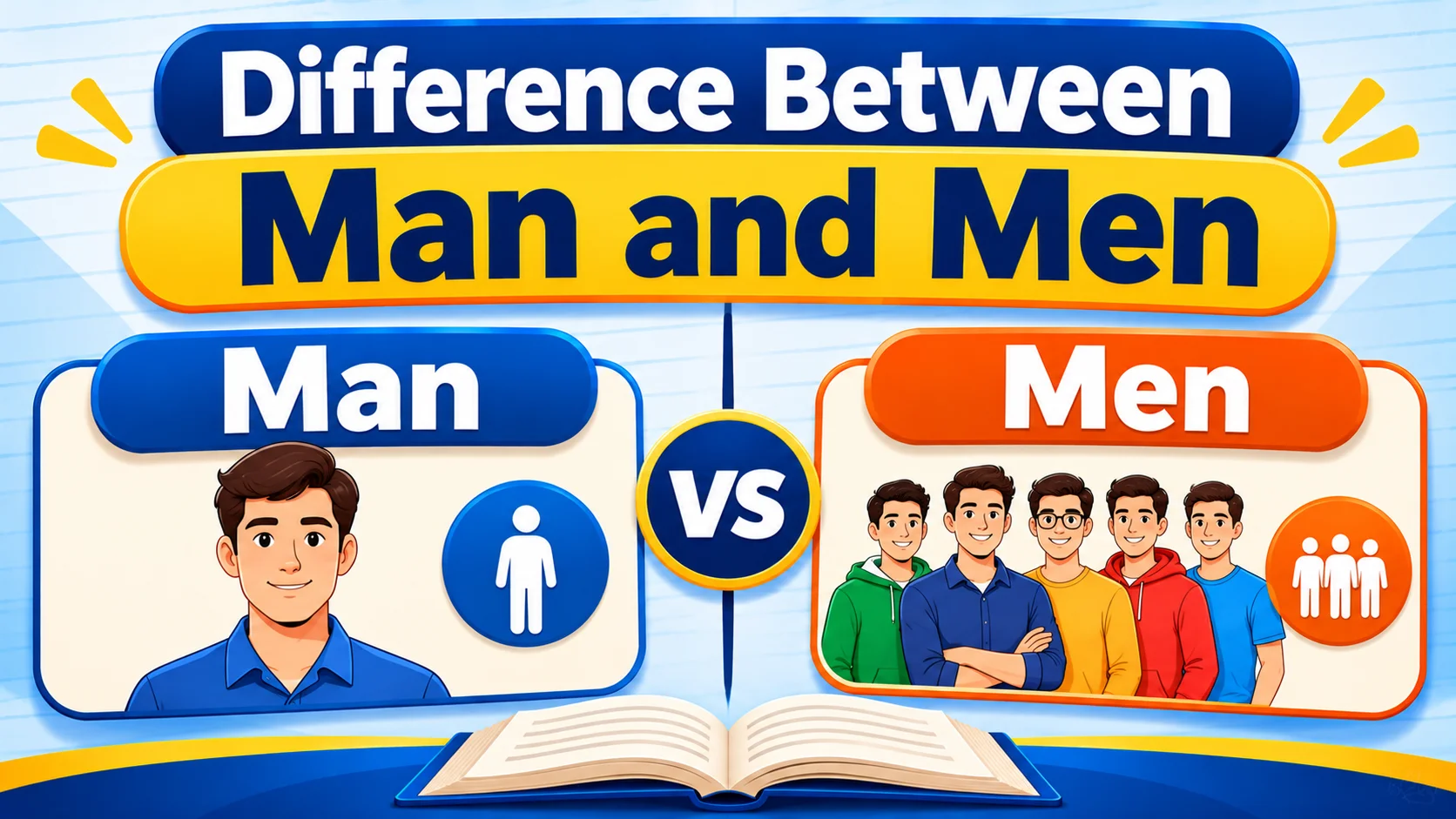
The difference between man and men is simple once you understand how English forms irregular plurals: man refers to one adult male, while men refers to two or more adult males. However, choosing the correct word involves more than changing one letter. The two forms affect verb agreement, pronouns, articles, and possessives. For example, you would write “The man is waiting” but “The men are waiting.” Both sentences are grammatically correct, yet using the wrong form can make an otherwise clear sentence sound unnatural.
One reason this distinction confuses English learners is that most English nouns form their plurals by adding -s or -es. Words such as book/books and teacher/teachers follow that familiar pattern, but man changes its internal vowel to become men. This makes it an irregular plural noun, similar to woman/women and foot/feet. The difference also appears in pronunciation, so recognizing the words when speaking is just as important as spelling them correctly.
In this guide, you’ll learn when to use man and men, why mans is not the ordinary plural form, and how both words behave in different grammatical situations. We’ll examine man’s vs. men’s, singular and plural verb agreement, pronunciation, everyday examples, and common mistakes. You’ll also discover when man can refer to humanity in general and why modern writers sometimes choose more inclusive alternatives. By the end, you’ll be able to use both forms confidently in conversations, academic assignments, and professional writing.
Man vs. Men: The Quick Answer
The main difference is grammatical number:
- Man is singular. It refers to one adult male person.
- Men is plural. It refers to two or more adult male people.
For example:
- A man is waiting outside the office.
- Three men are waiting outside the office.
The first sentence describes one individual. The second describes a group.
| Feature | Man | Men |
| Grammatical number | Singular | Plural |
| Meaning | One adult male | Two or more adult males |
| Article | A man / The man | The men |
| Pronoun | He / Him | They / Them |
| Possessive determiner | His | Their |
| Verb agreement | Is / Was / Has | Are / Were / Have |
| Possessive noun | Man’s | Men’s |
| Example | The man is a teacher. | The men are teachers. |
Remember: Man becomes men, not mans, when you are forming the ordinary plural noun.
What Does Man Mean?
Man is a singular countable noun that commonly refers to an adult male human being. It can identify an individual, describe someone’s role, or appear in expressions with broader meanings.
For example:
- The man at the reception desk helped us.
- My brother is a hardworking man.
- A man was standing near the entrance.
- The man in the photograph is my grandfather.
In each sentence, man refers to one individual.
When Should You Use Man?
Use man when referring to one adult male person.
It commonly appears in several situations:
1. Identifying an individual
- That man is my neighbor.
- The man wearing a black jacket is our manager.
2. Describing a person
- He is a kind and responsible man.
- The man was tall and wore glasses.
3. Discussing family relationships
- Her father is a retired man.
- The old man is my grandfather.
4. Referring to an individual in a general statement
– A man should be judged by his actions, not his appearance.
In ordinary sentences, man usually appears with a determiner such as a, the, this, or that when it is a singular countable noun.
For example, write “I saw a man” rather than “I saw man” when referring to an unspecified individual.
What Does Men Mean?
Men is the plural form of man. It refers to two or more adult male individuals.
Unlike man, which is singular, men represents a group.
Examples:
- The men are discussing the project.
- Several men attended the conference.
- Two men helped the injured cyclist.
- Those men work at the same company.
When Should You Use Men?
Use men when referring to multiple adult male people.
Common situations include:
1. Describing a group
- The men were standing near the entrance.
- Several men participated in the competition.
2. Discussing workplace teams
- The men on the engineering team completed the project.
- Three men work in the maintenance department.
3. Referring to groups in public situations
- The men were waiting for their train.
- Many men attended the community meeting.
4. Talking about multiple family members or individuals
- Her two brothers are grown men.
- The men in our family enjoy playing cricket.
An important grammatical point: men is already plural, so you do not add another -s to it to form its ordinary plural.
Write:
- The men are ready.
- Several men arrived early.
Not:
- The mens are ready.
- Several mens arrived early.
Why Does Man Become Men Instead of Mans?
English has two broad ways of forming plural nouns: regular and irregular.
Most regular nouns become plural by adding -s or -es:
- Car → Cars
- Student → Students
- Box → Boxes
- Chair → Chairs
However, some nouns change their spelling instead of following this pattern. These are called irregular plural nouns.
The word man belongs to this group. Its vowel changes from a to e when it becomes plural.
- Singular: Man
- Plural: Men
This is an established feature of English, so there is no need to add an -s to the end.
Other irregular nouns follow similar patterns:
| Singular | Plural | Example |
| Man | Men | One man, two men |
| Woman | Women | One woman, two women |
| Foot | Feet | One foot, two feet |
| Tooth | Teeth | One tooth, two teeth |
| Goose | Geese | One goose, two geese |
| Mouse | Mice | One mouse, two mice |
| Child | Children | One child, two children |
| Person | People | One person, several people |
The important lesson is that English does not have one plural rule that works for every noun. Some words need to be learned individually.
How to Use Man and Men in Different Grammatical Situations
Knowing the definitions is only the beginning. You also need to understand how singular and plural nouns affect the other words in a sentence.
1. Subject–Verb Agreement: Man Is vs. Men Are
One of the most common mistakes is using a singular verb with men or a plural verb with man.
A singular subject generally takes a singular verb, while a plural subject takes a plural verb.
Compare:
- The man is waiting for his appointment.
- The men are waiting for their appointments.
The same principle applies to other verb forms.
| Tense or Structure | With Man | With Men |
| Present simple (be) | The man is ready. | The men are ready. |
| Past simple (be) | The man was busy. | The men were busy. |
| Present perfect | The man has arrived. | The men have arrived. |
| Present simple (work) | The man works here. | The men work here. |
| Past simple (work) | The man worked yesterday. | The men worked yesterday. |
| Negative sentence | The man doesn’t agree. | The men don’t agree. |
Notice that the verb changes even though the basic meaning of the sentence remains similar.
A useful editing trick: When checking a sentence, temporarily replace man with he or men with they. If the pronoun and verb do not agree, your original sentence probably needs correction.
2. Choosing the Correct Pronouns: He vs. They
The number of people being discussed also determines which pronouns are appropriate.
When referring to one man, the traditional third-person singular pronouns include:
- He
- Him
- His
When referring to multiple men, use:
- They
- Them
- Their
Examples:
Singular:
- The man said he would return.
- I spoke to him yesterday.
- That is his office.
Plural:
- The men said they would return.
- I spoke to them yesterday.
- That is their office.
The possessive pronouns also follow the same distinction:
- The bag is his.
- The bags are theirs.
One qualification is important: English also uses singular they when a person’s gender is unknown or when referring to someone who uses they/them pronouns. Therefore, pronoun choice should reflect the actual person or people being discussed, not simply a mechanical rule based on appearance.
3. Articles and Determiners: A Man vs. Men
Articles and demonstratives help identify whether you are talking about one individual or a group.
Compare these expressions:
| Singular | Plural |
| A man | Men |
| The man | The men |
| This man | These men |
| That man | Those men |
| One man | Several men |
| Another man | Other men |
There are two important rules here.
First, use a or an with a singular countable noun, not an ordinary plural noun.
- Correct: A man entered the room.
- Incorrect: A men entered the room.
Second, demonstratives must agree with number.
- This man is my uncle.
- These men are my uncles.
- That man works here.
- Those men work here.
These combinations are especially useful when describing people or identifying individuals in a photograph, classroom, or public setting.
4. Possessive Forms: Man’s vs. Men’s
The distinction between man’s and men’s is particularly important because both forms show possession but refer to different numbers of people.
Man’s is the singular possessive form. It indicates that something belongs to one man.
Examples:
- The man’s wallet is on the table.
- I borrowed the man’s bicycle.
- The man’s office is upstairs.
Men’s is the plural possessive form. It indicates that something belongs to, is associated with, or is intended for multiple men.
Examples:
- The men’s changing room is downstairs.
- The men’s uniforms are ready.
- The men’s team won the competition.
Here is the spelling pattern:
| Form | Function | Example |
| Man | Singular noun | The man is here. |
| Men | Plural noun | The men are here. |
| Man’s | Singular possessive | The man’s car |
| Men’s | Plural possessive | The men’s cars |
Why Is It Men’s Instead of Mens’?
This becomes easier when you understand the general English possessive rule.
For most regular plural nouns ending in -s, the apostrophe comes after the final S:
- Students’ books
- Teachers’ lounge
- Players’ uniforms
However, men is an irregular plural that does not end in S. Therefore, its possessive form takes apostrophe + S:
– Men → Men’s
The same pattern applies to other irregular plurals:
- Women → Women’s
- Children → Children’s
- People → People’s
This is why mens’ is not the standard possessive spelling.
5. Man and Men in Questions and Negative Sentences
The difference also affects auxiliary verbs in questions and negative constructions.
Compare:
| Sentence Type | Singular | Plural |
| Question | Is the man your teacher? | Are the men your teachers? |
| Negative | The man doesn’t agree. | The men don’t agree. |
| Past question | Was the man present? | Were the men present? |
| Past negative | The man wasn’t ready. | The men weren’t ready. |
Remember that does and do follow the same singular/plural distinction in ordinary present-tense constructions.
- Does the man know you?
- Do the men know you?
Using the wrong auxiliary can make a sentence grammatically incorrect even when the noun itself is spelled properly.
Man vs. Men: Pronunciation Differences
The two words are not pronounced identically. Their main pronunciation difference comes from their vowel sounds.
How to Pronounce Man
The word man is pronounced /mæn/.
It contains the vowel sound /æ/, which is also heard in words such as:
- Cat
- Hat
- Map
- Bad
To produce this sound:
- Open your mouth relatively wide.
- Keep your tongue toward the front of your mouth.
- Produce a short vowel sound.
- Finish with the /n/ consonant.
How to Pronounce Men
The word men is pronounced /men/ in standard British and American English.
Its vowel /e/ is also heard in words such as:
- Pen
- Bed
- Ten
- Red
To produce this sound, keep your mouth somewhat less open than for /æ/ and position your tongue slightly higher.
Why Do Man and Men Sound Different?
The vowel changes when the singular noun becomes plural. This is known as vowel alternation, a feature found in several irregular English nouns.
Compare:
- Man: /mæn/
- Men: /men/
The difference is not in the final consonant. Both words end with /n/. The vowel is what distinguishes them.
Pronunciation practice
Read these pairs aloud, paying attention to the middle vowel:
- Man – Men
- Cat – Pen
- Bad – Bed
- Hat – Head
A useful exercise is to alternate between man and men several times without changing the final /n/ sound. This helps English learners hear the difference rather than relying only on spelling.
Man vs. Men: Examples in Everyday English
The following examples show how each word works in natural sentences across different situations.
Examples of Man in Sentences
- The man standing near the gate is my uncle.
- A man called the office to ask about the appointment.
- That man works as a software engineer.
- The man in the blue shirt helped us find the station.
- Every man on the committee received a copy of the report.
- The old man enjoys reading historical novels.
- A man should take responsibility for his decisions.
- The man who delivered the package left a message.
- He is a talented man with many years of experience.
- The man at the front desk answered my question.
Examples of Men in Sentences
- The men standing near the gate are my uncles.
- Several men called the office about the appointment.
- Those men work as software engineers.
- The men in blue shirts helped us find the station.
- The men on the committee received copies of the report.
- The old men enjoy reading historical novels.
- The men on the team took responsibility for their decisions.
- The men who delivered the packages left messages.
- They are talented men with many years of experience.
- The men at the front desk answered my questions.
Man vs. Men in Short Conversations
Seeing the words in dialogue makes their use easier to understand.
Conversation 1: Identifying Someone
Alex: Who is that man near the entrance?
Daniel: He is our new teacher.
Alex: And who are those men beside him?
Daniel: They are members of the school administration.
Conversation 2: Talking About Work
Manager: Has the man from the maintenance department arrived?
Assistant: Yes, he is waiting outside.
Manager: What about the other men?
Assistant: They are coming shortly.
In both conversations, the speakers naturally switch between singular and plural forms depending on how many individuals they are discussing.
Man vs. Men vs. Male: What Is the Difference?
Although man, men, and male are related, they are not interchangeable in every sentence. The main distinction involves grammatical function, meaning, and context.
Man vs. Male
Man is primarily a noun referring to an adult male human being. Male can function as both a noun and an adjective.
Compare:
- He is a man who works in healthcare.
- The male participant completed the survey.
- The study included 50 male participants.
In the first sentence, man identifies a person. In the other examples, male describes the sex of a participant.
When referring naturally to adult human beings in everyday conversation, man is often more appropriate than male.
Men vs. Males
Both men and males can refer to multiple male individuals, but their usage differs.
- Men is the ordinary plural of man and is natural in everyday conversation.
- Males is the plural of male and often appears in biological, medical, statistical, or research contexts.
For example:
- The men attended the conference.
- The research examined differences between male and female participants.
The second sentence uses male as an adjective rather than a noun.
Man vs. Guy vs. Men vs. Guys
Guy is an informal alternative to man, while guys is its regular plural.
| Word | Meaning | Typical Context |
| Man | One adult male | Neutral and general |
| Men | Multiple adult males | Neutral and general |
| Guy | One male person | Informal conversation |
| Guys | Multiple people, often a group of males | Informal conversation |
Examples:
- That man is my neighbor.
- Those men are my neighbors.
- That guy is my neighbor.
- Those guys are my neighbors.
An important exception is that guys is also commonly used as a casual form of address for mixed-gender groups, as in “Are you guys ready?” In formal writing, everyone, you all, or the group may be more suitable.
Is Man Always Used to Mean an Adult Male?
Not necessarily. The word man has historically had more than one meaning in English.
Besides referring to an adult male person, it has also been used to describe humanity as a whole. This broader meaning appears in older literature, established expressions, and some traditional phrases.
Man as a General Term for Humanity
Historically, man could refer to human beings collectively, regardless of sex.
For example:
- Man has always been fascinated by the stars.
- The history of man is full of discoveries.
- The achievements of man have transformed civilization.
These expressions use man in a general sense rather than referring exclusively to adult males.
However, contemporary English increasingly favors gender-neutral alternatives because the traditional usage can create ambiguity.
Consider these alternatives:
| Traditional Expression | More Inclusive Alternative |
| The history of man | Human history |
| Man’s achievements | Human achievements |
| Mankind | Humankind |
| Man-made products | Human-made products |
| Manpower | Workforce / Staffing |
For example, instead of writing “Man has explored the universe,” you could write “Humanity has explored the universe.”
The revised sentence is clear, inclusive, and natural in contemporary academic and professional writing.
Man in Common Expressions and Idioms
The singular word man also appears in several established English expressions.
Here are some examples:
| Expression | Meaning | Example |
| Man of the hour | Someone receiving attention or recognition | He became the man of the hour after solving the problem. |
| Man of action | Someone who takes action rather than merely talking | Everyone knows him as a man of action. |
| Every man for himself | Everyone must look after their own interests | During the competition, it was every man for himself. |
| Man-made | Made by humans rather than occurring naturally | The lake is man-made. |
| A man of his word | Someone who keeps promises | He is a man of his word. |
Some expressions have traditional gender-specific wording. Writers should consider whether a more inclusive alternative would communicate the intended meaning more clearly.
Can Men Refer to People in General?
Traditionally, men has sometimes been used to refer to humanity or people collectively.
For example, older writing might use expressions such as “the rights of men” to describe universal human rights.
However, this use can sound dated or ambiguous in modern communication.
When discussing people generally, consider alternatives such as:
- People
- Human beings
- Individuals
- Humanity
- Humankind
- Society
Editorial recommendation: Use men when you genuinely mean adult male individuals. Choose a gender-neutral expression when you mean people of all genders.
Common Mistakes to Avoid When Using Man and Men
Even though the basic distinction is straightforward, several related spelling and grammar errors frequently appear in everyday writing.
1. Writing Mans Instead of Men
Incorrect:
- Three mans are waiting outside.
- The mans are playing football.
Correct:
- Three men are waiting outside.
- The men are playing football.
The problem occurs because writers apply the regular plural rule to an irregular noun.
Remember that man changes to men rather than adding -s.
There is, however, a separate verb mans, meaning to operate, staff, or take responsibility for a position.
For example:
- She mans the reception desk every morning.
- He mans the security station at night.
Here, mans is a verb form, not the plural of the noun man.
2. Using Man When Referring to Multiple People
Incorrect: The man are waiting for their bus.
Correct: The men are waiting for their bus.
The subject must match the number of people being discussed. If you mean more than one adult male, use men.
3. Confusing Man’s With Men’s
These forms have different meanings.
- The man’s jacket is black. (One man’s jacket.)
- The men’s jackets are black. (Jackets belonging to multiple men.)
Do not remove or move the apostrophe simply because the plural spelling looks unusual.
4. Using Is Instead of Are With Men
Incorrect: The men is working on the project.
Correct: The men are working on the project.
Because men is plural, it normally requires a plural verb.
The same principle applies to was/were and has/have.
5. Confusing Man and Men With Woman and Women
These words follow corresponding irregular plural patterns:
- Man → Men
- Woman → Women
Examples:
- One man and one woman attended the meeting.
- Three men and four women attended the meeting.
Although the spelling patterns are similar, the pronunciation of woman and women has its own vowel distinctions. Do not assume that every word in the pair is pronounced exactly as its spelling might suggest.
How to Remember the Difference Between Man and Men
If you frequently confuse the two forms, a few simple techniques can make the distinction easier to remember.
Use the One-Person vs. Multiple-People Rule
The simplest memory trick is:
- Man = One
- Men = More than one
Think of these examples:
- One man is sitting.
- Two men are sitting.
- Five men are sitting.
The number of people determines which noun you need.
Remember the Different Vowel Sounds
The words also have different vowel sounds:
- Man: /æ/
- Men: /e/
Practice them alongside familiar words:
- Man – Cat – Hat
- Men – Pen – Ten
This helps you recognize the difference when listening to native English speakers.
Check the Verb Before Finalizing Your Sentence
If you are unsure which noun to use, examine the verb.
- The man is here.
- The men are here.
- The man has a car.
- The men have cars.
This technique is especially helpful when proofreading longer sentences, where the subject and verb may be separated by additional information.
Practice Exercise: Can You Choose Between Man and Men?
Test your understanding with the following sentences. Choose the correct form of man or men to complete each one.
Fill in the Blanks With Man or Men
- The ______ standing near the entrance is my father.
- Three ______ are playing basketball.
- That ______ works at the local hospital.
- The ______ were waiting for their train.
- A ______ is speaking to the receptionist.
- Several ______ attended the conference.
- The ______ in the blue jacket is my brother.
- Those ______ are my neighbors.
- One ______ has already completed the assignment.
- The two ______ have different opinions.
Answers and Explanations
| No. | Correct Answer | Explanation |
| 1 | Man | One individual is being described. |
| 2 | Men | Three people require the plural form. |
| 3 | Man | That refers to one person. |
| 4 | Men | The sentence describes multiple people. |
| 5 | Man | A is used with a singular countable noun. |
| 6 | Men | Several indicates more than one. |
| 7 | Man | The sentence identifies one individual. |
| 8 | Men | Those refers to multiple individuals. |
| 9 | Man | One requires the singular noun. |
| 10 | Men | Two requires the plural noun. |
Practice tip: After completing the exercise, read each sentence aloud. This reinforces both the spelling distinction and the correct verb agreement.
Conclusion:
Understanding the difference between man and men comes down to recognizing singular and plural forms, but using them correctly requires attention to the rest of the sentence. Man refers to one adult male, while men refers to multiple adult males. This distinction also affects verbs, pronouns, articles, and possessives, including man’s and men’s. One final actionable tip: When proofreading, check both the noun and its accompanying verb to ensure they agree. A common mistake to avoid is writing mans as the ordinary plural of man. Remember that English has irregular nouns, and this is one of them. Once you recognize the pattern, choosing the correct form becomes a natural part of writing and speaking confidently.
FAQs
Q1. Is it two man or two men?
Two men is correct because the number two requires a plural noun. For example, write “Two men are waiting outside.” However, two-man is correct when used as a compound adjective, as in “a two-man team” or “a two-man operation.”
Q2. Can man ever be used as a verb?
Yes. Man can function as a verb meaning to operate, staff, or take responsibility for a position. For example, “Two employees man the reception desk.” Its third-person singular form is mans, which is different from the plural noun men.
Q3. What is the difference between men’s and menswear?
Men’s is the possessive form of men, while menswear is a compound noun referring to clothing designed for men. For example, “The men’s clothing section sells formal suits.” Both expressions are correct, but they serve different grammatical purposes.
Q4. Is men a countable or uncountable noun?
Men is a plural countable noun. You can use numbers and quantity expressions with it, such as two men, several men, or many men. However, you cannot ordinarily use a directly before it because it already represents more than one person.
Q5. Is man singular even when it refers to humanity?
Yes. In traditional expressions such as “the history of man,” the word man can refer collectively to humanity. Although grammatically singular, its meaning is broader than one individual. Modern writers often prefer humanity or humankind for greater clarity and inclusiveness.