

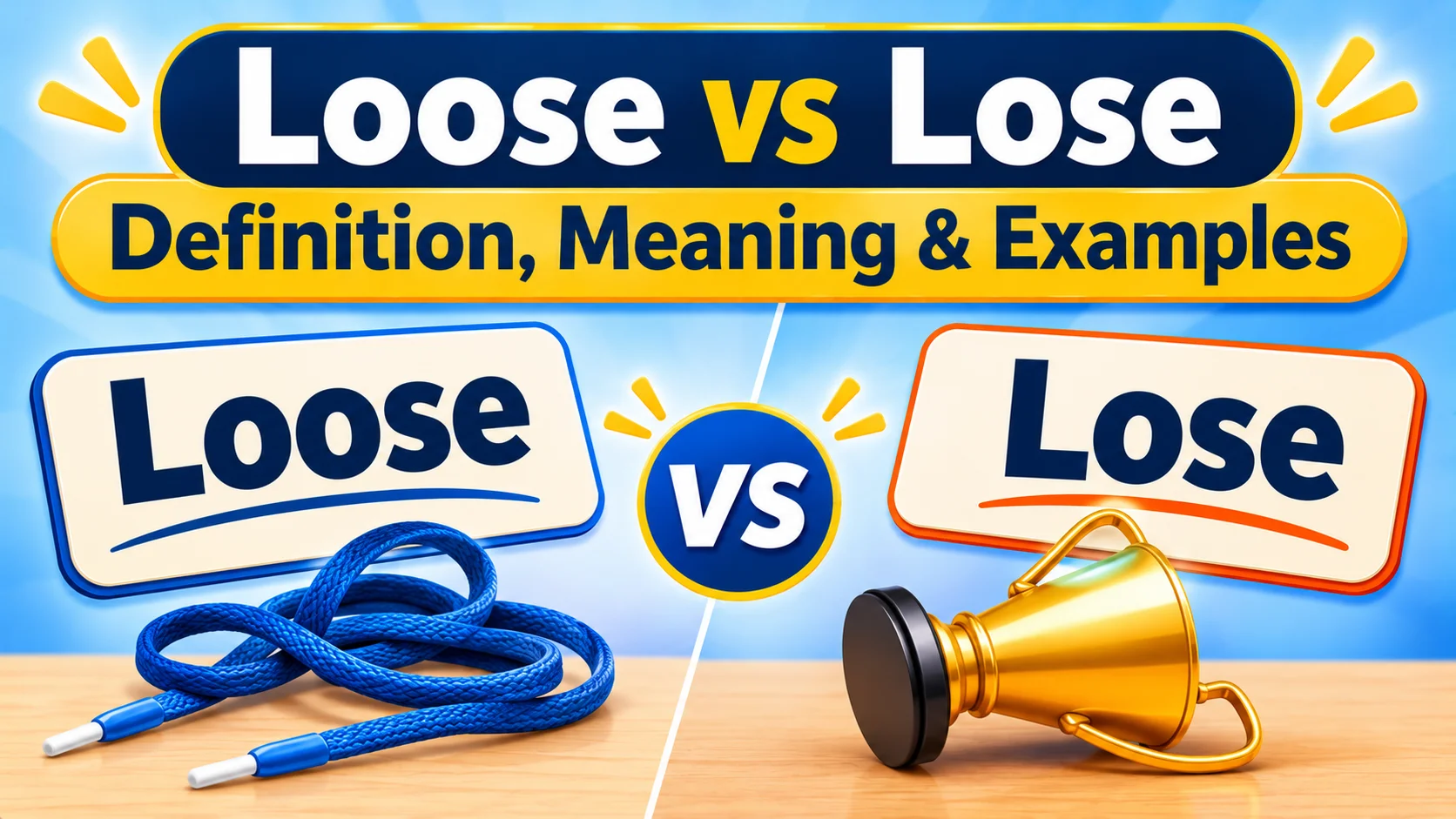
Loose vs lose is one of the most common spelling confusions in English. Although the words differ by only one letter, they have distinct meanings and grammatical functions. Loose usually describes something that is not tight, firmly attached, or restricted. Lose, on the other hand, is a verb that means to misplace something, fail to keep it, or fail to win. Confusing them can change the meaning of a sentence entirely. Whether you’re writing an email, completing an assignment, or sending a quick message, knowing which word belongs in each situation makes your writing clearer.
Part of the confusion comes from pronunciation. Both words contain the same long vowel sound, but their final consonants are different: loose ends with an /s/ sound, while lose ends with a /z/ sound. That small difference is easy to overlook, particularly when writing quickly. Their related forms create additional uncertainty: looser describes something less tight, whereas loser refers to someone or something that loses. Understanding these connections helps you recognize the correct spelling instead of relying on how a word looks at first glance.
This guide explains the meaning, definition, pronunciation, and grammatical use of loose and lose, with practical examples that show how they work in real sentences. You’ll also learn when loose can function as a verb, why the past tense of lose is lost, and how to distinguish loose, lose, looser, loser, and loosen. Along the way, we’ll examine common expressions, correct frequent spelling mistakes, and provide simple memory techniques. By the end, you’ll have a dependable way to choose the right word whenever the two become confusing.
Loose vs Lose: The Quick Answer
Both loose and lose are correctly spelled English words, but they serve different purposes.
- Loose is usually an adjective meaning not tight, not firmly fixed, or free from restriction.
- Lose is a verb meaning to misplace something, fail to keep something, or fail to win.
Consider these examples:
- The handle on this suitcase is loose. — The handle is not firmly attached.
- I don’t want to lose my suitcase. — I don’t want to misplace it.
- The team could lose the final. — The team might fail to win.
A simple way to remember the difference is to connect loose with extra space and lose with losing or no longer having something.
Quick rule: If you’re describing something that isn’t tight, use loose. If you’re talking about misplacing something or failing to win, use lose.
What Does “Loose” Mean?
Loose is primarily an adjective describing something that is not tight, firmly attached, securely held, or restricted. It can refer to physical objects, clothing, arrangements, rules, and even behavior.
For example:
- The lid is loose.
- She prefers loose clothing.
- The company has a loose management structure.
- The dog was running loose in the park.
Although the central idea is a lack of tightness or restraint, the precise meaning depends on what loose describes.
Loose as an Adjective: Not Tight or Secure
The most familiar use of loose describes something that does not fit tightly or is not firmly attached.
It commonly appears when talking about clothing, furniture, equipment, fastenings, and physical connections.
Examples:
- These shoes are too loose around my heels.
- One of the buttons on his coat is loose.
- The bicycle chain became loose during the ride.
- A loose tile needs to be repaired.
- The screw holding the shelf is loose.
In each sentence, loose describes the condition of a noun. It tells readers that something is not fitted, secured, or held as firmly as expected.
The word also has comparative and superlative forms:
- Loose: The knot is loose.
- Looser: This knot is looser than the other one.
- Loosest: That is the loosest connection in the system.
Practical distinction: Use loose when describing a condition. Use loosen when describing the action of making something less tight.
Loose Meaning Free, Unrestricted, or Not Confined
Loose can also describe a person, animal, or object that is free from restraint or no longer securely contained.
Examples:
- The horse broke loose from its enclosure.
- The dog was running loose near the entrance.
- The children were allowed to run loose in the garden.
- The prisoner was finally set loose.
- The boat came loose from its mooring.
This meaning is closely connected to the idea of something not being held firmly in place.
It also appears in expressions such as let loose and break loose. These phrases can describe becoming free, relaxing restrictions, or expressing feelings without restraint.
Loose Meaning Relaxed, Informal, or Not Strict
Not every use of loose involves physical objects. The adjective can also describe something that lacks strict organization, precision, or control.
Examples:
- The project follows a loose schedule.
- They agreed to a loose set of guidelines.
- The article offers a loose interpretation of the original text.
- The group has a loose organizational structure.
- He has a loose approach to planning.
Here, loose means flexible, informal, or not precisely defined.
The intended meaning is not necessarily negative. A loose schedule, for instance, may be useful when a project requires flexibility. However, a loose interpretation of evidence may suggest that the explanation is not sufficiently precise.
Loose as a Verb: To Release or Set Free
Although loose is most commonly an adjective, it can also function as a verb. As a verb, it means to release, let go, or set free.
This usage is less common in modern everyday English and often appears in literary, historical, or formal contexts.
Examples:
- The guard loosed the dogs.
- The archer loosed an arrow.
- The sailors loosed the ropes securing the vessel.
- The speaker loosed a stream of criticism.
The verb has these forms:
| Verb form | Example |
| Base form | Loose the rope. |
| Third-person singular | He looses the animal. |
| Past tense | She loosed the arrow. |
| Past participle | The animal was loosed. |
| Present participle | They are loosing the restraints. |
Do not confuse this relatively uncommon verb with lose. Although both can involve something no longer being held or retained, their meanings and standard grammatical uses are different.
What Does “Lose” Mean?
Lose is a verb that describes failing to keep, find, retain, or win something. It can refer to physical possessions, competitions, opportunities, relationships, abilities, or changes in quantity.
Unlike loose, which usually describes a condition, lose expresses an action, process, or result.
Examples:
- Don’t lose your passport.
- Our team might lose the championship.
- She doesn’t want to lose her job.
- The company could lose money this year.
The object of the verb often makes its intended meaning clear.
Lose Meaning to Misplace Something
One of the most common meanings of lose is to misplace something and become unable to find it.
Examples:
- I always lose my keys when I’m in a hurry.
- Be careful not to lose your library card.
- He lost his phone somewhere at the station.
- Don’t lose the document before the meeting.
There is a useful distinction between lose and misplace.
To misplace something generally means to put it somewhere and then forget where it is. To lose something can describe the same situation, but it can also mean that the item is permanently gone or no longer available.
For example:
- I misplaced my notebook, but I found it under the desk.
- She lost her notebook during the journey and never recovered it.
The words overlap, but lose has a broader range of meanings.
Lose Meaning to Fail to Win
In sports, competitions, elections, games, and other contests, lose means to fail to achieve victory.
Examples:
- Our school team may lose the final.
- He doesn’t like to lose at chess.
- The candidate lost the election.
- They played well but still lost the match.
- A good competitor learns from losing.
The opposite of lose in this context is win.
Compare:
- Our team won the tournament.
- Our team lost the tournament.
You can also use lose to when identifying the opponent who defeats someone:
- The defending champions lost to their rivals.
- She lost to the top-ranked player.
Lose Meaning to No Longer Have Something
Lose is not limited to misplaced objects or competitions. It can describe no longer having something that was previously available or possessed.
Examples:
- He doesn’t want to lose his job.
- The company lost several important clients.
- She lost confidence in the proposal.
- They lost contact after moving to different cities.
- We may lose the opportunity if we delay.
The thing being lost can be physical, emotional, professional, or abstract.
This is why lose appears in so many common expressions. People can lose trust, interest, patience, confidence, control, or hope without physically misplacing anything.
Lose Meaning to Reduce or Decrease
Another common use of lose describes a reduction in quantity, value, speed, or intensity.
Examples:
- The vehicle began to lose speed.
- The business lost money during the first quarter.
- The battery loses power over time.
- The fabric may lose its color after repeated washing.
- The conversation began to lose its focus.
The phrase lose weight is also a standard expression meaning to experience a reduction in body weight.
The distinction is straightforward:
- Lose weight — to experience a reduction.
- Loose clothing — clothing that is not tight.
The two expressions are not interchangeable.
Lose as a Verb: Forms and Tenses
One reason lose causes spelling problems is that its past-tense form does not follow the usual pattern of adding -ed.
It is an irregular verb.
| Verb form | Correct spelling | Example |
| Base form | Lose | Don’t lose your ticket. |
| Third-person singular | Loses | She loses interest quickly. |
| Past tense | Lost | He lost his wallet. |
| Past participle | Lost | They have lost the receipt. |
| Present participle | Losing | We are losing valuable time. |
Notice that the past tense and past participle are both lost, not loosed.
For example:
- Correct: I lost my notebook yesterday.
- Incorrect: I loosed my notebook yesterday.
The spelling loosed belongs to the separate verb loose, meaning to release. It is not the past tense of lose.
Loose vs Lose: Key Differences at a Glance
The following table summarizes the most important differences.
| Feature | Loose | Lose |
| Main part of speech | Adjective | Verb |
| Main meaning | Not tight, secure, or restricted | Misplace, fail to keep, or fail to win |
| Typical function | Describes a person, object, or condition | Expresses an action or result |
| Opposite | Tight, secure, fixed | Win, find, keep |
| Final consonant sound | /s/ | /z/ |
| Past-tense form | Loosed (as a verb meaning released) | Lost |
| Related forms | Looser, loosest, loosely, loosen | Loses, losing, lost, loser |
| Example | The handle is loose. | Don’t lose the handle. |
Difference in Meaning
The simplest way to understand the distinction is to compare sentences that use both words.
✅Example 1: Clothing
- My trousers are loose. — They do not fit tightly.
- I don’t want to lose my trousers. — I don’t want to misplace them.
Example 2: Equipment
- The cable is loose. — It is not firmly connected.
- Don’t lose the cable. — Do not misplace it.
Example 3: Competition
- The team has a loose defensive structure. — Its organization is not very strict.
- The team may lose the match. — It may fail to win.
The extra o in loose does not make it a form of lose. They are separate words with different meanings.
Difference in Grammar
The grammatical roles are just as important as the definitions.
Loose usually functions as an adjective. It describes a noun:
- A loose button
- Loose clothing
- A loose connection
Lose functions as a verb. It describes what someone or something does or experiences:
- Lose a match
- Lose a document
- Lose confidence
A useful editing question is: Am I describing something, or am I expressing an action?
If you’re describing a condition, loose may be the right choice. If you’re expressing the loss of something, lose is usually needed.
Difference in Pronunciation
Although the words look similar, they do not end with the same sound.
| Word | Pronunciation | Final sound | Similar sound |
| Loose | /luːs/ | /s/ | Bus |
| Lose | /luːz/ | /z/ | Zoo |
Both words begin with the same long vowel sound, represented by /uː/. The difference occurs at the end:
- Loose: The final sound is unvoiced, like the s in house.
- Lose: The final sound is voiced, like the z in zebra.
Try saying loose and lose aloud slowly. Pay attention to the final consonant rather than the vowel. This can help you recognize the difference when speaking, although pronunciation alone is not always enough to determine spelling.
Loose, Lose, Looser, Loser, and Loosen: Don’t Mix Them Up
The original spelling confusion often extends to four related forms. Understanding their grammatical roles prevents mistakes in sentences where the meanings are closely connected.
Loose vs Looser
Looser is the comparative form of the adjective loose. It means less tight, less firmly attached, or less restricted than something else.
Examples:
- These shoes are looser than my previous pair.
- The second knot is looser than the first.
- The new rules are looser than the old regulations.
Use looser when comparing two conditions.
Do not use it when you mean someone who has failed to win a competition.
Lose vs Loser
Loser is a noun formed from the verb lose. It commonly refers to someone who does not win a competition or contest.
Examples:
- The loser of the match congratulated the winner.
- Every competition has a winner and a loser.
- The losing team accepted the result.
In informal conversation, loser can also be used as an insult. Because of that, be careful when applying it to people outside a neutral discussion of competitions.
Remember:
- Lose: A verb describing an action or result.
- Loser: A noun describing someone or something that loses.
Loose vs Loosen
Loosen is a verb meaning to make something less tight, firm, strict, or restrictive.
Examples:
- The screw is loose.
- Please loosen the screw.
- The manager decided to loosen the restrictions.
- The mechanic loosened the bolt.
The difference is grammatical:
- Loose describes the condition.
- Loosen describes the action that changes the condition.
This distinction is useful because writers sometimes try to use loose as a verb when loosen is the natural modern choice.
Comparison Table: Loose, Lose, Looser, Loser, and Loosen
| Word | Part of speech | Meaning | Example |
| Loose | Adjective | Not tight or secure | The lid is loose. |
| Lose | Verb | Misplace or fail to win | Don’t lose your ticket. |
| Looser | Comparative adjective | Less tight | This knot is looser. |
| Loser | Noun | Someone who loses | The loser accepted the result. |
| Loosen | Verb | Make less tight | Loosen the screw. |
Common Expressions and Phrases With Loose and Lose
Both words appear in everyday expressions. Learning these phrases helps you understand their meanings in context and recognize the correct spelling more quickly.
Common Expressions With “Loose”
| Expression | Meaning | Example |
| Loose change | Coins or small amounts of money | I found some loose change in my pocket. |
| Loose ends | Unfinished details or matters | We need to tie up a few loose ends. |
| Loose clothing | Clothing that does not fit tightly | He prefers loose clothing. |
| Loose connection | A connection that is not secure | The monitor stopped working because of a loose connection. |
| Loose cannon | Someone who behaves unpredictably | The manager considered him a loose cannon. |
| Break loose | Escape from restraint | The boat broke loose from its anchor. |
| Let loose | Allow something or someone to act freely | The children let loose after the ceremony. |
| Play fast and loose | Act carelessly or without following rules | The company played fast and loose with the facts. |
Common Expressions With “Lose”
| Expression | Meaning | Example |
| Lose control | No longer be in control | The driver began to lose control of the vehicle. |
| Lose interest | Stop being interested | He started to lose interest in the project. |
| Lose hope | Stop believing that something will happen | Don’t lose hope after one setback. |
| Lose track of time | Stop noticing how much time has passed | I lost track of time while reading. |
| Lose one’s temper | Become angry | She rarely loses her temper. |
| Lose touch | Stop communicating or maintaining contact | We lost touch after graduation. |
| Lose sight of | Stop seeing or remembering something important | Don’t lose sight of your main objective. |
| Lose money | Experience a financial loss | The business lost money last year. |
✅Common Mistakes With Loose and Lose (And How to Fix Them)
These spelling errors often happen because people type quickly or choose a word based on how it looks rather than what it means. The following examples show how to correct them.
Writing “Loose Weight” Instead of “Lose Weight”
This is one of the most recognizable mistakes.
- Incorrect: She wants to loose weight.
- Correct: She wants to lose weight.
The sentence describes a reduction, so it requires the verb lose. The word loose would describe something that is not tight.
Compare:
- The jacket is loose.
- The word should be lose.
Writing “Don’t Loose Hope” Instead of “Don’t Lose Hope”
When talking about no longer having hope or confidence, use the verb lose.
- Incorrect: Don’t loose hope.
- Correct: Don’t lose hope.
The same rule applies to similar expressions:
- Don’t lose confidence.
- Don’t lose patience.
- Don’t lose focus.
Each sentence describes something that someone might stop having or maintaining.
Confusing “Loose” With “Lose” in Past-Tense Sentences
The past tense of lose is lost, not loosed.
- Incorrect: I loosed my wallet yesterday.
- Correct: I lost my wallet yesterday.
However, loosed is a legitimate word when it comes from the less common verb loose, meaning to release.
For example:
The archer loosed an arrow.
This means the archer released the arrow. It does not mean the archer misplaced it.
Using “Looser” When You Mean “Loser”
These words have different grammatical roles.
- Incorrect: The looser of the match received a medal.
- Correct: The loser of the match received a medal.
On the other hand:
- Correct: This knot is looser than the other one.
The first sentence needs a noun describing the person who lost. The second needs a comparative adjective describing the knot.
Choosing by Spelling Instead of Meaning
A common editing mistake is to look at the two words and choose the one that seems familiar without checking the sentence.
Instead, ask yourself:
- Does the word describe something that is not tight or secure?
- Does the sentence describe losing, misplacing, or failing to win something?
- Is the intended word a noun, verb, or adjective?
- Does the sentence require a related form such as loosen, looser, or loser?
Identifying the intended meaning first is more reliable than trying to remember the spelling in isolation.
Easy Ways to Remember the Difference Between Loose and Lose
A useful memory trick should be simple enough to apply while writing. These techniques connect each word to its meaning, sound, or opposite.
Remember the Extra “O” in Loose
The extra o in loose can remind you of extra room or space.
Think of:
- Loose clothing with extra room.
- A loose screw that is not firmly attached.
- A loose schedule with flexibility.
When something has room to move or is not tightly secured, loose is likely the correct word.
Remember the “Z” Sound in Lose
The word lose ends with a /z/ sound, like the beginning sound in zoo.
Say these words aloud:
- Lose
- Zoo
- Use (verb pronunciation)
The shared voiced /z/ sound can help you remember the final consonant in lose.
By contrast, loose ends with the unvoiced /s/ sound heard in bus.
Use the Opposite-Word Test
Thinking of the opposite can quickly identify the right spelling.
| If the opposite is… | Choose… | Example |
| Tight | Loose | The shirt is loose. |
| Secure | Loose | The handle is loose. |
| Win | Lose | Our team might lose. |
| Find | Lose | Don’t lose your keys. |
| Keep | Lose | I don’t want to lose this opportunity. |
This technique works particularly well in short sentences where the intended meaning is clear.
Ask Whether You Are Describing Something or Doing Something
One final check is to identify the word’s role.
- If you’re describing a condition, consider loose.
- If you’re describing an action or outcome involving loss, consider lose.
- If you’re describing the action of making something less tight, use loosen.
For example:
- The connection is loose. — Description.
- The connection may fail, and we could lose the signal. — Action or result.
- Please loosen the connection. — Action that makes something less tight.
Loose vs Lose in Real-Life Writing
Knowing the definitions is useful, but choosing the right word in context is what matters when writing for different audiences.
In Emails and Professional Communication
Professional messages often involve files, documents, connections, deadlines, and opportunities. Both words can appear naturally in these situations.
Examples:
- Please check whether the cable is loose.
- We don’t want to lose the client’s documents.
- The report contains a loose interpretation of the figures.
- The company could lose an important contract.
- A loose connection may interrupt the presentation.
Use loose when describing a condition or an informal arrangement. Use lose when discussing something that may be misplaced, missed, or no longer retained.
In Academic and Formal Writing
Both words have useful applications in academic writing.
Examples:
- The researcher offered a loose interpretation of the results.
- The experiment may lose accuracy if the equipment is not calibrated.
- The argument follows a loose structure.
- The author does not want to lose the original meaning of the passage.
In formal writing, precise word choice matters because the two words can communicate entirely different ideas. Avoid using loose as a substitute for lose simply because the words sound similar.
In Everyday Conversation and Social Media
Informal messages are particularly vulnerable to spelling mistakes because people often type without checking their sentences.
Examples:
- My shoelaces are loose.
- I don’t want to lose my phone again.
- Don’t lose the game!
- That button is loose.
- I always lose track of time when watching films.
A quick reread can catch most of these errors. Look at the meaning of the sentence, not just the individual word.
Practice: Test Your Understanding of Loose vs Lose
The best way to remember the difference is to apply it. Try completing these sentences before checking the answers.
Fill in the Blanks
Choose the correct word or form: loose, lose, looser, loser, or loosen.
- Don’t ______ your library card.
- The handle on this bag is too ______.
- Our team might ______ the final match.
- One of the screws has become ______.
- This knot is ______ than the previous one.
- The ______ of the competition congratulated the winner.
- Please ______ the lid before removing it.
- I don’t want to ______ my place in the queue.
- The dog managed to break ______ from its enclosure.
- The company could ______ several important clients.
Answers and Explanations
| No. | Answer | Explanation |
| 1 | Lose | The sentence refers to misplacing a card. |
| 2 | Loose | The adjective describes a handle that is not secure. |
| 3 | Lose | The team may fail to win. |
| 4 | Loose | The screw is not firmly attached. |
| 5 | Looser | The sentence compares two levels of tightness. |
| 6 | Loser | The noun refers to someone who does not win. |
| 7 | Loosen | The verb means to make the lid less tight. |
| 8 | Lose | The speaker does not want to forfeit or no longer have a place. |
| 9 | Loose | The expression break loose means to escape restraint. |
| 10 | Lose | The company may no longer have those clients. |
If you missed a few answers, focus on the grammatical role of each word. That is more useful than memorizing a list of isolated sentences.
Conclusion
Understanding loose vs lose comes down to recognizing what each word does in a sentence. Loose generally describes something that is not tight, firmly attached, or restricted, while lose is a verb associated with misplacing something, failing to win, or no longer having something. Their related forms—looser, loser, and loosen—follow different grammatical patterns, so pay attention to those distinctions as well. One final actionable tip: When proofreading, replace loose with tight or lose with win or keep to test the intended meaning. A common mistake to avoid is writing loose weight instead of lose weight. Remember the meaning first, and the correct spelling will become much easier to recognize.
FAQs
Q1. Is “loose” ever a verb?
Yes. Loose can function as a verb meaning to release or set something free, although this use is less common in everyday English. For example, The archer loosed an arrow. Do not confuse this verb with lose, whose past tense is lost.
Q2. Is “loose” a homophone of “lose”?
No. They are not homophones because their final consonant sounds differ. Loose ends in /s/, while lose ends in /z/. They share a similar vowel sound and spelling pattern, which explains why writers sometimes confuse them.
Q3. What is the difference between “lost” and “loose”?
Lost is the past tense and past participle of lose. Loose usually describes something that is not tight or secure. For example, I lost my keys describes misplacing them, while The keys are loose in the drawer describes how they are arranged.
Q4. Is “loose” the opposite of “lose”?
No. The words have different meanings, so they do not form an opposite pair. Loose is generally the opposite of tight or secure, while lose is the opposite of win, find, or keep, depending on the context.
Q5. How can I check whether I have used loose or lose correctly?
Read the sentence and identify what you mean. If you’re describing something that is not tight, use loose. If you’re describing misplacing something, failing to win, or no longer having something, use lose. A spelling or grammar checker can help, but context remains essential.