

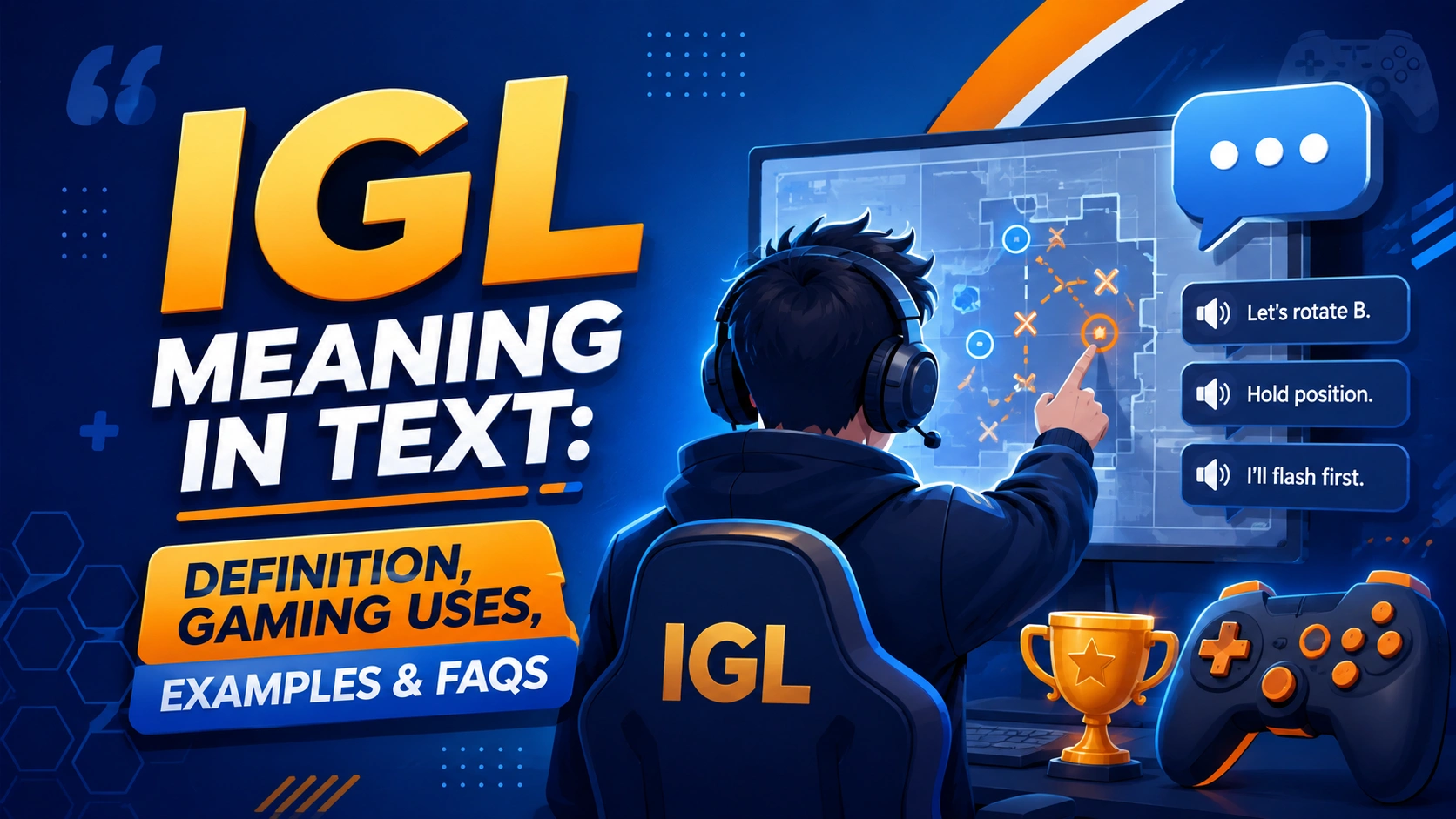
IGL meaning in text is usually “In-Game Leader.” In gaming conversations, an IGL is the player who takes primary responsibility for calling strategies, coordinating teammates, making tactical decisions, and adapting the team’s plan during a match. The term is especially common in competitive team games and esports.
If someone writes, “Who’s the IGL?”, they are generally asking which teammate is responsible for making the main calls. If a player says, “Let the IGL call,” they mean the team should follow the designated shot-caller rather than having several players give conflicting instructions. The exact responsibilities can vary by game, team, and competitive level, so IGL does not simply mean “the best player.”
This guide explains what IGL means in texting and gaming chat, what an in-game leader actually does, how the role differs from a captain or ordinary teammate, where you are likely to encounter the abbreviation, and how to understand it from context. You’ll also find practical examples, related gaming terms, common mistakes, and answers to the questions people most often ask about IGL. Quick answer: IGL = In-Game Leader. It refers to the player who primarily directs a team’s strategy and tactical decisions during a match.
What Does IGL Mean in Text and Chat?
In gaming-related text, IGL stands for “In-Game Leader.” It is both a role and a common abbreviation used by players, spectators, commentators, and esports communities.
The British Esports glossary defines an IGL as the player responsible for deciding team tactics and giving instructions to teammates, comparing the role to a captain in traditional sports.
In practical terms, the IGL is often the person who answers questions such as:
- Where should the team go?
- Should the team attack, defend, rotate, or wait?
- What strategy should be used?
- How should teammates respond to new information?
- When should the team change its original plan?
- Who should take a particular position or action?
The role is most obvious in organized team play, where several players need to make coordinated decisions quickly.
IGL Full Form
| Term | Meaning | Where you’ll see it |
| IGL | In-Game Leader | Gaming chats, esports, Discord, team discussions |
| Shot-caller | Player who makes tactical calls | Competitive gaming |
| Caller | A player who directs plays | Team games |
| Team captain | Person with leadership responsibility | Gaming and traditional sports |
| Coach | Person who helps prepare and guide a team | Organized esports |
These terms overlap, but they are not always interchangeable. An IGL specifically refers to leadership during gameplay, while a coach may work primarily outside the match.
What Does an In-Game Leader Actually Do?
Calling yourself the IGL is easy. Doing the job effectively is much harder.
An IGL has to process information from teammates, understand the current game state, choose a course of action, and communicate that decision clearly—often within seconds.
One esports explanation describes the IGL as the player who calls the shots and determines what teammates should do during each round.
Making Tactical Calls
The most recognizable responsibility is shot-calling.
For example, an IGL might decide:
“We’ve lost control of the original route. Reset and rotate.”
The important part is not the exact wording. The IGL is turning scattered information into one coordinated team decision.
Adapting When the Original Plan Fails
A strong IGL does not blindly follow a strategy simply because it was planned before the match.
Suppose a team intends to attack from one direction, but opponents unexpectedly stack that area. The IGL may change the plan and direct teammates elsewhere.
That ability to make a useful decision after new information appears is one of the most important parts of the role.
Managing Team Communication
An IGL also helps prevent communication from becoming chaotic.
In a five-player team, five people may have different ideas. If everyone talks over everyone else, useful information can get buried.
A good IGL helps establish a structure:
- Teammates provide relevant information.
- The IGL evaluates it.
- The IGL makes a decision.
- Teammates execute the call.
- The team adjusts if circumstances change.
The IGL therefore needs more than game knowledge. Communication, composure, decision-making, and situational awareness are central to the role.
IGL vs Captain vs Shot-Caller: What’s the Difference?
These terms are sometimes used as if they mean exactly the same thing, but there can be important distinctions.
| Role/term | Main responsibility | Always leads during gameplay? |
| IGL | Makes or coordinates tactical in-game decisions | Usually |
| Shot-caller | Gives tactical calls | Usually |
| Captain | Broader leadership of the team | Not necessarily |
| Coach | Preparation, strategy, development, feedback | Usually outside active gameplay |
| Star player | Provides high-level individual performance | No |
| Support player | Performs a specific team-support function | No |
An IGL can also be the captain, but the two roles do not have to be identical.
Likewise, an IGL does not necessarily have the highest individual statistics. A player can be an excellent aimer, scorer, or mechanical talent without being the person who directs the team’s strategy.
Why the Best Player Isn’t Automatically the IGL
Leadership and individual performance require different strengths.
A highly skilled player might focus on winning individual engagements, while the IGL focuses on the larger tactical picture.
That is why teams may choose an IGL based on:
- Game sense
- Communication
- Tactical knowledge
- Map awareness
- Decision-making
- Ability to stay calm
- Understanding of teammates
- Confidence under pressure
A good IGL is not simply the person who talks the most.
How IGL Is Used in Gaming Conversations
The abbreviation becomes especially useful because gaming communication often needs to be fast.
Instead of writing:
“Who is responsible for making the main strategic decisions during the match?”
players can simply ask:
“Who’s IGL?”
That makes IGL a convenient piece of gaming vocabulary rather than ordinary internet slang.
Example 1: Finding the Team Leader
Player A: “We need someone to call rotations.”
Player B: “Who’s IGL?”
Here, the player is asking who has the main shot-calling responsibility.
Example 2: Following the Strategy
Player A: “Don’t all push at once. Let the IGL call it.”
The message means that teammates should avoid making independent moves and wait for the team’s designated caller.
Example 3: Looking for an IGL
Player A: “Need one more for ranking. Preferably IGL.”
The speaker is looking for a player who can take the leadership and coordination role.
Example 4: Discussing Team Performance
Player A: “Their IGL completely changed the game in the second half.”
Here, IGL is being used as a noun referring to the person performing the role.
Example 5: Asking About a Player
Player A: “Is she the IGL for that team?”
Player B: “Yeah, she handles most of the calls.”
The abbreviation is functioning naturally as a job or team-role label.
Where You’re Most Likely to See “IGL”
IGL is strongly associated with team-based competitive gaming, particularly games where coordinated tactics and real-time decision-making matter.
It appears in:
- Gaming chats
- Esports discussions
- Team Discord servers
- Match commentary
- Competitive gaming forums
- Livestream conversations
- Tournament discussions
- Player interviews
- Team recruitment messages
- Social-media posts about esports
The British Esports glossary specifically includes IGL among esports terminology, while gaming glossaries commonly describe it as the in-game leader or strategic shot-caller.
IGL in Discord
On Discord, you might see:
“Looking for an IGL for tonight.”
or:
“Our IGL is offline.”
The meaning is normally straightforward because the surrounding conversation is already about gaming.
IGL in Social Media Posts
An esports fan might write:
“That IGL read the opponent perfectly.”
Or:
“They need a better IGL.”
Again, the abbreviation refers to the player’s tactical leadership rather than their general popularity or status.
IGL in Streaming Communities
Viewers may use IGL when discussing how a streamer leads a team:
“He’s actually a really good IGL.”
This usually comments on decision-making and team coordination, not simply individual skill.
Is IGL Used in Every Game?
No.
The term is most useful when a game or team has a meaningful strategic leadership structure.
It is particularly associated with competitive team games, including tactical shooters and other organized multiplayer titles. Sources discussing the term commonly connect IGL with games such as Counter-Strike, VALORANT, Apex Legends, Rainbow Six Siege, Fortnite, and other team-based competitive environments.
However, the role can look different depending on the game.
In Tactical Shooters
An IGL may coordinate:
- Round strategy
- Map control
- Rotations
- Attacks and defenses
- Timing
- Resource usage
- Mid-round adjustments
In Battle Royale Teams
The IGL may make broader calls about:
- Where to move
- When to rotate
- Which fights to take
- When to disengage
- Positioning
- Team priorities
In Other Team Games
The term can refer more generally to whoever provides the main strategic direction.
The important point is that IGL describes a leadership function, not one fixed list of tasks that applies identically to every game.
Why Do Teams Need an IGL?
The main reason is simple: coordination becomes difficult when everyone is making separate decisions.
Imagine four teammates see the same situation but interpret it differently.
One wants to attack.
Another wants to retreat.
A third wants to wait.
A fourth wants to rotate.
Without some decision-making structure, the team can hesitate or split apart.
An IGL provides a central point for tactical decisions.
Expert insight: A good IGL does not eliminate team input. The best systems usually depend on teammates providing useful information while the caller turns that information into a coordinated plan.
This distinction matters. An IGL is not necessarily a dictator. Their effectiveness depends heavily on receiving accurate information from the rest of the team.
What Makes a Good IGL?
A strong IGL usually combines several abilities rather than relying on one skill.
| Skill | Why it matters |
| Game knowledge | Helps the leader understand available strategies |
| Communication | Turns decisions into clear instructions |
| Map awareness | Helps identify positioning and movement options |
| Decision-making | Allows quick choices under pressure |
| Adaptability | Makes it possible to change plans |
| Composure | Prevents panic from spreading through the team |
| Team awareness | Helps the IGL understand teammates’ strengths |
| Leadership | Encourages coordinated execution |
Professional esports discussions often emphasize that IGL work involves much more than simply giving commands. For example, former professional VALORANT IGL FNS has described the role in terms of directing players, tracking what is happening across the map, maintaining focus, and making strategic decisions.
IGL Does Not Mean “The Person Who Controls Everyone”
One of the most common misunderstandings is treating an IGL as someone who must personally dictate every action.
That is not necessarily how effective teams operate.
A teammate might have information the IGL does not. For example, a player may notice something important before the rest of the team does. The IGL needs to listen, evaluate, and respond.
In other words:
Information comes from the team; strategic coordination often comes from the IGL.
This is also why good communication goes in both directions.
Can a Team Have More Than One IGL?
Yes.
Although many teams use one primary IGL, leadership structures can vary.
Some teams may use:
- A primary IGL
- A secondary caller
- Shared shot-calling
- Different players responsible for different phases
- A player who takes over certain decisions in specific situations
Community discussions around competitive gaming have also described teams using primary and secondary IGL arrangements rather than treating leadership as an absolutely fixed one-person responsibility.
So, if someone says:
“We have two IGLs.”
that is not automatically contradictory. It may describe a team where tactical leadership is shared.
IGL vs Similar Gaming Terms
Understanding related vocabulary makes the abbreviation much easier to recognize.
| Term | Meaning | Main distinction |
| IGL | In-Game Leader | Strategic leader during gameplay |
| Shot-caller | Tactical caller | Often used almost interchangeably with IGL |
| Captain | Team leader | Can include responsibilities outside gameplay |
| Entry | Player who initiates an engagement | Tactical role, not necessarily leadership |
| Support | Player who enables teammates | Usually a specialized gameplay role |
| Fragger | Player focused on securing eliminations | Individual/team combat role |
| Coach | Person who prepares and guides a team | Usually not actively controlling the game |
| IGL | In-Game Leader | Focuses specifically on in-match leadership |
The exact terminology varies between games and teams, so context matters.
Common Mistakes When Using IGL
1. Assuming IGL Means “Best Player”
It doesn’t.
A player can be mechanically exceptional without being an effective strategic leader.
2. Assuming the IGL Makes Every Decision
Teammates still contribute information and sometimes make local decisions themselves.
3. Treating IGL and Captain as Perfect Synonyms
They can overlap, but a captain may have broader responsibilities.
4. Using IGL in a Non-Gaming Conversation Without Context
If you suddenly text:
“Who’s the IGL?”
to someone who does not know the gaming terminology, they may have no idea what you mean.
5. Assuming Every Team Has a Formal IGL
Casual teams may not designate anyone officially. One player may simply become the person who naturally calls strategies.
How to Know What IGL Means From Context
If you encounter IGL and aren’t sure what it means, look at the surrounding words.
| Context | Most likely interpretation |
| “Who’s the IGL?” + team discussion | In-game leader |
| “Need an IGL for ranked” | In-game leader |
| “Their IGL made a great call” | In-game leader |
| “IGL for the tournament” | In-game leader |
| “Our IGL is offline” | In-game leader |
| Acronym appearing in a completely unrelated field | Check the surrounding context |
A useful rule is:
If the conversation involves teammates, strategy, rounds, rotations, calls, or esports, IGL almost certainly means “In-Game Leader.”
If the conversation has nothing to do with gaming, don’t automatically assume the same expansion. Acronyms can have multiple meanings in different industries and communities.
Is IGL Slang or a Gaming Acronym?
IGL is better described as a gaming/esports acronym or abbreviation than as general slang.
That distinction is useful.
Words such as casual internet slang may express an emotion, reaction, or social attitude. IGL instead identifies a specific team role.
It is therefore closer to terms such as:
- DPS
- NPC
- FPS
- HUD
- KDA
- IGN
than to conversational expressions such as “LOL” or “OMG.”
That also explains why someone unfamiliar with gaming may not understand it immediately.
Is IGL Rude or Offensive?
No. IGL is not inherently rude or offensive.
It is normally a neutral term describing a role.
Tone depends on the sentence around it.
For example:
“Who’s IGL?”
is neutral.
“Our IGL needs to make better calls.”
is critical but not inherently offensive.
“That IGL carried the team tactically.”
is positive.
The abbreviation itself does not create the tone.
How Should You Respond When Someone Says “IGL”?
The best response depends on what they are asking.
If Someone Asks, “Who’s IGL?”
You can answer with the player’s role or name:
“Alex is IGL.”
If Someone Says, “Need an IGL”
You could respond:
“I can call.”
or:
“I’m comfortable leading.”
If Someone Says, “Their IGL is really good”
A natural response might be:
“Yeah, their mid-game calls were solid.”
If You Don’t Understand the Term
There is nothing wrong with asking:
“What does IGL mean here?”
In a gaming conversation, this is usually enough to clarify the abbreviation immediately.
Is IGL Appropriate in School or Professional Communication?
It depends on the subject.
If you’re discussing an esports club, gaming competition, or tournament, IGL can be perfectly appropriate.
For example:
“Our IGL will coordinate the team during the tournament.”
But in a formal document for a general audience, spell it out the first time:
In-Game Leader (IGL)
After that, using IGL is much clearer because readers have already been given the definition.
For formal writing, avoid assuming that every reader knows gaming terminology.
A Simple IGL Decision Checklist
If you’re trying to determine whether someone is acting as an IGL, look for these signs:
- They regularly make strategic calls.
- Teammates look to them for direction.
- They coordinate team movement.
- They adapt plans when circumstances change.
- They communicate the team’s priorities.
- They understand the broader tactical situation.
- They help organize teammates rather than only focusing on personal performance.
Someone does not need to satisfy every point to contribute leadership, but these characteristics help distinguish in-game leadership from ordinary teamwork.
Conclusion :
IGL meaning in text is usually “In-Game Leader,” especially when the conversation involves gaming, esports, team strategy, or competitive matches. The IGL is the player who takes primary responsibility for tactical calls, coordination, and strategic decisions during gameplay. The role can overlap with captain or shot-caller, but those terms are not always identical.The most important point is that an IGL is not simply the best player or the loudest teammate. Effective in-game leadership depends on understanding the situation, listening to teammates, making timely decisions, communicating clearly, and adapting when a plan stops working. The role can also be shared or structured differently across teams.One final actionable tip: when you see “IGL,” check whether the surrounding conversation mentions teams, strategy, rounds, or esports. A common mistake to avoid is assuming the abbreviation has the same meaning outside gaming contexts. In the right conversation, though, IGL is straightforward: the person helping turn individual players into one coordinated team.
FAQs
Q1. What does IGL mean in gaming?
IGL means “In-Game Leader.” It refers to the player who primarily handles strategic calls and coordinates teammates during a match. The exact responsibilities vary by game, but the role generally involves decision-making, communication, tactical planning, and adapting the team’s strategy as the match develops.
Q2. Is IGL the same as captain?
Not always. An IGL leads tactical decisions during gameplay, while a captain may have broader leadership responsibilities. One person can hold both roles, but a team can also separate them. The terminology depends on the game, organization, and team’s internal structure.
Q3. What is another word for IGL?
The closest alternatives are shot-caller, caller, or, in some contexts, team leader. “Shot-caller” is particularly close because it emphasizes the player’s responsibility for making tactical decisions. However, these terms are not guaranteed to have exactly the same responsibilities on every team.
Q4. Does every esports team have an IGL?
No. Many organized competitive teams have a designated IGL, but leadership structures differ. Some teams use a primary IGL, while others share or divide shot-calling responsibilities. Casual groups may not formally assign the role at all, even if one player naturally directs the team.
Q5. Does IGL mean the best player on a team?
No. IGL describes leadership, not individual skill level. A team’s strongest mechanical player may not be its best strategist or communicator. Effective IGLs generally need game knowledge, situational awareness, communication skills, adaptability, and the confidence to make decisions under pressure.