

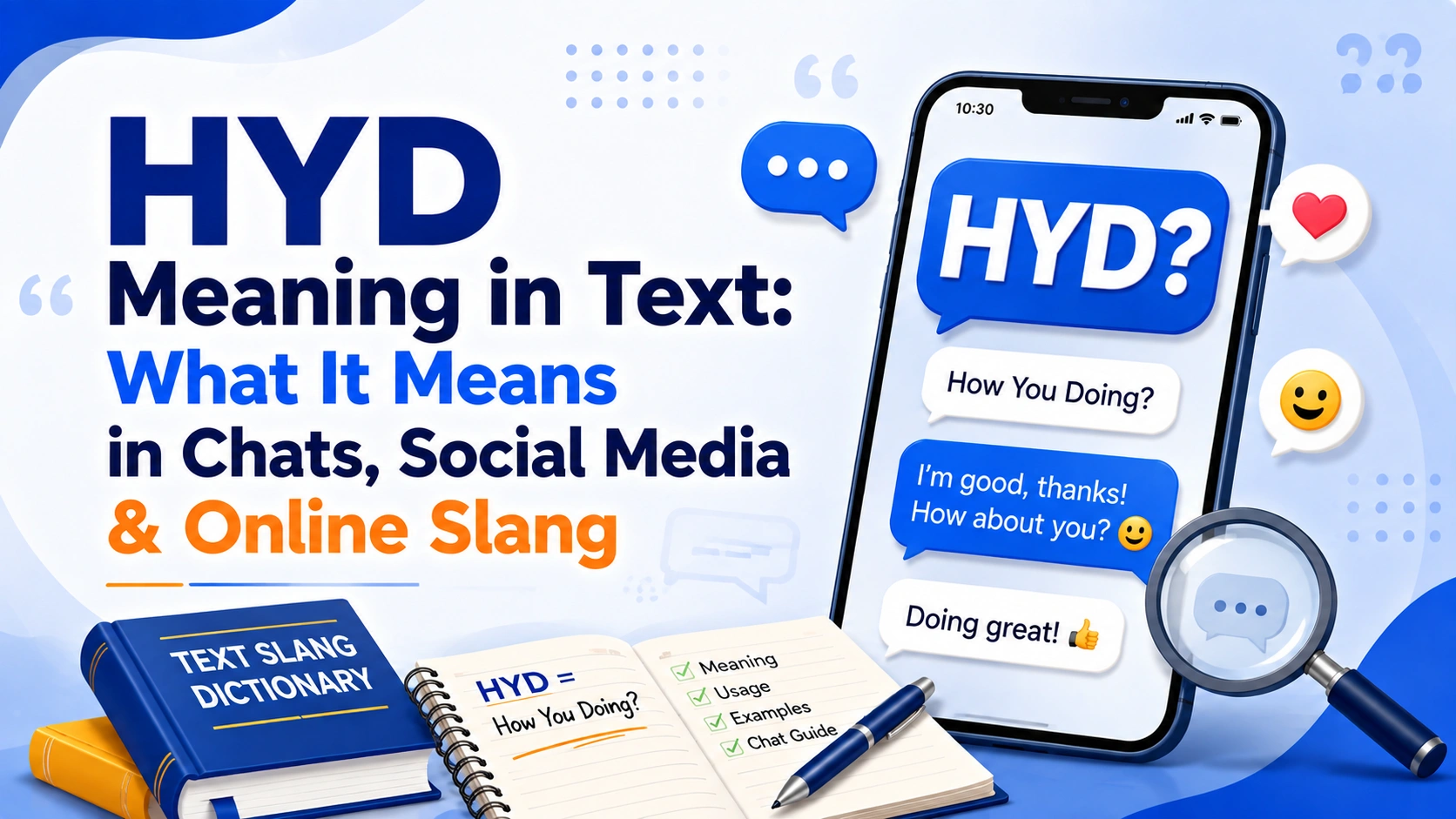
HYD meaning in text is usually “How You Doing?”, an informal way to ask someone how they are, how things are going, or how they have been. You may see it as “HYD?”, “hyd?”, or occasionally “Hyd” in text messages, DMs, and casual online conversations. Although the abbreviation is simple, the intention behind it can vary. A friend may be checking in, an acquaintance may be opening a conversation, or someone may simply be using a familiar greeting.
The important point is that HYD does not automatically have a romantic, serious, or deeply emotional meaning. Context determines the tone. Compare “HYD bro?” with “hey stranger, HYD?” The first sounds like a straightforward friendly check-in, while the second may feel more personal or playful. Understanding who sent the message, what came before it, punctuation, emojis, and the rest of the conversation can help you interpret the intended tone.
This guide explains what HYD stands for, how people actually use it, what it means on social media, how it differs from WYD and similar abbreviations, and how to respond naturally. You will also learn when HYD works well, when a full sentence is better, why the phrase became culturally recognizable, and how to avoid reading too much into three simple letters.
Quick Answer: What Does HYD Mean in Text?
HYD usually means “How You Doing?”
In natural standard English, the intended question is generally equivalent to “How are you doing?” or “How are you?” It is an informal texting abbreviation used primarily as a greeting, check-in, or conversation opener.
| Question | Answer |
| HYD meaning in text | How Are You Doing? |
| Natural English equivalent | How are you doing? |
| Type | Informal texting abbreviation/initialism |
| Main purpose | Check in or start a conversation |
| Typical tone | Casual, friendly, curious |
| Can it be flirty? | Sometimes, depending on context |
| Professional? | Usually too informal for formal writing |
| HYD vs. WYD | HYD asks how someone is doing; WYD asks what they are doing |
Quick rule: If someone sends you “HYD?” in an ordinary chat, read it first as “How are you doing?” Then use the surrounding conversation to judge the tone.
What Does HYD Stand For?
HYD is formed from the first letters of How You Doing:
- H = How
- Y = You
- D = Doing
The fuller grammatical question in standard English is “How are you doing?” Texting often removes small words that are easy to infer, which is why abbreviations such as HYD can still be understood without every word being represented.
This is best treated as an informal initialism or texting abbreviation, rather than a conventional word. It functions as a complete conversational question even though it consists of only three letters.
For example:
Alex: HYD?
Sam: Pretty good. Just relaxing. You?
Here, there is no hidden meaning. Alex is simply asking how Sam is doing.
Why Does “How You Doing?” Sound Familiar?
The phrase itself became especially recognizable through Joey Tribbiani’s repeated “How you doin’?” catchphrase on Friends. Research on the show’s signature lines notes that Joey’s phrase moved beyond the television series and became part of real-world social usage.
That does not mean Friends invented the underlying question or necessarily invented the abbreviation HYD. The safer conclusion is that the show helped make the particular phrasing highly recognizable in popular culture.
What Does HYD Actually Communicate?
At its basic level, HYD asks about someone’s current condition, mood, or general situation.
But short messages often perform more than one conversational function. Depending on context, HYD can be:
1. A Simple Check-In
A friend may send:
“Hey, HYD?”
The person may simply want to know whether you’re doing okay.
2. A Conversation Starter
Sometimes the sender is not looking for a detailed answer. HYD is simply an easy way to reopen communication.
“HYD? Been a while.”
The real intention may be: Let’s start talking again.
3. A Friendly Greeting
Among people who already chat regularly, HYD can function almost like “Hey, how are things?”
“Morning! HYD?”
The message is not necessarily asking for a serious emotional report.
4. A Sign of Interest
A person may use HYD because they want to continue a conversation with you.
That can indicate social interest, but it does not automatically mean romantic interest. One abbreviation is not enough evidence to determine someone’s feelings.
5. A Low-Effort Opener
Sometimes HYD is simply convenient.
A person may have no particular topic in mind and use the question to see whether you are available to chat.
“HYD”
That can be as simple as “Hey, want to talk?”
HYD Tone: Friendly, Caring, Dry, or Flirty?
The three letters themselves have relatively little emotional information. Context supplies most of the tone.
Compare these examples:
| Message | Likely impression |
| “HYD bro?” | Friendly and casual |
| “Hey, HYD?” | Neutral and conversational |
| “HYD today?” | Caring or interested |
| “Hey stranger, HYD?” | Playful or more personal |
| “HYD 😂” | Lighthearted |
| “HYD??” | More energetic or possibly concerned |
| “hyd” | Very casual, potentially low-effort |
| “Hi, how are you doing?” | More polished and deliberate |
Punctuation and capitalization are not fixed rules. People often type inconsistently, so “hyd” is not automatically colder than “HYD?” The conversation around it matters more.
Is HYD Always Flirty?
No.
HYD can appear in a flirtatious conversation, but the abbreviation itself is not inherently romantic. A friend, classmate, relative, or acquaintance can use exactly the same letters.
A message such as:
“Hey, HYD?”
is usually too ambiguous to establish romantic intent by itself.
Look at the broader conversation, not one abbreviation.
How People Use HYD in Real Conversations
HYD is particularly useful when the sender wants a response that can lead somewhere else.
Checking on a Friend
A: HYD?
B: Doing pretty good. I just finished my homework. You?
Reconnecting After a Break
A: Hey, HYD? Haven’t talked in ages.
B: I’m good! Been really busy lately.
Continuing an Existing Conversation
A: Hope your presentation went well.
B: Thanks! It actually did.
A: Nice. HYD now?
Here, HYD refers to the person’s current state rather than simply functioning as a greeting.
When Someone May Be Having a Difficult Day
A: You seemed stressed earlier. HYD now?
B: A little better, thanks.
This version can sound more caring because the preceding context establishes concern.
Group Chat Example
A: HYD everyone?
B: Surviving 😂
C: Same here.
In a group, HYD can address several people at once and act as a casual conversation opener.
HYD on Snapchat, Instagram, WhatsApp, TikTok, and Discord
There is usually no special platform-specific definition of HYD. The core texting meaning remains “How You Doing?” across ordinary social conversations. Sources covering current usage similarly describe it as a casual check-in used across messaging and social platforms.
HYD on Snapchat
On Snapchat, HYD commonly appears in direct chats or as a quick message intended to start a conversation.
“HYD?”
usually means:
“How are you doing?”
The platform does not give HYD a separate Snapchat-specific meaning.
HYD on Instagram
In Instagram DMs, someone may use HYD as a short opener:
“Heyyy HYD?”
It can be friendly, casual, or playful depending on the existing relationship.
HYD on WhatsApp
WhatsApp conversations often contain abbreviations, so HYD can naturally appear alongside other casual shorthand.
“HYD? Is everything good?”
The second sentence can make the intention clearer: the sender is checking on you.
HYD on TikTok
If HYD appears in a TikTok-related conversation or DM, it generally retains its ordinary texting meaning. It does not become a special TikTok term merely because it appears there.
HYD on Discord
Discord users may use HYD in direct messages or community chats, particularly when starting a casual conversation.
As always, specialized communities can assign their own meanings to abbreviations, so context should override assumptions.
HYD vs. Similar Texting Abbreviations
One of the easiest mistakes is confusing HYD with abbreviations that look or sound similar.
| Abbreviation | Meaning | Main question |
| HYD | How Are You Doing? | How are you doing? |
| WYD | What Are You Doing? | What are you doing? |
| HRU | How Are You? | How are you? |
| HBU | How About You? | And you? |
| WBU | What About You? | And what about you? |
| SUP | What’s Up? | What’s happening? |
| NVM | Never Mind | Ignore/retract the previous point |
| NBD | No Big Deal | It isn’t important |
HYD vs. WYD
This is the most important distinction.
HYD asks about your condition or general state:
“HYD?”
≈ “How are you doing?”
WYD asks about your current activity:
“WYD?”
≈ “What are you doing?”
They can appear together:
“HYD? WYD later?”
That means something like:
“How are you doing? What are you doing later?”
HYD vs. HRU
These are extremely close in function.
- HYD = How You Doing?
- HRU = How Are You?
Both can be used as casual check-ins. HYD may feel slightly more conversational because it mirrors the phrase “How you doing?”
HYD vs. HBU
These are not interchangeable.
A: HYD?
B: I’m good. HBU?
Here, HYD begins the check-in, while HBU sends the question back.
HYD vs. “What’s Up?”
“What’s up?” can be a greeting rather than a literal request for information. HYD is more directly focused on how the person is doing.
Still, in everyday conversation, both can serve as easy openers.
How to Reply When Someone Says “HYD”
The safest approach is simple: answer the question naturally.
You do not need to decode every possible hidden meaning before replying.
Short Casual Replies
- “Good, you?”
- “I’m good!”
- “Doing okay.”
- “Pretty good. Hbu?”
- “All good here.”
Friendly Replies
If you want to continue the conversation:
“I’m doing pretty well! Just got home. How about you?”
Or:
“Good! It’s been a busy day though. HYD?”
If You Are Not Doing Great
You do not have to pretend everything is perfect.
“Honestly, I’m kind of tired today.”
Or:
“Not my best day, but I’m okay.”
You can decide how much detail you want to share.
If You Want to Keep the Conversation Short
A brief answer is perfectly acceptable:
“Good, thanks!”
You are not obligated to turn a three-letter check-in into a long conversation.
If the Message Is Unclear
If HYD appears in an unusual context, you can simply ask:
“What do you mean by HYD?”
That’s especially reasonable when the surrounding conversation does not make the abbreviation clear.
When Should You Use HYD?
HYD works best when the relationship and setting are casual.
Good situations
Use HYD when messaging:
- Friends
- People you regularly chat with
- Casual acquaintances
- Informal group chats
- Social-media contacts you already know
- Online communities where shorthand is normal
Situations where a full sentence is better
Avoid relying on HYD when communicating with:
- Teachers
- Employers
- Customers
- Clients
- Official organizations
- People you do not know well in a formal setting
Instead of:
“Hi, HYD?”
a workplace message would normally be clearer as:
“Hi, how are you doing?”
The full version is not necessarily more grammatically sophisticated; it is simply better matched to a formal communication setting.
Expert tip: Informal abbreviations save time only when the reader already understands them. In professional communication, clarity usually matters more than saving three keystrokes.
Common Mistakes When Interpreting HYD
Mistake 1: Assuming HYD Is Always Flirty
A short greeting does not prove romantic interest. HYD can be completely ordinary between friends.
Mistake 2: Confusing HYD With WYD
Remember:
HYD = how are you doing?
WYD = what are you doing?
The first focuses on someone’s state; the second focuses on their activity.
Mistake 3: Thinking HYD Requires a Long Answer
It does not. “Good, you?” is a perfectly normal response.
Mistake 4: Treating Capitalization as a Secret Code
“HYD,” “hyd,” and “Hyd” can all represent the same abbreviation. Typing habits vary considerably.
Mistake 5: Assuming the Sender Has a Deep Emotional Concern
Someone may genuinely be checking on you, but HYD can also be nothing more than a casual greeting.
Mistake 6: Using It Everywhere
Text slang belongs to the right register. A phrase that sounds natural in a group chat may look unnecessarily informal in an email.
How to Decode HYD From Context
If you are unsure what someone means, use this quick checklist.
Step 1: Look at the message before HYD
Was the conversation about your mood, health, plans, school, work, or something else?
Step 2: Look at who sent it
A close friend and a new acquaintance may use identical wording for completely different social purposes.
Step 3: Check what follows
Compare:
“HYD?”
with:
“HYD? Haven’t heard from you lately.”
The second gives you much more information about the sender’s intention.
Step 4: Notice emojis and punctuation
An emoji can soften or brighten the message, while repeated punctuation may make it feel more energetic. These are clues, not strict rules.
Step 5: Don’t overinterpret one abbreviation
This is the most useful rule.
Interpret the whole conversation, not just HYD.
Does HYD Have Other Meanings?
Yes. HYD can represent other abbreviations outside casual texting, which is why context matters.
For example, HYD can appear in technical, organizational, geographic, or specialized contexts. One commonly encountered non-slang use is HYD as the IATA airport code for Hyderabad, India. A technical document may also use HYD as part of a specialized abbreviation.
This does not make those meanings equally likely in ordinary messaging.
| Where you see HYD | Most sensible first interpretation |
| Text message | How Are You Doing? |
| Instagram DM | How Are You Doing? |
| Snapchat chat | How Are You Doing? |
| Casual group chat | How Are You Doing? |
| Technical document | Check the document’s terminology |
| Travel/flight context | Hyderabad airport code may be relevant |
| Specialized professional context | Use the surrounding subject matter |
The key is context before dictionary hunting. If someone texts “HYD?” After asking about your day, the conversational meaning is overwhelmingly more relevant than a specialized abbreviation.
Is HYD Still Popular in 2026?
HYD remains recognizable in current online slang and texting references, and multiple recent 2026 sources continue to describe it as a casual way to ask “How are you doing?”
However, it would be misleading to claim a precise rise or decline in HYD’s popularity without reliable longitudinal usage data. Search results and individual websites are not the same thing as a comprehensive measurement of everyday language use.
A better practical conclusion is:
- HYD is still understandable in casual digital communication.
- It remains useful as a short check-in.
- Its exact frequency varies by age group, platform, community, and personal texting style.
- Newer abbreviations can coexist with older ones rather than completely replacing them.
So, if you encounter HYD in a current conversation, you should not assume it is obsolete simply because it is short-form slang.
HYD in Social and Cultural Context
There is an interesting distinction between the abbreviation HYD and the phrase “How you doin’?”
The phrase became strongly associated with Joey Tribbiani on Friends, where it was used as a memorable pickup line. A linguistic study of the character’s signature phrase argues that it moved from a recurring television line into broader social use.
That cultural association explains why some people may hear “How you doin’?” as playful or flirtatious. But modern texting use is broader. When someone types HYD, the abbreviation can simply mean “How are you doing?” without reproducing Joey’s particular persona or intent.
In other words, cultural history influences the phrase’s flavor, but it does not determine every modern message.
HYD Meaning: Practical Decision Guide
When you receive HYD, this simple framework can help:
| If the message looks like… | Most likely interpretation | Best response |
| “HYD?” | Casual check-in | “Good, you?” |
| “Hey, HYD?” | Conversation opener | Give a short update |
| “HYD today?” | Asking about your day/state | Mention how your day is going |
| “HYD bro?” | Friendly greeting | Casual response |
| “HYD? Haven’t talked in ages.” | Reconnecting | Acknowledge the gap |
| “HYD 😂” | Lighthearted check-in | Match the casual tone |
| HYD in a technical report | Possibly a specialized abbreviation | Use document context |
| HYD in travel information | Could refer to Hyderabad airport | Check the travel context |
Conclusion:
HYD meaning in text is usually “How You Doing?”—a short, informal way to ask how someone is doing and often an easy way to begin a conversation. Its basic definition is simple, but its tone depends on context. The same abbreviation can sound friendly, caring, playful, neutral, or occasionally flirtatious depending on the relationship and surrounding messages.The most useful distinction to remember is HYD vs. WYD: HYD asks about someone’s state, while WYD asks about their activity. You should also avoid assuming that every HYD carries a hidden emotional message. One final actionable tip: answer HYD as naturally as you would answer “How are you doing?” A common mistake to avoid is overanalyzing three letters when the rest of the conversation already tells you what the sender means. In everyday chat, simple context usually solves the mystery.
FAQs
Q1. What does HYD mean from a guy?
HYD usually means “How You Doing?” when sent by a guy, just as it does when sent by anyone else. The message may be friendly, casual, or conversational. It can sometimes appear in a flirtatious exchange, but the abbreviation alone does not establish romantic intent.
Q2. What does HYD mean from a girl?
A girl texting HYD is generally asking “How are you doing?” The meaning does not change based on the sender’s gender. Whether the message is friendly, playful, or more personal depends on the relationship and surrounding conversation, not the three letters themselves.
Q3. Is HYD rude or disrespectful?
No, HYD is not inherently rude. It is simply informal. It might seem overly casual in a formal email or professional message, but among friends and online contacts it is normally a straightforward check-in. Tone can change if the surrounding conversation is sarcastic or tense.
Q4. Can HYD mean “What are you doing?”
Normally, no. HYD means “How You Doing?” while WYD usually means “What You Doing?” They ask different questions. HYD focuses on someone’s condition or general state; WYD focuses on their current activity or plans.
Q5. Should I reply to HYD with “HBU”?
Yes, if you have already answered the question. For example: “I’m good, HBU?” means “I’m good; how about you?” HBU is therefore a natural follow-up rather than a direct replacement for HYD. It keeps the conversation moving without requiring a long response.