

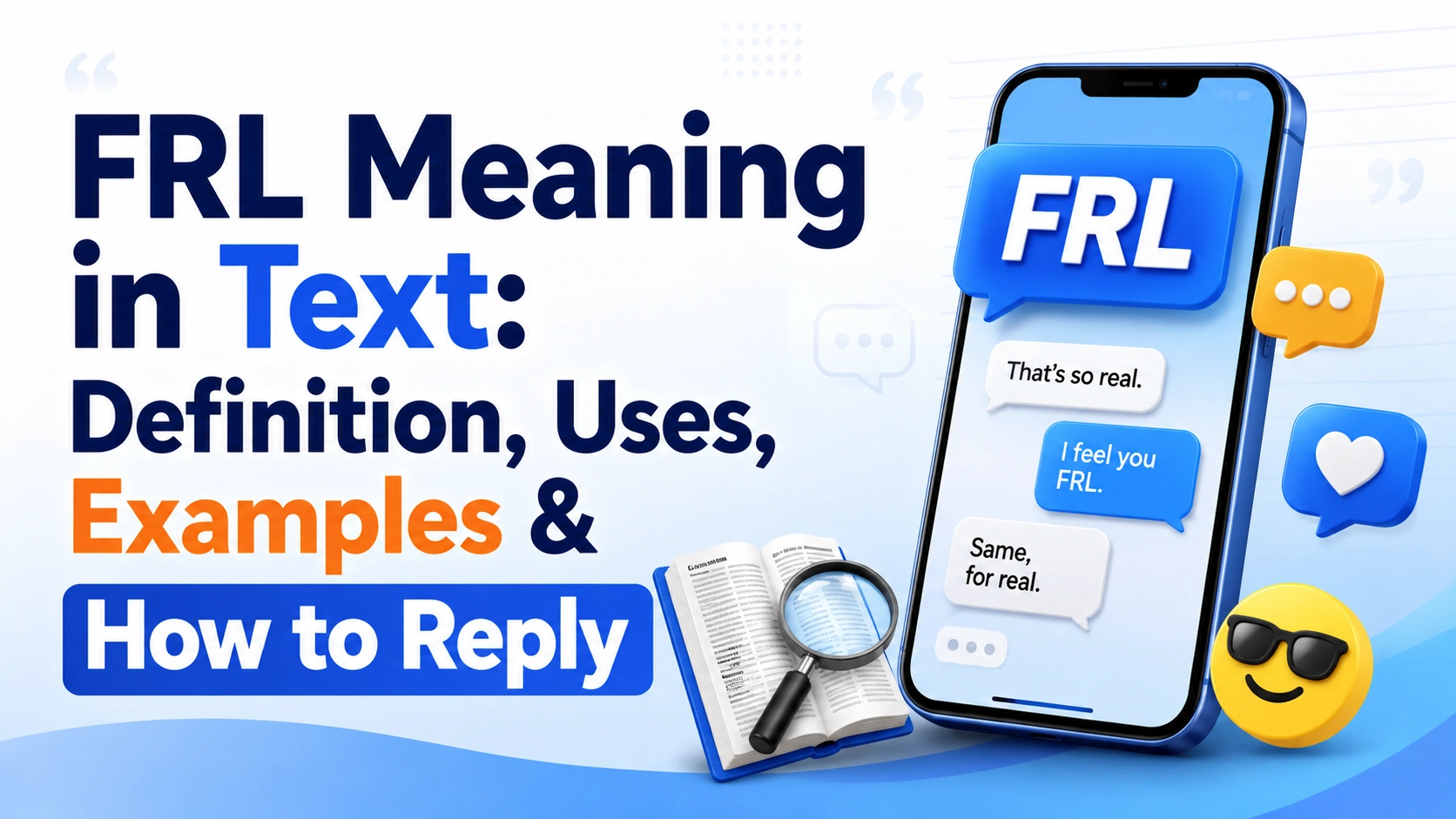
FRL meaning in text is usually “for real,” a compact abbreviation people use in messages, comments, group chats, and other casual online conversations. Depending on where it appears, FRL can communicate agreement, sincerity, surprise, disbelief, or strong emphasis. That flexibility is what makes the abbreviation useful—and occasionally confusing. A simple “FRL?” can mean “Really?” while “That was amazing frl” can mean “That was genuinely amazing.” Understanding the surrounding message, punctuation, and relationship between the people involved is often more important than the abbreviation itself.
If someone sends you “frl”, you generally do not need to search for an elaborate hidden meaning. In everyday texting slang, the most likely interpretation is “for real.” Slang references consistently define FRL this way and describe it as a casual way to emphasize truth or seriousness. The interesting part is how the phrase functions in conversation. It can reinforce an opinion, validate somebody else’s statement, question whether something is true, or add emotional weight to an otherwise ordinary sentence.
This guide explains what FRL means in text, how people actually use it, how punctuation changes its tone, and how to reply naturally. You will also see examples from different conversational situations, a comparison with related abbreviations such as FR, guidance on when not to use FRL, and a look at other meanings that can appear outside internet slang. The goal is not simply to memorize “FRL = for real,” but to understand what the sender is communicating when those three letters appear in a real conversation.
Quick answer: FRL usually means “for real.” It can mean “seriously,” “genuinely,” “I agree,” or “really?” depending on context.
What Does FRL Mean in Text?
In texting and online slang, FRL stands for “for real.” It is an informal abbreviation used to express sincerity, agreement, emphasis, or disbelief.
For example:
- “That movie was incredible frl.” → That movie was genuinely incredible.
- “FRL?” → Really? / Are you serious?
- “I’m tired frl.” → I’m genuinely tired.
- “FRL, that was the funniest thing ever.” → Seriously, that was extremely funny.
- “You actually finished it? FRL?” → Did you really finish it?
The same abbreviation can therefore perform different conversational jobs.
The simplest definition
| Expression | Typical meaning | Common function |
| FRL | For real | Sincerity or emphasis |
| FRL? | For real? | Surprise or doubt |
| frl at the end | For real / genuinely | Reinforcement |
| FRL!!! | For real! | Strong reaction |
| frl tho | For real, though | Strong agreement or emphasis |
| frl frl | For real, seriously | Extra emphasis |
The important point is that FRL does not have one fixed emotional tone. Context determines whether it sounds supportive, surprised, skeptical, excited, or even slightly confrontational.
FRL Meaning in Texting: What Does It Actually Communicate?
When someone uses FRL, they are usually doing more than saving typing time. The abbreviation acts as a small tone marker.
FRL can show agreement
One of the most common uses is agreeing strongly with something another person has said.
“This summer is going by way too fast.”
“FRL.”
Here, FRL is essentially “For real” or “I completely agree.”
Another example:
“That restaurant is expensive.”
“frl, the prices are crazy.”
The second speaker is validating the first speaker’s observation.
FRL can emphasize sincerity
FRL can also tell the reader that the speaker is being genuine.
“I’m actually done arguing about it, frl.”
The abbreviation reinforces the idea that the person really means what they just said.
Similarly:
“I wasn’t joking frl.”
Here, FRL strengthens the seriousness of the statement.
FRL can express surprise or disbelief
Put a question mark after it and the meaning shifts.
“I got tickets for tomorrow.”
“FRL?”
This is closer to:
“Seriously?”
“Really?”
“Are you actually serious?”
The speaker may be excited, shocked, or skeptical. The surrounding conversation determines which interpretation makes the most sense.
FRL can add emotional emphasis
Sometimes FRL appears at the end of an emotional statement:
“That was one of the best games I’ve watched frl.”
The abbreviation does not introduce a new fact. Instead, it tells the reader that the speaker strongly stands behind the statement.
FRL vs. “For Real”: Is There a Difference?
The basic meaning is the same, but the style and tone can differ.
“For real” is a complete phrase that works naturally in both speech and writing. FRL is a shortened digital form designed for informal communication.
Compare:
- “That was genuinely difficult, for real.”
- “That was genuinely difficult frl.”
Both communicate sincerity, but the second feels more like casual internet conversation.
This distinction matters because abbreviations often carry social information. Choosing FRL signals familiarity with informal messaging conventions, while spelling out “for real” is more universally understandable.
Expert tip: If you are writing something that needs to be clear to an unfamiliar audience, spelling out “for real” is safer than assuming the reader knows FRL.
How People Use FRL in Different Contexts
FRL is flexible enough to appear in several types of casual digital communication.
Text messages
In one-to-one texting, FRL can be used for agreement, honesty, or reactions.
Example:
“I need a break from everything.”
“FRL, same.”
The abbreviation communicates solidarity and agreement.
Group chats
Group conversations often move quickly, so short expressions such as FRL can work as rapid reactions.
Example:
“Everyone has to be there at 7.”
“frl 😭”
Depending on the conversation, this could mean “seriously?”, “for real?”, or simply emphasize the speaker’s reaction.
Social media comments
FRL can appear as a reaction to a post or opinion.
Example:
“This is the most relatable thing I’ve seen today.”
“FRL.”
Here, it means something like “Absolutely” or “Seriously, yes.”
Gaming and online communities
In fast-moving gaming or community chats, FRL may function as a quick reaction.
“That boss was harder than I expected.”
“frl.”
The response means “For real—I agree.”
The abbreviation itself does not become a special gaming term. Its basic slang meaning remains the same.
FRL Tone: How Punctuation Changes the Meaning
One of the easiest ways to misunderstand FRL is to read the letters without considering punctuation.
| Form | Likely tone | Possible interpretation |
| FRL | Neutral/affirming | “For real.” |
| frl | Casual | “Seriously / genuinely.” |
| FRL? | Questioning | “Really?” |
| FRL?? | Strong disbelief | “Seriously?!” |
| FRL!!! | Excited/intense | “For real!” |
| frl tho | Emphatic | “Seriously, though.” |
| FRL… | Uncertain/heavy | “Are you serious…?” |
These are contextual tendencies, not rigid grammar rules.
For example, “FRL!!!” could express excitement:
“You won the competition?”
“FRL!!!”
But the same punctuation could appear in an annoyed message:
“You forgot again?”
“FRL!!!”
The relationship, subject, emojis, and previous messages matter.
Why “FRL?” is particularly important
A statement and a question can perform almost opposite conversational functions:
“FRL.”
= I agree / I genuinely mean this.
“FRL?”
= Really? / Are you serious?
That tiny question mark can completely change how the message should be interpreted.
Realistic Examples of FRL in Text Conversations
Example 1: Agreement
Alex: “That exam was brutal.”
Sam: “FRL.”
Meaning: Sam strongly agrees.
Example 2: Genuine opinion
Alex: “I actually liked the ending.”
Sam: “Same frl.”
Meaning: Sam genuinely shares the opinion.
Example 3: Surprise
Alex: “I’m moving next month.”
Sam: “FRL?”
Meaning: Sam is surprised and wants confirmation.
Example 4: Emphasis
Alex: “I’m never doing that again.”
Sam: “You said that last time.”
Alex: “No frl this time.”
Meaning: Alex is emphasizing that they genuinely mean it.
Example 5: Validation
Alex: “Sometimes I just need a day without my phone.”
Sam: “frl, that sounds nice.”
Meaning: Sam agrees and validates the thought.
Example 6: Strong reaction
Alex: “The concert was unbelievable.”
Sam: “FRL, I wish I went.”
Meaning: Sam strongly agrees and expresses regret about missing it.
Example 7: Mild disbelief
Alex: “He submitted the project five minutes before the deadline.”
Sam: “FRL?”
Meaning: Sam is surprised and possibly skeptical.
FRL Meaning on Social Media
FRL generally keeps the same meaning across social platforms: “for real.” What changes is the conversational setting.
On fast-moving platforms, users often use short abbreviations as reactions rather than complete sentences. Slang references describe FRL as common in text messages, online chats, social media, and forums.
FRL in comments
A user might comment:
“This is so true frl.”
The commenter is emphasizing agreement.
FRL in direct messages
A friend might write:
“I’m exhausted frl.”
Here, FRL reinforces sincerity.
FRL as a reaction
Someone might simply reply:
“FRL?”
This requires more context because it could mean “Really?”, “Seriously?”, or “Are you being honest?”
Does FRL have a different meaning on each platform?
Usually, no. It is not necessary to learn a separate definition for every social network.
Instead, learn the basic meaning and interpret the tone from the surrounding message.
FRL vs. FR: Are They the Same?
FR and FRL can both abbreviate “for real.” FRL simply contains the additional “L” from the word real. Slang references list FR as another abbreviation for the same phrase.
| Expression | Meaning | Typical feel |
| FR | For real | Very short, casual |
| FRL | For real | Casual, slightly more explicit |
| For real | For real | Clearer, works in ordinary speech |
| Seriously | Seriously | More conventional |
| Honestly | Honestly | Sincerity-focused |
| No joke | No joke | Emphasis on truth |
| Genuinely | Genuinely | More polished |
There is no universal rule saying one is always stronger than another. People develop their own habits, and slang varies between communities.
FRL vs. Similar Texting Expressions
Understanding nearby expressions can make FRL easier to interpret.
FR vs. FRL
Both can mean “for real.” FR is shorter, while FRL spells out more of the phrase.
FRL vs. LOL
These do completely different jobs.
- FRL → for real
- LOL → laughing out loud
A message can even contain both:
“That was so ridiculous lol frl.”
The writer may be laughing while also emphasizing that the situation genuinely happened.
FRL vs. NGL
- FRL → for real
- NGL → not gonna lie
Both can introduce sincerity, but they are not interchangeable.
“NGL, I expected it to be boring.”
means:
“Not gonna lie, I expected it to be boring.”
Whereas:
“It was actually good frl.”
means:
“It was genuinely good.”
FRL vs. TBH
- FRL → for real
- TBH → to be honest
TBH often introduces an opinion or admission, while FRL usually reinforces something already being said.
When Should You Use FRL?
FRL works best when the conversation is informal and familiar.
Good situations include:
- Texting close friends
- Casual group chats
- Informal social media comments
- Gaming conversations
- Memes and online communities
- Casual direct messages
- Friendly conversations where abbreviations are already common
The key is not simply whether you can use FRL. Ask whether it fits the relationship and communication style.
When FRL feels natural
“That food was amazing.”
“FRL, I didn’t expect that.”
“Same frl.”
These sound natural in casual digital conversation.
When Should You Avoid FRL?
FRL is informal slang, so it is usually inappropriate in communication where clarity, professionalism, or formality matters more than conversational speed.
Avoid it in:
- Job applications
- Formal emails
- Academic assignments
- Professional reports
- Official correspondence
- Formal customer communication
- Important messages where the recipient may not know the abbreviation
Instead of:
“FRL, I think the proposal needs changes.”
write:
“I genuinely think the proposal needs some changes.”
Or:
“I agree; the proposal needs some revisions.”
The problem is not that FRL is grammatically “wrong.” It is that register matters. A slang abbreviation can be perfectly appropriate in one environment and noticeably out of place in another.
Common Mistakes People Make With FRL
Mistake 1: Assuming FRL always means agreement
It does not.
“FRL?”
may express doubt or surprise rather than agreement.
Mistake 2: Ignoring punctuation
“FRL” and “FRL?” can have very different intentions.
Mistake 3: Treating FRL as formal English
FRL belongs primarily to informal digital communication.
Mistake 4: Assuming every age group knows it
Internet slang is not universal. Some readers may understand “for real” immediately but not recognize FRL.
Mistake 5: Overusing it
Putting FRL into every sentence can make writing feel forced.
Compare:
“That was good frl. I liked it frl. You should try it frl.”
with:
“That was actually good frl. You should try it.”
The second sounds much more natural.
A useful rule: Use FRL to add emphasis, not simply because you have the option to shorten “for real.”
How to Reply When Someone Says FRL
The best response depends on what FRL is doing in the conversation.
If they mean “I agree”
You can respond naturally:
- “Exactly.”
- “Same.”
- “I know right?”
- “Literally.”
- “That’s what I’m saying.”
If they ask “FRL?”
If someone sends:
“FRL?”
they may be asking whether you are serious.
Possible replies:
- “Yeah, seriously.”
- “Yep, I mean it.”
- “100%.”
- “No joke.”
- “I’m being serious.”
If they sound surprised
You can clarify:
“Yeah 😂 I’m not even joking.”
Or:
“Yep, actually.”
If you are unsure what they mean
You can simply ask:
“You mean for real?”
That is completely reasonable, especially if the conversation contains other possible interpretations.
Should FRL Be Capitalized?
There is no strict capitalization rule for texting slang.
You may see:
- FRL
- frl
- Frl
Lowercase frl is especially natural in casual texting, while uppercase FRL can feel more emphatic.
For example:
“that was crazy frl”
feels relaxed.
Meanwhile:
“FRL??”
looks more visually forceful because of the capitalization and punctuation.
These are stylistic choices rather than formal grammatical distinctions.
Does FRL Have Other Meanings?
Yes. FRL is not exclusively a slang abbreviation. Outside casual messaging, the same three letters can represent unrelated technical or organizational terms.
For example, one source lists Finished Reduced Level in civil engineering, Free and Reduced Lunch in education, and Fixed Rate Link in electronics/HDMI-related contexts.
Older slang references also list uncommon interpretations such as Flashing Red Light, Full Reservoir Level, and Fire Resistance Level.
That does not mean you should automatically assume one of these meanings when you see FRL in a text.
How to identify the intended meaning
Use the surrounding context:
| Context | Most likely FRL meaning |
| Friend’s text | For real |
| TikTok/social comment | For real |
| Group chat | For real |
| Gaming chat | For real |
| Engineering document | Could be a technical abbreviation |
| School administration | Could refer to Free and Reduced Lunch |
| HDMI/electronics documentation | Could refer to Fixed Rate Link |
| Construction/surveying | Could have a technical meaning |
The conversation topic is the strongest clue.
Where Did FRL Come From?
It is difficult to identify one definitive inventor or launch date for FRL. The underlying expression “for real” has existed in spoken English long before modern social media, while the shortened internet form developed within digital communication.
An early user-submitted Urban Dictionary entry for frl dates to September 2006, where it was described as a contraction of “for real.” Because Urban Dictionary is user-generated, this is useful evidence that the abbreviation was circulating by that time, but it should not be treated as proof of the abbreviation’s exact origin.
The development makes linguistic sense: digital communication encourages people to shorten familiar phrases while retaining their recognizable meaning. FRL sits alongside related shorthand such as FR, showing how conversational phrases can acquire multiple abbreviated forms.
Why Has FRL Become Useful in Digital Communication?
FRL works because it combines brevity with emotional emphasis.
Instead of writing:
“I genuinely agree with what you just said.”
someone can write:
“FRL.”
That saves time, but the benefit is not merely speed. The abbreviation also fits the informal rhythm of digital conversation.
People may use it to:
- Reinforce agreement
- Signal sincerity
- React quickly
- Emphasize an opinion
- Confirm that something is true
- Express surprise
- Match the conversational style of friends
This is why slang abbreviations should not be judged solely as shortened words. They also function as social signals.
Is FRL Formal or Informal?
FRL is informal.
It belongs naturally in texting, social media, casual chats, and online communities. It should generally be replaced with standard wording when communicating in a professional or academic setting.
| Situation | Use FRL? | Better choice |
| Texting a close friend | ✅ | FRL |
| Casual group chat | ✅ | FRL |
| Social media comment | ✅ | FRL |
| Gaming chat | ✅ | FRL |
| Message to a teacher | Usually no | “Seriously” / “I agree” |
| Academic paper | ❌ | Standard English |
| Job application | ❌ | Formal wording |
| Professional email | ❌ | “I agree” / “genuinely” |
| Official document | ❌ | Precise formal language |
The goal is to register awareness, not avoid slang altogether.
A Practical Checklist for Understanding FRL
When you see FRL in a message, run through these questions:
- Is the conversation casual?
If yes, “for real” is likely. - Is FRL followed by a question mark?
It may mean “really?” or “are you serious?” - Is the sender agreeing with something?
FRL may mean “I completely agree.” - Does it appear after an opinion?
It may reinforce sincerity or emphasis. - Is the conversation technical?
If so, FRL could have an entirely different meaning. - Does the recipient normally use slang?
Personal communication habits matter.
This approach is more reliable than trying to memorize every possible definition.
FRL Meaning in Text: Key Takeaways
The most useful way to remember FRL is simple:
- FRL usually means “for real.”
- It is primarily informal texting and internet slang.
- It can express agreement, sincerity, emphasis, surprise, or disbelief.
- “FRL?” commonly functions as “Really?” or “Are you serious?”
- Punctuation and context can significantly affect tone.
- FR can also mean “for real” and is a related abbreviation.
- FRL is generally unsuitable for formal, academic, or professional writing.
- Outside slang, FRL can represent unrelated technical or organizational terms.
- The surrounding conversation should always determine the intended meaning.
Conclusion:
FRL meaning in text is usually straightforward: it means “for real.” What makes the abbreviation interesting is how much tone those three letters can carry. Depending on context, FRL can show agreement, reinforce sincerity, express surprise, or question whether something is actually true. “FRL?” and “FRL.” should not automatically be read the same way, because punctuation and surrounding conversation can change the message considerably. One final actionable tip: when you encounter FRL, read the entire message before deciding what the sender means. A common mistake to avoid is assuming that every FRL expresses agreement; sometimes it is a genuine question or reaction. Once you understand the context, FRL becomes less of a confusing acronym and more of a useful piece of everyday digital language.
FAQs
Q1. What does FRL mean in text?
FRL usually means “for real” in texting and online conversations. It can express agreement, sincerity, emphasis, or surprise. When written as “FRL?”, it often means “Really?” or “Are you serious?” The exact tone depends on the surrounding message, punctuation, and relationship between the speakers.
Q2. Is FRL the same as FR?
Yes. FR and FRL can both mean “for real” in informal digital communication. FR is shorter, while FRL includes the final letter from “real.” Neither has a universally fixed level of intensity, so individual texting habits and context can determine which abbreviation someone prefers.
Q3. What does FRL mean with a question mark?
“FRL?” usually means something like “Really?” “For real?” or “Are you serious?” It can communicate surprise, disbelief, or a request for confirmation. The speaker’s emotional intention depends on context. A surprised reaction and an annoyed challenge can both use the same abbreviation.
Q4. Is FRL appropriate for professional communication?
Generally, no. FRL is informal internet slang, so it is better suited to friends, casual chats, and social media. In professional or academic writing, use clearer alternatives such as “seriously,” “genuinely,” “I agree,” or “I understand.” The issue is register rather than grammatical correctness.
Q5. Can FRL mean something other than “for real”?
Yes. FRL has technical, educational, and organizational meanings outside texting. For example, it can represent terms used in engineering, electronics, or school administration. However, when FRL appears in an ordinary text, social-media comment, or casual chat, “for real” is usually the intended meaning.