

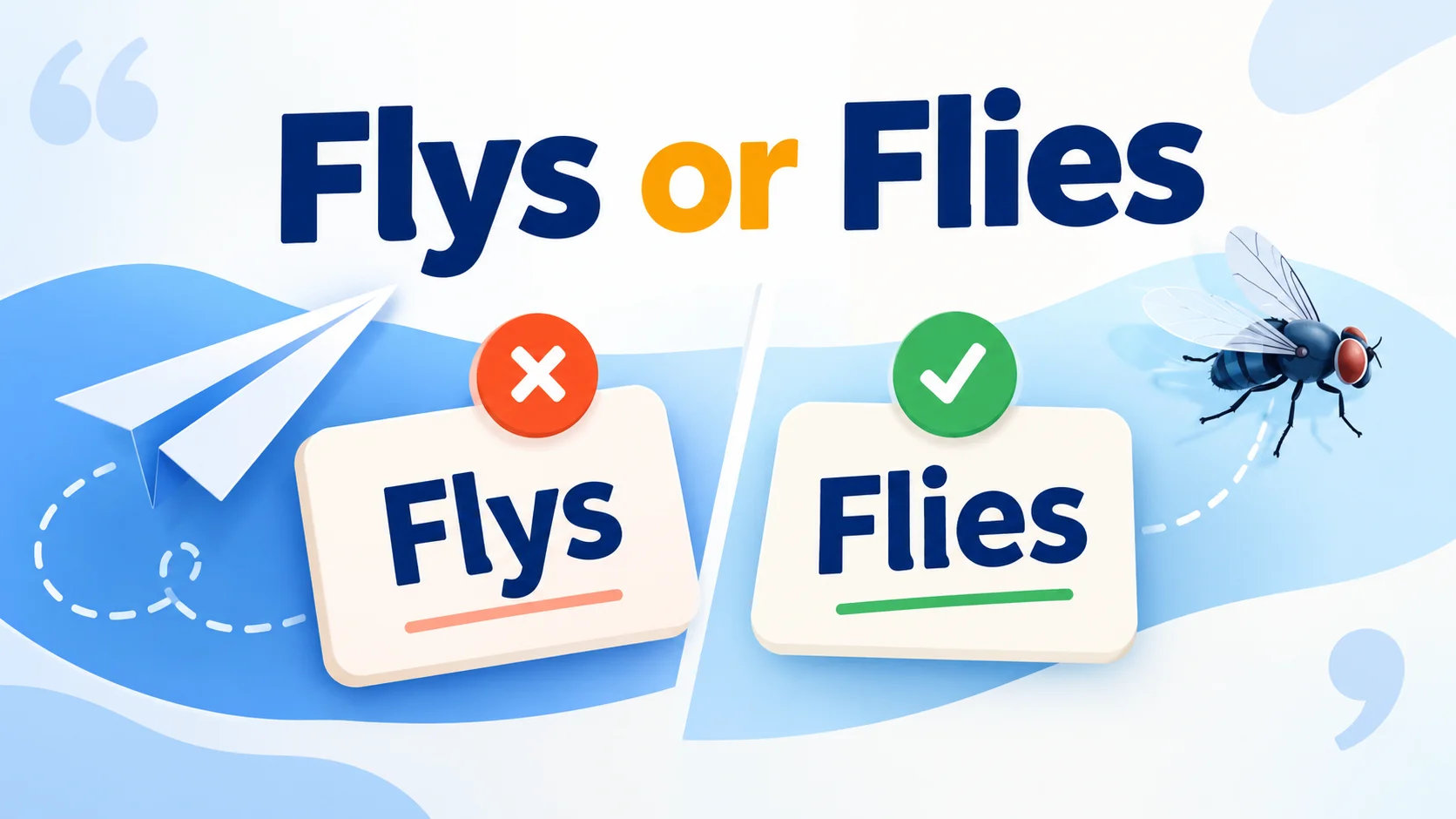
The correct choice in standard English is flies, not flys, when you are referring to more than one insect or describing what a person, animal, or object does. Although flys may look like a reasonable spelling, English has a specific rule for words ending in a consonant followed by y. Understanding that rule makes this spelling much easier to remember. Whether you are writing a school assignment, composing a professional email, or checking a sentence such as “Time flies,” knowing when to use flies helps you communicate clearly and avoid a common grammatical error.
The confusion becomes understandable when you consider that English uses different forms of the same word depending on its role in a sentence. A fly can name an insect or describe movement through the air. Flies can be the plural of that noun or the present-tense verb used with a singular subject. Meanwhile, flew, flown, and flying serve other grammatical purposes. Each form has a distinct use, and choosing the right one depends on both spelling rules and sentence structure. Once you recognize these patterns, you can apply them to many other English words.
In this guide, you will learn the difference between flys and flies, the correct plural of fly, and the reason the spelling changes. You will also see practical examples, common mistakes, and a comparison of fly, flies, flew, flown, and flying. Special attention is given to the familiar expression “Time flies”, which is frequently misspelled. By the end, you will have a simple method for checking your writing, understand how subject–verb agreement affects the choice, and know when an unusual spelling might be intentional rather than an ordinary grammatical mistake.
Flys or Flies: Which Spelling Is Correct?
Flies is the correct standard spelling in ordinary English when fly refers to multiple insects or when it is the third-person singular present-tense form of the verb.
Flys is generally considered a spelling error in these situations.
Consider these examples:
- Correct: Several flies gathered around the fruit.
- Incorrect: Several flys gathered around the fruit.
- Correct: She flies to another city for work.
- Incorrect: She flys to another city for work.
The spelling changes because fly ends in a consonant followed by y. In the relevant plural noun and verb forms, the y changes to ies.
Flys vs. Flies at a Glance
| Word or form | Correct usage | Example |
| Fly | Singular noun | A fly landed on my desk. |
| Flies | Plural noun | Three flies entered the room. |
| Fly | Present-tense verb with I, you, we, or they | They fly every summer. |
| Flies | Present-tense verb with he, she, it, or a singular noun | He flies every month. |
| Flys | Usually incorrect in ordinary prose | The flys are buzzing. |
There is one qualification: Flys can appear in a proper name, title, username, or specialized context where that spelling has been deliberately established. Such exceptions do not change the standard spelling rule.
Quick rule: Use flies for multiple insects and for a present-tense verb with a third-person singular subject. Use fly in the other present-tense contexts that require the base verb.
What Does “Flies” Mean?
The word flies has two main grammatical uses. It can be a plural noun, referring to more than one insect, or a verb, describing movement through the air or travel by aircraft.
The sentence determines which meaning applies.
1. Flies as the Plural of “Fly”
As a noun, fly commonly refers to a small, winged insect. Its plural is flies.
Examples:
- A fly settled on the kitchen counter.
- Several flies hovered around the ripe bananas.
- The children watched the flies near the pond.
- We closed the windows to keep flies out of the house.
In each sentence, flies identify more than one insect.
The spelling follows the same pattern as baby → babies and city → cities. This is a useful connection because learning one spelling rule can help you spell many words correctly.
Notice the difference between these two sentences:
- A fly landed on the window.
- Several flies landed on the window.
The first refers to one insect, while the second refers to more than one. The change from fly to flies signals that difference.
2. Flies as a Verb
Flies is also the simple present-tense form of the verb fly when the subject is third-person singular.
Examples:
- The eagle flies above the mountains.
- My sister flies to Karachi for work.
- A small aircraft flies over the valley.
- The butterfly flies from flower to flower.
In these examples, flies describe an action rather than naming an insect.
The subject determines the form of the verb:
- I fly to work.
- You fly to work.
- We fly to work.
- They fly to work.
- She flies to work.
This distinction matters because writers sometimes focus on the spelling of the verb without checking the subject. Correct spelling and correct grammar must work together.
3. Flies in Figurative Language
The verb fly also appears in expressions where it does not describe literal movement through the air.
For example:
- Time flies: Time seems to pass quickly.
- The days fly by: Days seem to pass rapidly.
- Tempers fly: People become angry or an argument becomes heated.
These expressions are common in conversation and writing. Understanding their figurative meanings helps you recognize the word in contexts where no aircraft, bird, or insect is involved.
Why Is “Flys” Usually Incorrect?
The main reason is a standard English spelling pattern involving words that end in a consonant followed by y.
When many such nouns form their plurals, the final y changes to ies. The same spelling change applies to regular third-person singular present-tense verbs with this ending.
For example:
- Fly → flies
- Baby → babies
- City → cities
- Try → tries
- Carry → carries
Writing flys ignores this standard pattern.
The Consonant + Y Rule
The rule becomes easier to understand when you examine the letters immediately before the final y.
If a word ends in a consonant followed by y, the y generally changes to ies when forming the plural of a noun or the third-person singular form of a regular present-tense verb.
| Base word | Correct form | Example |
| Fly | Flies | The flies disappeared. |
| Baby | Babies | The babies are sleeping. |
| City | Cities | Several cities hosted the event. |
| Story | Stories | She writes short stories. |
| Try | Tries | He tries a different approach. |
| Carry | Carries | She carries a notebook. |
The rule applies to fly because the letter immediately before y is l, a consonant.
What Happens When a Word Ends in a Vowel + Y?
Words ending in a vowel followed by y generally add s without changing the final y.
Examples include:
- Toy → toys
- Key → keys
- Day → days
- Boy → boys
Compare the patterns:
| Ending | Typical spelling change | Examples |
| Consonant + y | Change y to ies | Fly → flies; baby → babies |
| Vowel + y | Add s | Toy → toys; day → days |
This is why flies are correct while toys are correct rather than toies.
Practical tip: When you are unsure about a word ending in y, look at the letter directly before it. That small check resolves many everyday spelling questions.
Does the Rule Apply to Verbs, Too?
Yes. The same spelling pattern appears in regular verbs when the subject is third-person singular.
Consider the verb try:
- I try to arrive early.
- They try to arrive early.
- She tries to arrive early.
The same pattern applies to fly:
- Birds fly south in winter.
- The bird flies south in winter.
The base verb remains fly with subjects such as I, you, we, and they. With he, she, it, or a singular noun, the present-tense verb becomes flies.
Is “Flys” Ever Correct?
Although flys is generally incorrect as the ordinary plural of fly or the standard present-tense verb form, the spelling can appear in particular contexts.
For example, a business might use Flys as part of its registered name, or a writer might deliberately use it in a fictional title. A specialized term may also have its own established spelling.
In such cases, the spelling belongs to that specific name or usage. It should not be treated as evidence that flys is an accepted alternative for ordinary sentences.
When writing an essay, report, article, or email, use flies unless you have a specific reason to reproduce a nonstandard spelling.
Flys vs. Flies: Examples in Real Sentences
Examples make the difference easier to recognize because they show how the word functions in context.
Examples of “Flies” as a Noun
Here, flies refers to multiple insects.
- The flies gathered around the uncovered food.
- We opened the door and several flies entered the house.
- Flies can be a nuisance during outdoor meals.
- The gardener noticed flies around the compost bin.
- A few flies hovered near the open window.
- The children learned how flies differ from butterflies.
In each sentence, flies is a plural noun. It names the insects being discussed.
Examples of “Flies” as a Verb
In the following sentences, flies describe an action performed by a singular subject.
- My father flies to Islamabad several times a year.
- The bird flies toward the tallest tree.
- A helicopter flies over the coastline.
- She flies home during the holidays.
- The paper plane flies farther when launched carefully.
- Time flies when we are absorbed in an interesting project.
The last example uses flies figuratively. The subject is time, which is grammatically singular.
Incorrect Sentences and Their Corrections
| Incorrect sentence | Correct sentence | Explanation |
| The flys are near the window. | The flies are near the window. | The plural of fly is flies. |
| She flys every Friday. | She flies every Friday. | The singular subject she takes flies. |
| Two flys landed on the table. | Two flies landed on the table. | The noun requires its standard plural form. |
| He flys to work each month. | He flies to work each month. | The third-person singular verb changes y to ies. |
| The birds fly south. | The birds fly south. | The plural subject birds take fly. |
| The bird flies south. | The bird flies south. | The singular subject bird takes flies. |
The final two examples illustrate an important point: not every error involves flys. A sentence can use the correct spelling but still have incorrect subject–verb agreement.
How to Choose the Correct Form
Before writing fly or flies, follow this short checklist:
- Naming one insect? Use fly.
- Naming multiple insects? Use flies.
- Describing what I, you, we, or they do? Use fly in the simple present.
- Describing what he, she, it, or a singular noun does? Use flies in the simple present.
- Describing a past action? Use flew.
- Using a form with has, have, or had to express a completed action? You will generally need to fly.
This approach works because it checks both the meaning and the grammar rather than relying on the appearance of the word alone.
“Time Flies” or “Time Flys”: Which Is Correct?
The correct expression is “Time flies.” The spelling time flys is incorrect in standard English.
This expression means that time appears to pass quickly. People commonly use it when reflecting on a busy day, a memorable event, a holiday, or a period that seems to have ended sooner than expected.
Examples:
- Time flies when you’re having fun.
- I can’t believe the school year is nearly over. Time flies!
- Time flies when you’re working on something you enjoy.
- It feels like yesterday that we moved here. Time flies.
Why Does “Time Flies” Use an S Sound but End in “IES”?
The word time is the subject of the sentence. It is grammatically singular, so the present-tense verb takes its third-person singular form.
The base verb is fly. When it changes to the third-person singular present tense, the final y changes to ies.
Therefore:
- Time flies.
- The day flies by.
- The hours fly by.
Notice the last example. Hours is plural, so the verb is fly, not flies. This comparison is particularly useful for writers who understand the expression but struggle to apply the rule in new sentences.
Is “Time Flys” Ever Acceptable?
In ordinary writing, no. Use time flies in essays, professional emails, blog posts, captions, and other standard prose.
If Time Flys appears as a deliberately chosen title, username, or brand name, its spelling may be intentional. That special usage does not change the standard expression.
Fly, Flies, Flew, Flown, or Flying? Understanding the Verb Forms
The spelling confusion sometimes extends beyond flys and flies. English uses several forms of the verb fly, and each has a different grammatical role.
Learning these forms prevents errors involving tense, agreement, and helping verbs.
The Main Forms of “Fly”
| Verb form | Grammatical use | Example |
| Fly | Base form; simple present with I, you, we, and they | They fly to work. |
| Flies | Third-person singular simple present | She flies to work. |
| Flew | Simple past tense | She flew yesterday. |
| Flown | Past participle | She has flown before. |
| Flying | Present participle or gerund | She is flying today. |
When to Use “Fly”
Use fly with subjects such as I, you, we, and they in the simple present. It also appears after modal verbs such as can, will, and should.
Examples:
- I fly to Lahore twice a year.
- Birds fly south when the season changes.
- We can fly directly to the destination.
- They will fly tomorrow morning.
A useful detail: after a modal verb, use the base form, even when the subject is singular.
Correct: “She can fly.”
Incorrect: “She can flies.”
When to Use “Flew”
Flew is the simple past tense of fly. Use it for an action that occurred in the past.
Examples:
- The plane flew through the clouds.
- We flew to another city last weekend.
- The bird flew away when the door opened.
Do not use flyed. The verb is irregular, so its past tense does not follow the usual pattern of adding -ed.
When to Use “Flown”
Flown is the past participle. It usually appears with a helping verb, such as has, have, or had.
Examples:
- She has flown internationally several times.
- We have flown with that airline before.
- The aircraft had flown for several hours before landing.
In standard English, write “has flown,” not “has flown.” The distinction is between the simple past form (flew) and the past participle (flown).
When to Use “Flying”
Flying is the -ing form of the verb. It can appear in continuous verb tenses or function as a gerund, a verb form used as a noun.
Examples:
- The bird is flying above the trees.
- They were flying when the weather changed.
- Flying can be an efficient way to travel.
These forms are related, but they are not interchangeable. Choosing the correct one depends on when the action happens and how the verb fits into the sentence.
Common Mistakes to Avoid When Using “Flies”
Several errors recur because writers concentrate on spelling while overlooking the grammar surrounding the word.
Mistake 1: Adding S Instead of Changing Y to IES
Incorrect: “The flys are outside.”
Correct: “The flies are outside.”
Why it happens: Writers often assume that plural nouns simply add s. That pattern works for many words, but fly follows the consonant + y rule.
How to avoid it: Check the ending before adding a plural or verb ending. If the word ends in a consonant + y, check whether the spelling changes to ies.
Mistake 2: Using “Flies” With a Plural Subject
Incorrect: “The birds flies across the field.”
Correct: “The birds fly across the field.”
The subject birds is plural, so the simple present-tense verb is fly. The form flies is used with a singular third-person subject.
This distinction is particularly important in longer sentences where the subject may be separated from the verb by other words.
For example:
“The bird near the trees flies over the field.”
“The birds near the trees fly over the field.”
The words between the subject and verb do not change the agreement rule.
Mistake 3: Using “Fly” With a Third-Person Singular Subject
Incorrect: “My brother fly to work.”
Correct: “My brother flies to work.”
In the simple present, a singular third-person subject usually requires an -s or -es form of the verb. With fly, the spelling becomes flies.
Remember that this rule concerns the subject and tense, not whether the person flies frequently or only occasionally.
Mistake 4: Confusing the Noun and Verb
Consider these sentences:
- The flies are near the window.
- The bird flies near the window.
In the first sentence, flies is a plural noun. In the second, it is a verb.
This matters because the word’s role affects how the rest of the sentence is constructed. A plural noun generally takes a plural verb, while the verb flies itself agrees with a singular subject.
Mistake 5: Assuming Every Word Ending in Y Follows the Same Pattern
The spelling of fly does not mean that every word ending in y changes to ies.
Compare:
- Fly → flies
- Baby → babies
- Toy → toys
- Day → days
The letter before the final y determines the usual pattern. Check that letter rather than applying the same change to every word.
Conclusion:
When deciding between flys or flies, choose flies in standard English when referring to multiple insects or describing what a singular third-person subject does. The spelling follows the consonant + y rule, which also explains forms such as baby → babies and try → tries. Remember that fly, flies, flew, flown, and flying have different grammatical uses, so the correct choice depends on both tense and sentence structure. One final actionable tip: Before finalizing a sentence, identify the subject and determine whether the word is a noun or a verb. A common mistake to avoid is adding s automatically without checking the spelling pattern. Once you understand these distinctions, you can write naturally, confidently, and accurately.
FAQs
Q1. Can “Flys” Be Used in British or American English?
In both standard British and American English, flies is the normal spelling for the plural of fly and the third-person singular present-tense verb. Regional spelling differences do not make flys a standard alternative. A proper name or specialized term may retain its own spelling.
Q2. Is “Flies” a Homonym?
Flies has different grammatical uses and meanings: it can be the plural noun referring to insects or the present-tense verb describing movement. These uses share the same spelling and pronunciation, although their grammatical functions differ. Context tells the reader which meaning is intended.
Q3. Why Is It “One Fly, Two Flies” but “One Toy, Two Toys”?
The difference comes from the letter before the final y. In fly, the y follows the consonant l, so the plural becomes flies. In toy, the y follows the vowel o, so the plural is toys.
Q4. Should I Use “Flies” or “Fly” After “Can”?
Use the base form fly after the modal verb can, regardless of whether the subject is singular or plural. For example, write “She can fly” and “They can fly.” Modal verbs are followed by the base form rather than the third-person singular form flies.
Q5. Is “The Time Flies By” Grammatically Correct?
Yes. “Time flies by” is a grammatical expression meaning that time passes quickly. The subject time is singular, so the verb flies. The word by functions as a particle that completes the expression. For example, “The afternoon flies by when we are busy.”