

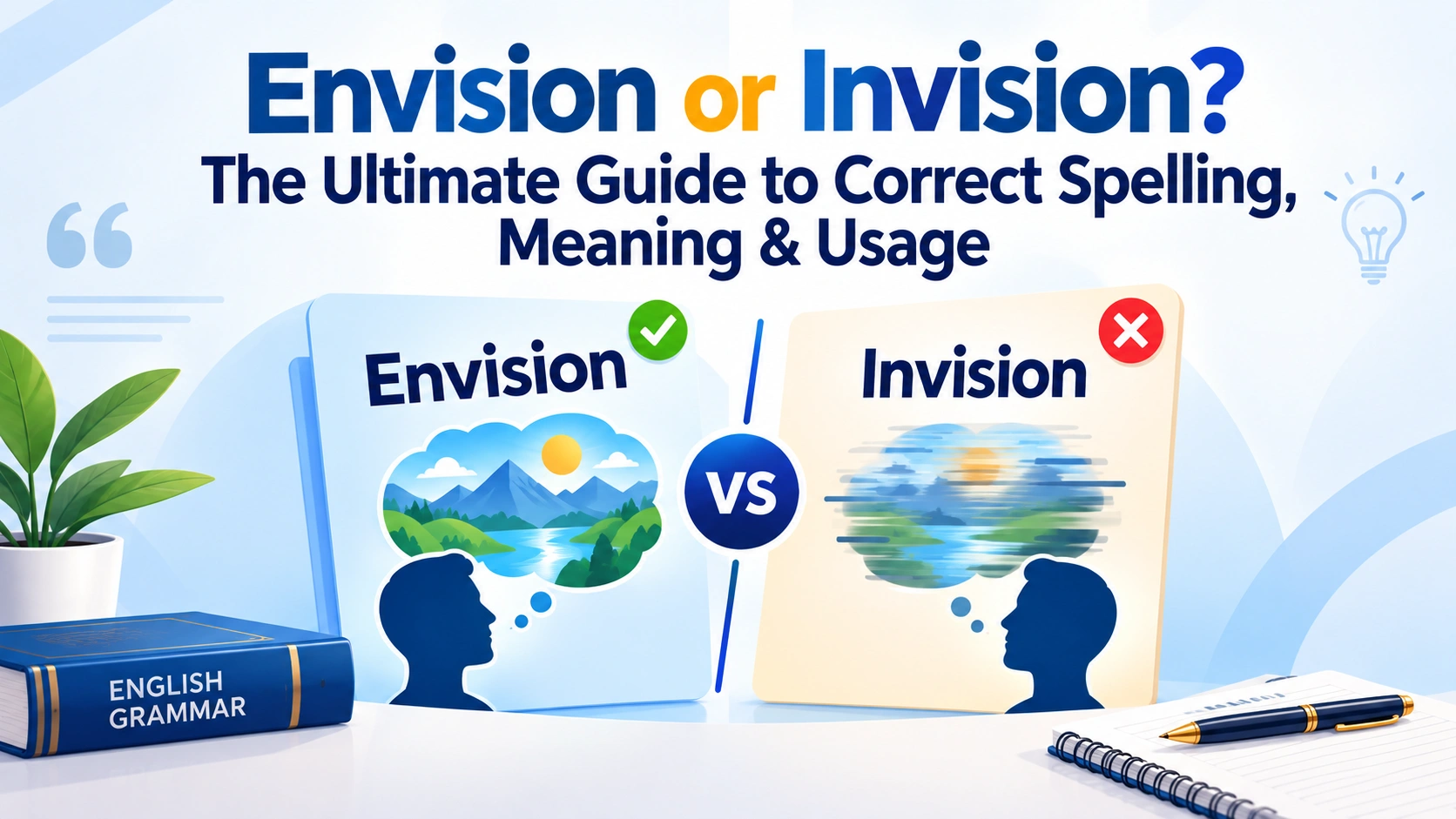
Envision or Invision is an easy spelling question to stumble over because both versions look plausible, especially when you connect the word with “vision.” The correct spelling for the standard English verb is envision. It means to imagine, picture, or form a clear idea of something, particularly a future situation or possibility. Major dictionaries recognize envision as a standard verb, while invision is not the standard spelling for this meaning.
The confusion becomes more interesting when you look beyond spelling. Envision, envisage, imagine, visualize, foresee, and anticipate overlap, but they are not always interchangeable. Regional usage matters too: envisage is especially associated with British English, while envision is the usual North American form. Oxford also notes that envision is particularly common in business and political contexts.
This guide settles the spelling question first, then explains what envision means, how to use it grammatically, why people write “invision,” and when “Invision” may appear as part of a proper name. You will also see practical examples, comparisons with similar verbs, British-versus-American usage, common mistakes, and a simple decision rule you can use whenever you are unsure.
Quick Answer: Is It Envision or Invision?
The standard spelling is envisioned.
- Correct: We envision a more efficient system.
- Correct: She envisions herself running her own business.
- Incorrect in ordinary standard English: We envision a more efficient system.
Envision is a verb meaning to imagine or picture something, especially a future situation or possibility. Merriam-Webster defines it as “to picture oneself,” while Cambridge describes it as imagining or expecting something to happen or appear in a particular way.
There is one important qualification: “Invision” can appear in names of companies, products, organizations, or other proper nouns. For example, Invision AI is a company name. That does not make the standard spelling of the ordinary English verb envision.
Quick rule: If you mean “to imagine a future possibility,” write envision.
What Does “Envision” Mean?
Envision means to form a mental picture or idea of something. It is especially useful when the thing being imagined is future-oriented, planned, or intended as a goal.
For example:
The architects envision a public library that serves the entire neighborhood.
The sentence does more than say that the architects have a vague thought. It suggests that they have a particular picture of what the future library could be.
Cambridge gives a similar sense: envision can mean to imagine or expect something to happen or appear in a particular way.
Is “Envision” a verb?
Yes. Envision is a transitive verb, meaning it normally takes an object.
Examples:
- They envision a new campus.
- I envision a better solution.
- She envisions herself leading the project.
- We envision that the plan will succeed.
Oxford lists several common grammatical patterns, including envision something, envision somebody doing something, envision that…, and envision how/where/what….
Envision vs Invision: Which Spelling Is Correct?
For ordinary English usage, envision is the spelling you want.
| Form | Standard ordinary English verb? | Typical meaning |
| envision | Yes | Imagine or picture something |
| invision | No, not as the standard verb | Usually a spelling error for envision |
| Invision | Can be a proper name | Depends on the organization, product, or brand |
The important distinction is between a dictionary word and a proper name.
If you are writing:
I can envision several ways to solve the problem.
you need to envision.
If you are referring to a company whose official name is Invision, you should preserve its official capitalization and spelling.
Why is “invasion” so tempting?
The mistake makes visual sense.
People see:
in + vision
and naturally assume that vision means something like “put a vision in your mind.”
But English spelling does not always work by combining recognizable pieces in the most intuitive way. The standard verb developed as envision, and that is the form established in modern dictionaries. Merriam-Webster records envision as a verb meaning “to picture to oneself” and dates its first known use to 1855.
Why Do People Spell Envision as “Invision”?
The error is understandable rather than random.
1. The word “vision” is clearly visible
The ending -vision strongly influences how people spell the beginning.
Because vision is a familiar word, writers may mentally construct:
in + vision → invision
instead of remembering the established spelling:
en + vision → envision
2. Pronunciation does not settle the spelling
The first syllable of envision is pronounced similarly to the ordinary English prefix-like sound in words beginning with in-.
That makes the distinction difficult to hear.
A person may know exactly what word they mean but still type the wrong spelling.
3. English contains both “in-” and “en-”
English has many words beginning with both forms:
- include
- inform
- enclose
- encourage
- enable
- enlarge
So a writer cannot reliably reconstruct an envision simply by applying a general prefix rule.
4. The meaning encourages the mistake
Because envision is associated with seeing something mentally, people naturally connect it directly with vision. That semantic connection is correct, but it does not tell you whether the first part should be spelled en- or in-.
Envision vs Envisage: Are They the Same?
In many contexts, envision and envisage express essentially the same idea: imagining or anticipating something, especially something in the future.
The biggest practical difference is regional preference.
Oxford describes envisage as especially British English and says North American English usually uses envision instead.
Cambridge likewise labels envisage as formal and notes that US English also uses envision.
| Feature | Envision | Envisage |
| Core meaning | Imagine a future situation | Imagine a future situation |
| Common in | American/North American English | British English |
| Register | Often formal, especially in business | Formal |
| Example | We envision major changes. | We envisage major changes. |
| -ing form | envisioning | envisaging |
| Past form | envisioned | envisaged |
British English vs American English
Consider:
American English:
How do you envision the project developing?
British English:
How do you envisage the project developing?
Both are natural within their respective varieties.
Neither writer needs to change the meaning simply because the spelling differs.
Which should you choose?
If your audience is primarily American or Canadian, envision is usually the safest choice.
If you are writing specifically for a British audience, envisage may sound more natural.
For international content, envision is perfectly understandable and widely established.
How to Use “Envision” Correctly
The most useful way to master envision is to learn its grammatical patterns rather than memorize isolated sentences.
Envision + noun
This is one of the simplest constructions.
The company envisions a major expansion.
She envisions a peaceful future.
The researchers envision new applications for the technology.
Here, the noun identifies the thing being imagined.
Envision + someone/something + -ing
Use this structure when you imagine a person or thing performing an action.
I can envision them working together.
She envisions herself becoming a teacher.
We cannot envision the system operating without additional support.
Oxford specifically lists the pattern envisioning somebody doing something.
Envision + that-clause
You can also use that followed by a clause.
They envision that the project will be completed next year.
She envisioned that the business would eventually become international.
This construction is grammatically possible, although in some sentences a simpler structure sounds more natural.
Compare:
They envision that the project will succeed.
with:
They envision the project succeeding.
The second is often more compact.
Envision + question word
The verb can introduce an embedded question.
It is difficult to envision how the system will work.
Can you envision what the city might look like in twenty years?
We cannot yet envision where the technology will lead.
These patterns are also documented by Oxford.
The Word Forms of “Envision”
Knowing the correct forms helps prevent spelling errors beyond the base word.
| Grammatical form | Correct spelling | Example |
| Base form | envision | I envision a better future. |
| Third-person singular | envisions | She envisions a new approach. |
| Past tense | envisioned | They envisioned a larger facility. |
| Past participle | envisioned | The changes were originally envisioned. |
| -ing form | envisioning | We are envisioning several possibilities. |
Oxford lists envision, envisions, envisioned, and envisioning as the standard forms.
A common spelling trap is the -ing form. It is:
envisioning
not envisionning.
The verb does not double the final consonant.
Envision vs Imagine: What Is the Difference?
Imagine is broader.
You can imagine a person, event, object, possibility, memory, fictional situation, or hypothetical scenario. Cambridge defines imagine broadly as forming or having a mental picture or idea of something.
Envision tends to work especially well when the mental picture is clear, deliberate, or future-oriented.
Compare:
Imagine living on Mars.
This can simply invite a mental exercise.
Scientists envision humans living on Mars.
This sounds more like a possible future being considered or planned.
Merriam-Webster’s thesaurus notes that envisage and envision can suggest a particularly clear or detailed conception.
A useful rule
Use imagine when the idea is broad.
Use envision when you want to emphasize a particular future picture, goal, or outcome.
Envision vs Visualize
These verbs overlap, but their emphasis can differ.
Visualising often suggests deliberately creating a mental image.
Visualize the layout before you begin drawing.
Envision often suggests imagining how something could exist or develop.
The architect envisions a completely redesigned building.
The distinction is not absolute. In many contexts, either word can work.
A useful professional distinction is:
- Visualize: focus on the mental picture.
- Envision: focus on the broader future possibility or intended outcome.
Envision vs Foresee vs Anticipate
These words are related but should not be treated as interchangeable.
| Word | Main emphasis | Example |
| Envision | Imagine a future possibility | We envision a larger market. |
| Foresee | Predict or recognize something before it happens | We foresee several challenges. |
| Anticipate | Expect something and often prepare for it | We anticipate higher demand. |
| Imagine | Form a mental picture or idea | Imagine a world without traffic. |
| Visualize | Create a mental image | Visualize the finished design. |
This distinction matters in professional writing.
For example:
The company envisions rapid growth.
means the company has a picture or goal involving rapid growth.
The company anticipates rapid growth.
means the company expects rapid growth.
The company foresees rapid growth.
sounds like a prediction about what is likely to happen.
Changing the verb can subtly change the writer’s level of certainty.
Where “Envision” Works Best
Business and strategy
This is one of the strongest environments for envision.
The founders envision the company becoming a regional leader.
The team envisions a more flexible operating model.
Oxford specifically notes that envision is used especially in business and political contexts.
Planning and project management
The designers envision a three-stage rollout.
We initially envisioned the project taking six months.
This use is helpful because it distinguishes the original plan from what eventually happened.
Education
The university envisions a campus centered on collaborative learning.
Students can envision themselves working in different fields.
Creative work
The director envisioned the film as a quiet character study.
The designer envisioned a minimalist interior.
Personal goals
She envisions herself working internationally.
He envisions a career in scientific research.
The word works particularly well when the imagined future is more than a passing thought.
Examples of “Envision” in Realistic Sentences
Everyday examples
- Can you envision living somewhere completely different?
- I never envisioned the trip becoming such a memorable experience.
- She envisioned a quiet weekend at home.
Professional examples
- The company envisions expanding into three new markets.
- The team envisioned several ways to improve customer support.
- Management does not envision major changes this year.
Academic examples
- Researchers envision new applications for the discovery.
- The university envisions a more accessible learning environment.
Future-oriented examples
- How do you envision the industry changing over the next decade?
- I can easily envision this technology becoming more affordable.
- They envision the city becoming a major transportation hub.
Notice the recurring pattern: the word often introduces a mental model of what something could become.
Common Mistakes With “Envision”
Mistake 1: Writing “invision” for the verb
Incorrect:
We invision a better solution.
Correct:
We envision a better solution.
This is the most important spelling correction.
Mistake 2: Assuming “invision” is always meaningless
That is too broad.
Invision can occur in proper names. For example, Invision AI uses Invision as its company name.
The important question is therefore not simply “Does the sequence of letters invision ever appear?”
It does.
The useful question is:
Am I using the standard English verb meaning “to imagine”?
If yes, write envision.
Mistake 3: Treating envision and envisage as different meanings
- They are often regional alternatives.
- They envision major changes.
- They envisage major changes.
Both can express the same basic idea, with regional and stylistic differences.
Mistake 4: Using envision when “anticipate” is more precise
We envision delays.
is possible, but if the intended meaning is specifically expect, anticipate may be clearer:
We anticipate delays.
Choose the verb that communicates the intended relationship with the future.
When “Invision” Can Be Correct
This is where spelling guides sometimes become unnecessarily absolute.
Invision is not the standard spelling of the ordinary English verb envision. However, a capitalized or specially styled Invision may be part of a proper name.
For example, Invision AI identifies itself as Invision AI and describes its work in computer vision and AI.
There are also other organizations and products whose names may use Invision or InVision.
So capitalization and context matter.
Editing test
Ask:
Am I describing an action of mentally imagining something?
- Yes → envision
- No, I am naming a company/product/organization → preserve that entity’s official spelling.
This simple test prevents most errors.
Envision in American vs British English
The regional distinction is worth remembering because it explains why you may encounter different forms in otherwise excellent writing.
| Meaning | American English | British English |
| Imagine a future situation | envision | envisage |
| Formal planning context | envision | envisage |
| “What do you expect?” style question | envision | envisage |
| -ing form | envisioning | envisaging |
| Past form | envisioned | envisaged |
Oxford identifies envisage as especially British English and envision as the usual North American equivalent.
Cambridge likewise lists envisage as a formal verb and identifies US envision as the corresponding form.
Neither spelling is inherently “more correct.” Audience and regional variety determine the better choice.
Is “Envision” Formal or Casual?
Envision is generally more formal than everyday “imagine,” although it is not restricted to formal writing.
Oxford labels it formal and notes its strong use in business and political contexts.
In casual conversation, you might say:
Can you imagine doing that every day?
In a presentation or strategic document, you might say:
We envision a system that reduces unnecessary delays.
That does not mean envision is too formal for conversation. It simply has a more deliberate, future-oriented tone.
A Practical Decision Guide: Which Word Should You Use?
When you are writing quickly, use this decision process.
Step 1: Do you mean “imagine”?
If yes, continue.
Step 2: Are you describing a future possibility, goal, plan, or mental picture?
If yes, envision is often an excellent choice.
Step 3: Are you writing primarily for a British audience?
Consider envisage instead.
Step 4: Are you actually talking about a prediction?
If so, foresee may be more precise.
Step 5: Are you talking about expected demand, events, or problems?
Anticipating may communicate the idea better.
Step 6: Is “Invision” part of a proper name?
If yes, retain the organization’s official spelling.
How to Remember the Correct Spelling
A useful memory trick is to learn the complete word rather than reconstructing it from in + vision.
Think:
ENvision = imagine something in advance
The “en” is part of the established spelling.
Another useful association is the related British form:
envision ↔ envisage
Seeing both forms together makes it easier to remember that the standard English verb does not begin with in-.
Do not rely too heavily on pronunciation. Spelling memory is more reliable here than trying to hear the difference.
Synonyms for “Envision”
Depending on the exact meaning, you can replace envision with:
- imagine
- visualize
- picture
- foresee
- anticipate
- conceive
- see
- project
- envisage
But these are not perfect substitutes.
For example:
The engineers envisioned a safer design.
could become:
The engineers imagined a safer design.
But:
The engineers anticipated a delay.
is different because anticipated emphasizes expectation rather than the creation of a future mental picture.
Good writing is not about finding a synonym that looks different. It is about choosing the word that carries the right shade of meaning.
A Quick “Envision or Invision?” Checklist
Before publishing or submitting your writing, check:
- Use envision for the standard English verb.
- Use envisioned for the past tense.
- Use envisioning for the -ing form.
- Use envisage when British English style calls for it.
- Do not automatically change a proper name containing Invision.
- Choose to anticipate when you mean to expect.
- Choose to foresee when you mean to predict or recognize something in advance.
- Choose to visualize when the emphasis is specifically on creating a mental image.
Conclusion:
The answer to “Envision or Invision?” is straightforward when you separate ordinary vocabulary from proper names: envision is the standard English verb for imagining or picturing a future situation, while invision is not the standard spelling for that meaning. At the same time, Invision can legitimately appear in names, so context still matters.Remember that envisage is not simply a competing spelling error. It is an established formal verb, particularly associated with British English, while envision is especially common in North American English.One final actionable tip: when you mean “picture a future possibility,” choose envision. A common mistake to avoid is assuming that because the word contains vision, it must begin with in-. The safest approach is to remember the whole word: envision.
FAQs
Q1. Is “invision” a word?
Invision can appear in proper names, but it is not the standard spelling of the ordinary English verb meaning “to imagine.” For that meaning, use envision. If Invision appears as part of an official company or product name, retain the name’s established capitalization and spelling.
Q2. Is “envision” American or British English?
Envision is especially common in American and North American English. British English commonly uses envisage for the same general idea. Both forms are established English words, so the best choice depends largely on your intended regional audience and editorial style.
Q3. What is the past tense of “envision”?
The past tense is envisioned. For example: The planners envisioned a larger facility. The past participle is also envisioned, while the -ing form is envisioned. Oxford lists all these standard forms.
Q4. Can I say “envision to do”?
Usually, avoid the construction “envision to do.” More natural patterns include envisioning doing something, envisioning something, or envisioning that something will happen. For example: She envisions working abroad is preferable to She envisions working abroad.
Q5. Is “envision” the same as “imagine”?
They overlap, but envision often emphasizes a clear or detailed future possibility, while imagine has a much broader range of uses. You can imagine almost anything; envision is especially natural when discussing a future state, objective, plan, or intended outcome.