

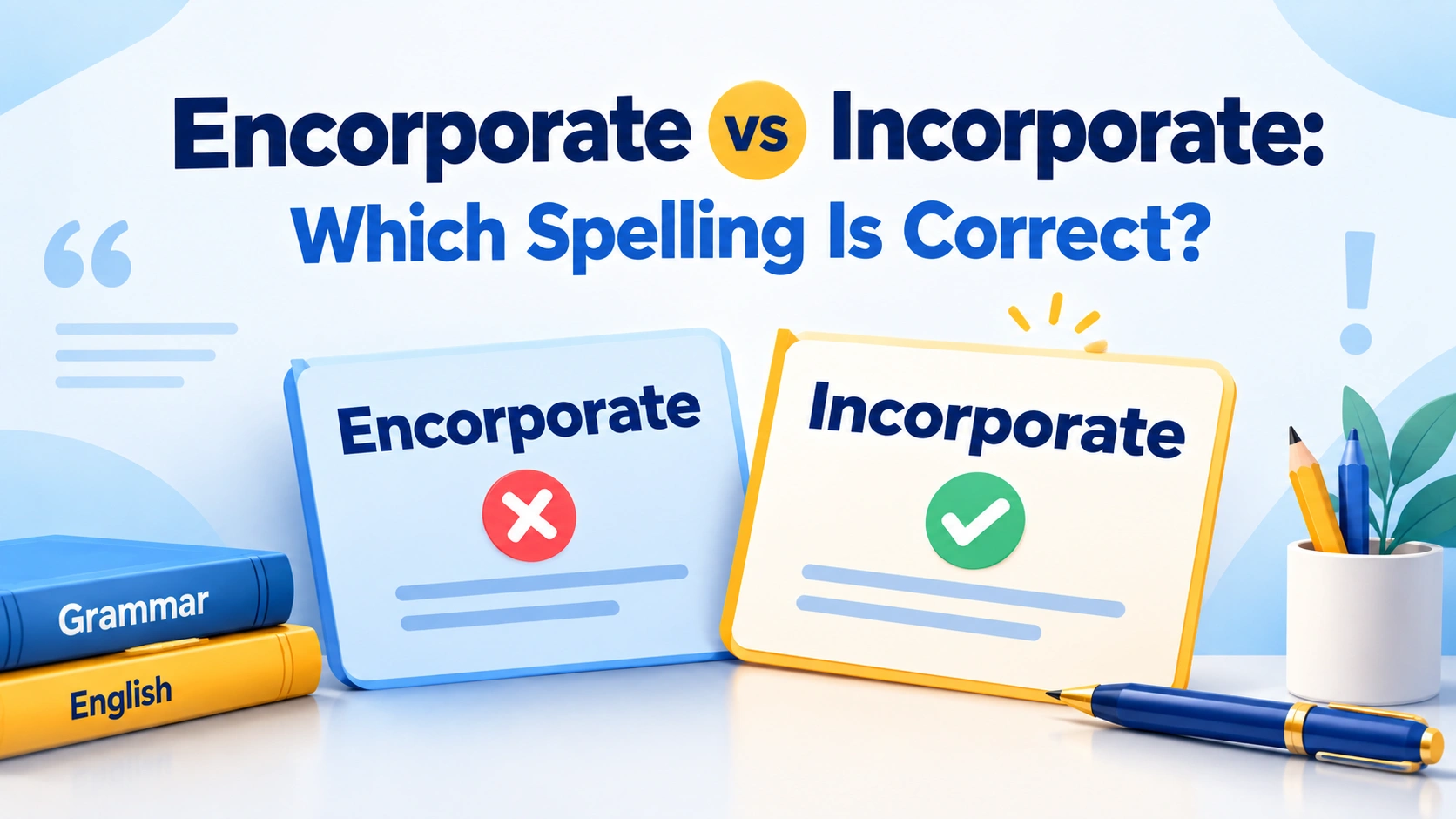
Encorporate vs incorporate is a common spelling confusion, but the answer is straightforward: incorporate is the correct standard English spelling. If you want to say that something is included, combined, or made part of a larger whole, incorporate is the word you need.
The confusion usually comes from pronunciation and from the familiar en- beginning found in words such as enclose, encourage, and enrich. However, incorporate follows a different spelling pattern. It begins with in-, and changing that first vowel produces encorporate, which is not the standard spelling of the verb. Recognizing the correct form matters particularly in academic writing, professional communication, business documents, and formal correspondence.
There is another reason this word deserves a closer look: incorporate has several related meanings. You can incorporate an idea into a report, incorporate new features into software, or incorporate a business in the legal sense. This guide explains all of these uses, shows how incorporate differs from include, integrate, and combine, and gives you practical ways to remember the spelling without relying on guesswork.
Encorporate vs Incorporate: The Quick Answer
The correct spelling is incorporated.
Encorporate is not the standard spelling of this English verb. If you are writing a sentence such as “We need to incorporate the feedback into the proposal,” the first letter after the initial i should be n, not e.
| Word | Correct? | Meaning |
| incorporate | ✓ Yes | Include, combine, or make part of a whole |
| encorporate | ✗ No | Common misspelling of incorporate |
The simplest rule to remember
Think of incorporate as something being put into a larger whole:
We incorporated the new suggestions into the plan.
That connection between in- and into can serve as a useful memory aid.
Remember: When you mean “include or make part of a whole,” spell it incorporate.
What Does “Incorporate” Mean?
Incorporate Meaning in Simple English
Incorporate is a verb meaning to include something as part of a larger whole.
For example:
The teacher incorporated games into the lesson.
The games are not simply mentioned; they have become part of the lesson.
Another example:
The architect incorporated natural light into the design.
Here, natural light is deliberately made part of the overall design.
The word often suggests more than simply adding something. The new element becomes connected to or embedded within an existing structure, plan, system, or idea.
Incorporate Meaning: Include or Add
Sometimes incorporate is close to include or add.
The report incorporates data from several recent studies.
This means the data has been included as part of the report.
However, incorporate can sound more deliberate than add. It often suggests that the writer, designer, teacher, developer, or organization has worked the new element into an existing whole.
Compare:
I added her suggestion to the list.
I incorporated her suggestion into the final proposal.
The first sentence simply tells us that something was added. The second suggests that the suggestion became part of the proposal itself.
Incorporate Meaning: Combine or Blend
Incorporate can also mean to combine something with another thing so that it becomes part of the whole.
The recipe incorporates several traditional ingredients.
The new building incorporates modern and traditional design elements.
This use is especially common when discussing design, art, architecture, writing, food, education, and technology.
Incorporate as a Verb in Business and Law
In business and legal contexts, incorporate has a distinct meaning: to form a corporation as a legal entity.
For example:
The founders decided to incorporate the company.
This does not mean they merely “included” the company in something. It refers to the legal process of establishing a corporation under the applicable law.
That distinction is important because incorporate has both a general English meaning and a specialized business/legal meaning.
Is “Encorporate” a Real Word?
For standard modern English usage, encorporate should be treated as a misspelling of incorporate, not as an alternative spelling that you can freely use.
If you are writing an email, essay, report, application, article, or business document, use:
incorporate
not:
encorporate
This distinction is particularly important for English learners because an unfamiliar word can sometimes look as though it could reasonably exist in more than one spelling.
Why “Encorporate” Is Usually a Spelling Error
The mistake does not usually reflect a misunderstanding of the word’s meaning. Most people who write encorporate intend exactly the same meaning as incorporate.
The problem is simply the spelling.
For example:
❌ We should encorporate these recommendations into the report.
✓ We should incorporate these recommendations into the report.
The second sentence uses the established spelling and should be preferred in standard English.
Does “Encorporate” Have a Separate Meaning?
No separate everyday meaning should be assigned to encorporate merely because it resembles a possible English word.
If your intended meaning is include, combine, or make part of a whole, the standard verb is incorporated.
Why Do People Confuse “Encorporate” and “Incorporate”?
The error is understandable. English spelling does not always follow pronunciation closely, and the beginning of incorporate can be easy to misremember.
Pronunciation Can Make the First Vowel Easy to Mishear
When people encounter a relatively long word primarily through speech, they may not have a clear visual memory of its spelling.
That can lead to a sound-based guess:
“en-corporate”
instead of the correct:
“in-corporate”
Pronunciation is therefore not always a reliable spelling guide.
Confusion With Words Beginning With “En-”
English has many familiar words beginning with en-:
- encourage
- enlarge
- enrich
- enable
- enclose
- enforce
Because en- is a familiar pattern, it can feel natural to insert it into an unfamiliar word.
But English prefixes cannot always be selected simply by analogy with another word. Incorporate has its established spelling and word history, so replacing in- with en- creates an error.
The Influence of Similar-Sounding Words
Long words are particularly vulnerable to phonetic spelling mistakes. When a word is heard rather than seen, speakers may reproduce the sound they remember rather than the letters used in the standard written form.
This is one reason reading widely helps. Repeatedly seeing incorporated in books, articles, reports, and professional documents builds a visual memory of the word.
Typing, Autocomplete, and Spellcheck
Digital writing tools are useful, but they should not replace proofreading.
A spellchecker may identify an obvious misspelling, but not every writing system catches every error. Autocomplete can also reinforce a word that a writer has repeatedly typed.
For important documents, it is better to develop word recognition rather than depend entirely on software.
Second-Language and Translation Influence
English learners may also be influenced by spelling patterns in another language. A word that resembles a familiar construction can encourage an incorrect spelling.
The most effective response is not to memorize a long list of exceptions. Instead, learn the correct word, its common forms, and a few natural sentence patterns together.
Incorporate vs Encorporate: Side-by-Side Comparison
| Point of comparison | Incorporate | Encorporate |
| Standard spelling | Yes | No |
| Meaning “include” | Yes | No |
| Meaning “combine” | Yes | No |
| Business/legal meaning | Yes | No |
| Suitable for formal writing | Yes | No |
| Recommended form | Use | Avoid |
The practical takeaway is simple: there is no spelling choice to make here. When the intended verb is the one meaning “include” or “make part of a whole,” incorporate is the standard form.
How to Spell “Incorporate” Correctly
Break the Word Into Manageable Parts
One useful way to remember the spelling is to recognize its internal structure:
in + corpor + ate
The middle portion connects with the Latin root related to body, which also appears in words such as corporate and corporation.
You do not need to know Latin to spell the word correctly, but recognizing related words can make the spelling easier to retain.
Related Words That Reinforce the Spelling
Learning the word family gives you several visual anchors:
- incorporate
- incorporated
- incorporating
- incorporation
- corporate
- corporation
Notice that the in- spelling remains visible in incorporate, incorporated, incorporating, and incorporation.
A Simple Memory Trick for “Incorporate”
Think:
INcorporate = put something IN the whole.
For example:
Incorporate the new information into the report.
The connection is not a complete spelling rule, but it is a useful memory device.
How to Use “Incorporate” Correctly in a Sentence
Incorporate Something Into Something
The most useful everyday pattern is:
incorporate + something + into + something
Examples:
The designer incorporated several traditional patterns into the new collection.
We should incorporate the customer’s feedback into the revised plan.
The teacher incorporated short quizzes into the course.
This structure clearly expresses the idea that one element becomes part of another.
Incorporate Something in Something
You may occasionally see incorporate followed by in, depending on the sentence structure and intended meaning.
However, when you are specifically describing something being added to an existing whole, incorporating X into Y is often the clearest construction.
Compare:
The designer incorporated local materials into the building.
The preposition into makes the relationship especially clear: the materials are being made part of the design.
Incorporate Something With Something
Which can appear when the sentence focuses on combining elements rather than placing one element into a defined container or structure.
For example:
The designer incorporated modern materials with traditional techniques.
Still, if the intended meaning is that modern materials were added to an existing design, and may communicate the relationship more precisely.
Active and Passive Forms of Incorporate
The active form places the person or organization performing the action first:
The team incorporated the recommendations into the plan.
The passive form shifts attention to what was incorporated:
The recommendations were incorporated into the plan.
The passive form is particularly common in formal reports, academic writing, and professional documentation when the action matters more than who performed it.
Common Verb Forms
| Verb form | Example |
| incorporate | We need to incorporate the changes. |
| incorporates | The design incorporates several new features. |
| incorporating | We are incorporating customer feedback. |
| incorporated | The team incorporated the recommendations. |
Incorporate in Real-World Contexts
Incorporate in Academic Writing
Academic writers frequently use incorporate when discussing evidence, sources, arguments, or feedback.
The revised essay incorporates evidence from several primary sources.
Students should incorporate relevant evidence into their arguments.
Here, the word is useful because it suggests that evidence is not merely listed; it has been worked into the larger argument.
Incorporate in Business and Workplace Communication
Professional writing often uses incorporate for recommendations, feedback, strategies, and changes.
We have incorporated your suggestions into the revised proposal.
The company plans to incorporate customer feedback into its product strategy.
It can sound appropriately precise in this context, although simpler alternatives such as add or include may be preferable when the distinction is not important.
Incorporate in Design and Creative Work
Designers may incorporate:
- colors
- patterns
- cultural references
- materials
- historical influences
- client preferences
For example:
The interior design incorporates natural wood and locally made furniture.
The word suggests that these elements are part of the overall design rather than separate additions.
Incorporate in Technology and Software
Technical writing may describe a system that incorporates:
- new features
- security measures
- external services
- data sources
- user feedback
For example:
The latest version incorporates several accessibility improvements.
However, integration may be a better choice when the emphasis is on different technical systems working together.
Incorporate in Everyday Conversation
You can use incorporate in ordinary speech, but it is somewhat more formal than add.
I’ll incorporate your suggestions into the plan.
is perfectly natural.
But in a casual conversation, you might simply say:
I’ll add your suggestions to the plan.
Neither is inherently better. The choice depends on tone and precision.
Incorporate vs Include vs Integrate vs Combine
These four verbs overlap, but they are not exact substitutes.
| Word | Main idea | Example | Typical nuance |
| Incorporate | Make something part of a larger whole | “We incorporated the feedback into the plan.” | Deliberate addition into an existing whole |
| Include | Contain or add something | “The report includes three charts.” | Broad and straightforward |
| Integrate | Combine elements so they function together | “The software integrates several tools.” | Functional or coordinated connection |
| Combine | Join things together | “Combine the ingredients.” | General joining or mixing |
Incorporate vs Include: What’s the Difference?
Include is the broader and simpler word.
The package includes breakfast.
This simply tells us breakfast is part of what is provided.
Incorporate often gives more emphasis to the process of making something part of an existing whole:
The chef incorporated local ingredients into the menu.
The distinction is subtle, and the words can overlap. Use include when simplicity is enough; use incorporate when the idea of working something into an existing structure matters.
Incorporate vs Integrate: What’s the Difference?
Integrate often emphasizes that separate parts are brought together so that they work as a coordinated system.
The company integrated its new software with the existing database.
Incorporate can describe the addition without placing as much emphasis on functional interaction:
The company incorporated several new features into the software.
In technical contexts, the distinction can matter. If two systems must communicate or operate together, integration is often the more precise choice.
Incorporate vs Combine: What’s the Difference?
Combine simply means to join things together.
Combine the flour and water.
Incorporate generally starts with an existing whole and describes bringing something into it:
The designer incorporated traditional motifs into the modern design.
That difference in perspective is often more useful than trying to memorize a rigid synonym rule.
Which Word Sounds More Natural?
Ask yourself what you are trying to emphasize:
- Include → “Is it part of this?”
- Incorporate → “Was it worked into this?”
- Integrate → “Do these parts now function together?”
- Combine → “Were these things joined?”
This quick test can prevent unnecessary synonym swapping.
Common Grammar and Usage Mistakes With “Incorporate”
Mistake: Writing “Encorporate”
❌ We will encorporate the feedback.
✓ We will incorporate the feedback.
This is a spelling error, not a different grammatical form.
Mistake: Using “Incorporate” When “Include” Is Clearer
Sometimes writers choose to incorporate because it sounds more sophisticated.
The document incorporates your name and contact information.
If the intended meaning is simply that the information appears in the document, includes may be clearer:
The document includes your name and contact information.
Good writing is not about choosing the longest or most formal word. It is about choosing the word that communicates the intended relationship accurately.
Mistake: Choosing the Wrong Preposition
A common structure is:
incorporate X into Y
For example:
The editor incorporated the new paragraph into the article.
When writers are unsure about the construction, this pattern is usually a safe and natural starting point.
Mistake: Assuming Incorporate Always Means “Form a Company”
The business meaning is only one sense of the word.
The teacher incorporated music into the lesson.
has nothing to do with forming a corporation.
Always use the surrounding context to determine which meaning is intended.
Mistake: Confusing “Incorporate” With “Incorporated”
These forms are related but have different grammatical functions.
The company plans to incorporate next year.
Here, incorporate is the verb.
The company is incorporated in Delaware.
Here, incorporated describes the company’s legal status.
Incorporate in Business: What Does “Incorporated” Mean?
The business sense deserves separate attention because it can confuse learners.
What Does It Mean When a Business Is Incorporated?
When a business is incorporated, it has been legally formed as a corporation under the relevant jurisdiction’s laws.
The precise legal effects and requirements depend on the jurisdiction, so the everyday language meaning should not be treated as a universal legal explanation.
For general English purposes, the important distinction is:
incorporate a business = form it as a corporation
while:
incorporate an idea into a plan = make the idea part of the plan
The spelling remains the same even though the meanings differ.
Incorporate vs Incorporation vs Incorporated
| Word | Part of speech | Meaning/use |
| incorporate | Verb | To include, combine, or legally form a corporation |
| incorporation | Noun | The act or process of incorporating |
| incorporated | Past participle/adjective | Having been incorporated |
| corporation | Noun | A legal business entity |
Understanding this word family makes both spelling and grammar easier.
What Does “Inc.” Mean?
Inc. is a common abbreviation for Incorporated in company names in jurisdictions where that designation is used.
For example, a company may have a legal name ending in “Inc.”
The exact rules surrounding corporate designators differ by jurisdiction, so Inc. should not be treated as interchangeable with every other business structure or abbreviation.
Formal vs Informal Use of “Incorporate”
When “Incorporate” Works Well
Incorporate is particularly natural in:
- academic writing
- professional reports
- business communication
- design discussions
- technical documentation
- formal explanations
- policy or strategy documents
For example:
The revised proposal incorporates recommendations from the review committee.
When a Simpler Word May Be Better
In casual communication, add or include may sound more direct.
We should incorporate more examples.
is perfectly acceptable, but:
We should add more examples.
may be more conversational.
The goal is not to eliminate formal vocabulary. It is to avoid unnecessary formality.
Avoiding Unnecessary Formality
Compare:
Formal: We will incorporate the requested changes into the document.
Simpler: We’ll add the requested changes to the document.
The first is useful when discussing a formal revision process. The second may be preferable in a quick message.
Neither is universally superior.
Incorrect vs Correct Examples of “Incorporate”
| Incorrect or less suitable | Correct or clearer version | Reason |
| We will encorporate the feedback. | We will incorporate the feedback. | Encorporate is a misspelling. |
| Please encorporate these ideas. | Please incorporate these ideas. | Use the standard spelling. |
| The team incorporated the data into its analysis. | The team incorporated the data into its analysis. | Natural construction. |
| The designer incorporated the colors into the logo. | The designer incorporated the colors into the logo. | The colors become part of the design. |
| The article incorporates several sources. | The article includes several sources. | Includes may be clearer if simple presence is the only idea. |
Examples for School and Academic Writing
The essay incorporates evidence from historical sources.
The researcher incorporated the participants’ feedback into the final analysis.
The revised paper incorporates several suggestions from the instructor.
Examples for Workplace Emails
We’ll incorporate your comments into the next draft.
I’ve incorporated the requested changes into the presentation.
Examples for Business and Marketing
The campaign incorporates customer testimonials.
The company incorporated sustainability goals into its long-term strategy.
Examples for Everyday Conversation
I can incorporate your idea into the plan.
Let’s incorporate some fresh ingredients into the recipe.
Examples for Technical Writing
The application incorporates additional security features.
The platform incorporates automated reporting tools.
In technical contexts, however, ask whether integration is more precise if separate systems are being connected.
How to Avoid Spelling “Incorporate” Incorrectly
Remember “Incorporate” Starts With “In”
The simplest memory aid is:
Incorporate → put something IN into a whole.
For example:
Incorporate the new information into the report.
The shared “in” sound and visual pattern can help reinforce the correct spelling.
Learn the Word Family Together
Instead of memorizing incorporate as an isolated word, learn it alongside:
- incorporation
- incorporated
- incorporating
- corporation
- corporate
Seeing the family repeatedly makes the spelling less dependent on pronunciation.
Don’t Depend on Pronunciation Alone
English contains many words whose spelling cannot be predicted reliably from sound alone.
If you hear “incorporate,” don’t try to reconstruct the spelling entirely from pronunciation. Recognize the word visually and connect it to familiar forms such as incorporated and incorporation.
Proofread High-Stakes Writing
Give special attention to spelling in:
- job applications
- academic assignments
- business proposals
- professional emails
- published articles
- presentations
- legal or corporate documents
A single spelling error does not necessarily change the meaning, but repeated errors can distract readers from otherwise strong writing.
A Quick Practice: Incorporate or Encorporate?
Fill in the Blank
Choose the correct spelling:
- We need to ______ the new recommendations into the policy.
- The designer ______ traditional patterns into the modern layout.
- The company plans to ______ several accessibility features.
- The revised essay ______ evidence from three sources.
Answers: incorporate, incorporated, incorporate, incorporates.
Correct the Mistake
❌ The editor asked me to encorporate more examples.
Correct version:
✓ The editor asked me to incorporate more examples.
Choose the Best Word
Consider this sentence:
The new application ______ several tools so that users can work from one platform.
Depending on the intended meaning, incorporating or integrating may work.
If the focus is on the tools being included as features, incorporating is suitable. If the focus is on separate tools being connected to function together, integrates may be more precise.
That is an important lesson: good word choice is not always about finding one “correct synonym.” Context determines the best expression.
Conclusion:
When choosing between encorporate vs incorporate, there is a clear answer: incorporate is the standard spelling. The incorrect form is usually the result of pronunciation, prefix confusion, or simply typing the word as it sounds.More importantly, understanding incorporate means knowing how the word works. It can mean to include something in a larger whole, blend or combine an element with an existing structure, or, in business and legal contexts, form a corporation. Its close alternatives—include, integrate, and combine—overlap but are not identical.One final actionable tip: when you mean “make something part of something else,” remember INcorporate → into.A common mistake to avoid: don’t choose incorporate merely because it sounds more sophisticated than add or include. Use it when its particular meaning and tone genuinely fit. Precise word choice is what makes good writing feel effortless.
FAQs
Q1. Is “encorporate” a correct spelling?
No. Incorporate is the standard English spelling for the verb meaning to include, combine, or make something part of a larger whole. Encorporate is generally a misspelling. In formal, academic, professional, or published writing, use incorporate.
Q2. What is the correct spelling: incorporate or encorporate?
The correct spelling is incorporated, beginning with in-. A useful memory aid is to connect the word with the phrase “into a whole.” For example: “The editor incorporated the new evidence into the article.”
Q3. Why do people spell incorporate as encorporate?
The confusion likely comes from pronunciation and familiar English spelling patterns. English contains many words beginning with en-, so encorporate may look plausible. However, spelling should not be reconstructed from sound alone; the established form is incorporated.
Q4. Is incorporate the same as include?
They can overlap, but they are not always identical in nuance. Include simply indicates that something is part of a larger set or whole. Incorporate often suggests that something has been deliberately worked into an existing structure, plan, design, or system.
Q5. What is the correct phrase: incorporate into or incorporate in?
When describing something being added to an existing whole, incorporating X into Y is the clearest and most common construction. For example: “The team incorporated the new recommendations into the proposal.” Other prepositions can occur depending on sentence structure and meaning.