

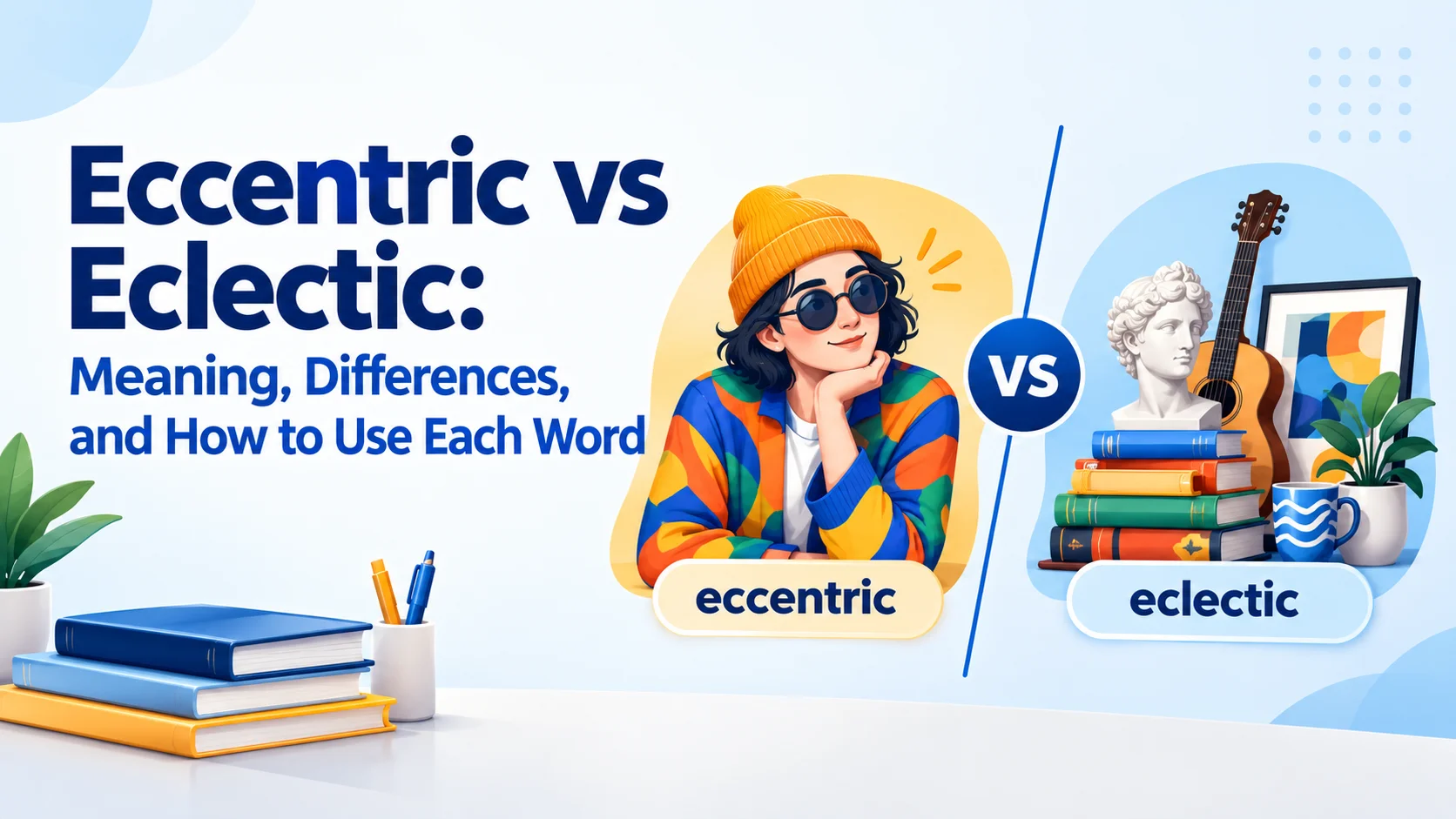
The eccentric vs eclectic distinction becomes much easier once you stop focusing on how similar the words look and focus on what each one describes. Eccentric usually points to something unusually different from what people consider normal or conventional, while eclectic points to a deliberate mixture of ideas, styles, influences, or sources. That difference sounds small, but it changes the meaning of a sentence considerably. Calling someone eccentric comments on their unusualness; calling their musical taste eclectic comments on its range and variety. Knowing which quality you mean is the key to choosing correctly.
These words are also confusing because they can describe similar subjects. A person’s clothing might be eccentric because it is strikingly unconventional and eclectic because it combines influences from several eras or cultures. An artist can have an eccentric personality but an eclectic artistic style. A room can look eccentric because one feature is unusually bold, while its overall design can be eclectic because it brings together modern furniture, antique pieces, and handmade decorations. The important question is not simply, “Is this unusual?” but “What exactly am I emphasizing?”
This guide explains eccentric and eclectic meaning, grammar, pronunciation, word origins, collocations, connotations, and real-world usage. You will see where the words overlap, where they cannot replace each other, and why eclectic does not simply mean “random.” You will also get side-by-side examples, common mistakes, practical editing tests, and comparisons with words such as strange, unconventional, diverse, and varied. By the end, you should be able to choose the right word based on meaning rather than guesswork.
Quick answer:
Use eccentric when you want to emphasize something unusually unconventional, especially a person’s behavior, personality, appearance, or style. Use eclectic when you want to emphasize a mixture of elements, ideas, or influences selected from different sources.
Eccentric vs Eclectic: The Quick Difference
The simplest distinction is:
- Eccentric = unusually different from the norm.
- Eclectic = combining elements from different sources or styles.
Consider these two sentences:
Marcus has an eccentric personality.
The sentence tells us that Marcus behaves or presents himself in an unusually unconventional way.
Marcus has eclectic musical taste.
This tells us that Marcus listens to music from many different styles, genres, or traditions.
The first sentence focuses on unusual behavior. The second focuses on a variety of influences.
That is the central difference.
| Word | Core meaning | Common focus | Typical examples |
| Eccentric | Unusually different or unconventional | People, behavior, appearance, ideas, style | eccentric person, eccentric behavior |
| Eclectic | Combining elements from different sources | Taste, design, music, ideas, collections, approaches | eclectic taste, eclectic style |
| Eccentricity | The quality of being eccentric | Unusual behavior or character | his eccentricity |
| Eclecticism | The practice or quality of combining diverse sources | Ideas, art, philosophy, methods | intellectual eclecticism |
A useful shortcut is to remember odd versus varied. If the sentence is about being noticeably outside the usual pattern, eccentric is probably the better choice. If it is about bringing together things from different sources, eclectic is usually more precise.
What Does “Eccentric” Mean?
Eccentric as an Adjective
As an adjective, eccentric describes someone or something that is noticeably unusual, unconventional, or outside ordinary expectations.
For example:
- She has an eccentric sense of humor.
- The professor wore an eccentric combination of colors.
- His eccentric behavior attracted attention.
- The artist developed an eccentric style.
The word does not necessarily mean something is bad. Depending on context, eccentric can suggest creative, distinctive, amusing, unconventional, or odd.
The important idea is deviation from a perceived norm.
If everyone in an office wears conservative business clothing and one employee arrives every day in theatrical costumes, that employee might be described as eccentric. The description does not primarily tell us that the clothing comes from many different sources. It tells us that the clothing is far outside the expected norm.
Eccentric as a Noun
Eccentric can also function as a noun meaning a person who behaves in an eccentric way.
For example:
The village was known for its colorful eccentrics.
Or:
She was something of an eccentric.
This construction is useful when the person’s unusual character is the main point.
The related noun eccentricity refers to the quality or characteristic itself:
His eccentricity became part of his public image.
This gives you a useful grammatical family:
- eccentric — adjective
- an eccentric — noun for a person
- eccentricity — noun describing the quality
- eccentrically — adverb
Eccentric Can Describe More Than People
Although eccentricity is strongly associated with people, it is not limited to personality.
You can describe:
- eccentric behavior
- eccentric clothing
- eccentric architecture
- eccentric ideas
- eccentric characters
- eccentric artistic choices
- eccentric designs
- eccentric habits
There is also a specialized scientific and mathematical meaning of eccentric, referring to something whose center differs from another reference center. That technical meaning is separate from the everyday sense of “unusual.”
For ordinary writing, however, the unconventional or unusual meaning is usually the one readers expect.
What Does “Eclectic” Mean?
Eclectic describes something that combines, draws from, or selects elements from different sources, systems, styles, or traditions.
For example:
- She has eclectic taste in music.
- The restaurant has an eclectic menu.
- His apartment has an eclectic interior.
- The researcher uses an eclectic approach.
- The exhibition contains an eclectic collection of artwork.
The defining feature is variety with selection.
That last phrase matters. An eclectic combination is not necessarily thrown together without thought. In many contexts, eclectic suggests that someone has chosen useful, attractive, interesting, or valuable elements from different places rather than committing to one single style or system.
What Can Be Eclectic?
The word works particularly naturally with subjects involving collections, preferences, influences, or combinations:
- eclectic taste
- eclectic style
- eclectic music
- eclectic playlist
- eclectic collection
- eclectic wardrobe
- eclectic interior
- eclectic approach
- eclectic background
- eclectic interests
- eclectic range of influences
- eclectic mix of ideas
This is why you will often hear someone say:
She has eclectic taste in music.
The speaker is not necessarily saying that her taste is strange. The point is that she enjoys many different kinds of music.
The Core Difference Between Eccentric and Eclectic
The clearest way to understand the distinction is to ask what the adjective is measuring.
Eccentric measures distance from convention.
Eclectic describes breadth across sources or styles.
Imagine a person wearing a bright green jacket covered with unusual handmade decorations.
If you say:
His outfit is eccentric.
You are emphasizing how unusual the outfit is.
If you say:
His outfit is eclectic.
You are emphasizing that it combines different styles, influences, or types of clothing.
Both statements can be true. They simply highlight different characteristics.
Unusual vs. Diverse
This is why eccentric is closer to words such as:
- unusual
- unconventional
- peculiar
- quirky
- unorthodox
- distinctive
Meanwhile, eclectic overlaps more with:
- diverse
- varied
- wide-ranging
- multifaceted
- mixed
- broadly influenced
They occupy different semantic territory.
Expert rule: When editing a sentence, identify the feature you want the reader to notice first. If it is a departure from convention, choose eccentric. If it has a variety of sources or influences, choose eclectic.
Can Someone or Something Be Both Eccentric and Eclectic?
Yes.
There is no contradiction between the two words because they describe different qualities.
Imagine a musician who wears extremely unconventional clothing and produces songs influenced by jazz, folk, electronic music, classical composition, and regional traditions.
You could reasonably describe the musician as:
- eccentric because their personality or appearance is unusually unconventional;
- eclectic because their musical influences come from many different sources.
However, being eclectic does not automatically make someone eccentric.
A person can have extremely broad musical interests while dressing and behaving conventionally.
Likewise, an eccentric person may have very narrow tastes. Someone could be intensely devoted to one musical genre while having an unusual personality.
The two qualities can overlap, but neither one logically implies the other.
Eccentric vs Eclectic in Real-Life Contexts
Describing People and Personality
Eccentric is particularly natural when describing a person’s behavior or personality:
The eccentric inventor kept a notebook of unusual ideas.
Eclectic is more natural when describing a person’s interests, influences, or tastes:
The professor has eclectic interests ranging from medieval history to modern robotics.
Notice the difference. In the first sentence, the person’s character is unusual. In the second, the person’s range of interests is broad.
Calling someone simply “an eclectic person” is possible in some contexts, but it is usually less precise than specifying what is eclectic:
She has eclectic interests.
He has an eclectic taste in literature.
Fashion and Clothing
Fashion provides an excellent example of overlap.
Eccentric fashion suggests clothing that is striking, unconventional, or unexpected.
Eclectic fashion suggests clothing that combines different styles, periods, or influences.
For example:
Her eccentric outfit included a dramatically oversized hat.
The hat is unusual.
Her eclectic wardrobe combines vintage jackets, modern sneakers, traditional textiles, and minimalist accessories.
The wardrobe is diverse in its influences.
One outfit could be both eccentric and eclectic.
Art and Creative Work
An artist may be called eccentric because of unusual behavior or unconventional artistic choices.
An artwork may be called eclectic because it combines multiple artistic traditions or influences.
For instance:
The painter was known for his eccentric personality.
versus:
Her paintings have an eclectic visual language influenced by folk art, photography, and modern abstraction.
The first describes the person. The second describes the range of artistic influences.
Interior Design
Interior design makes the distinction especially visible.
An eclectic interior deliberately brings together different styles. A room might combine antique furniture, contemporary lighting, handmade textiles, industrial materials, and traditional artwork.
An eccentric interior emphasizes something unusual or unexpected.
For example:
The room had an eccentric ceiling painted with enormous imaginary birds.
The unusual ceiling creates the eccentric quality.
The room had an eclectic design, combining Scandinavian furniture with antique cabinets and colorful textiles.
The variety creates the eclectic quality.
Music and Entertainment
If someone asks about your musical preferences, eclectic is usually the more useful word:
My music taste is eclectic.
That means you listen to many different kinds of music.
Calling your taste eccentric would suggest something more unusual or unconventional about your preferences.
Likewise:
- eclectic playlist → contains varied genres or influences
- eccentric musician → unusually unconventional personality or behavior
- eclectic musical style → draws from multiple genres
- eccentric performance → unusually unconventional or strange
Writing, Ideas, and Intellectual Interests
Eclectic is also useful when discussing approaches to knowledge or ideas.
The author takes an eclectic approach, drawing on history, psychology, economics, and literature.
Here, the important point is that the writer does not rely on one intellectual tradition.
Eccentric, by contrast, suggests that an idea or approach departs noticeably from established expectations:
The researcher proposed an eccentric theory that challenged conventional assumptions.
The theory may be unconventional without being a mixture of multiple systems.
Common Collocations With Eccentric
Natural word combinations make correct usage much easier to recognize.
Common examples include:
- eccentric person
- eccentric personality
- eccentric behavior
- eccentric character
- eccentric habits
- eccentric clothes
- eccentric appearance
- eccentric style
- eccentric ideas
- eccentric artist
- eccentric approach
- eccentric design
The strongest collocations tend to involve people, behavior, personality, appearance, or noticeable departures from convention.
Common Collocations With Eclectic
Common combinations include:
- eclectic taste
- eclectic interests
- eclectic style
- eclectic mix
- eclectic collection
- eclectic approach
- eclectic background
- eclectic influences
- eclectic range
- eclectic playlist
- eclectic interior
- eclectic design
- eclectic ideas
The common thread is combination, breadth, selection, or multiple influences.
Eccentric vs Eclectic: Natural Example Sentences
Examples With Eccentric
- The eccentric artist painted murals on the walls of his studio.
- Her eccentric sense of humor surprised everyone at the meeting.
- The character has an eccentric habit of collecting antique clocks.
- His eccentric clothing made him easy to recognize in a crowd.
- The novelist created an eccentric character with unusual routines.
- Her eccentric approach to problem-solving produced an unexpected solution.
- The architect was famous for several eccentric designs.
Examples With Eclectic
- She has an eclectic taste in music.
- The apartment contains an eclectic mix of old and new furniture.
- His eclectic reading list includes poetry, science, history, and biographies.
- The restaurant offers an eclectic menu inspired by several cuisines.
- The band’s eclectic sound is difficult to place in one genre.
- Her eclectic interests make conversations with her unpredictable and interesting.
- The researcher adopted an eclectic approach to the subject.
Side-by-Side Examples That Change the Meaning
| Sentence | What it emphasizes |
| He has an eccentric style. | His style is unusual or unconventional. |
| He has an eclectic style. | His style combines different influences. |
| She is an eccentric artist. | Her personality or behavior is unconventional. |
| She is an artist with eclectic influences. | Her work draws from different sources. |
| His taste is eccentric. | His preferences are unusual. |
| His taste is eclectic. | His preferences cover many different styles or categories. |
| The room is eccentric. | Something about its design is unusually unconventional. |
| The room is eclectic. | Its design combines multiple styles or influences. |
Common Mistakes With Eccentric and Eclectic
Mistake 1: Using “Eclectic” to Mean “Strange”
This is probably the most important misunderstanding.
An eclectic collection may look unusual, but eclectic itself does not simply mean strange.
❌ He has an eclectic personality because he behaves strangely.
✅ He has an eccentric personality because he behaves strangely.
If the emphasis is on unusual behavior, eccentric is the more accurate choice.
Mistake 2: Calling a Mixed Collection “Eccentric”
A collection containing objects from many periods, cultures, or styles may be eclectic.
The museum shop has an eclectic selection of gifts.
The variety is the defining feature.
Calling the selection eccentric would suggest that the selection itself is unusually strange rather than simply diverse.
Mistake 3: Thinking “Eclectic” Means Random
An eclectic combination can be carefully chosen.
A designer might deliberately combine traditional furniture with contemporary art. A researcher might intentionally use methods from several disciplines. A musician might deliberately blend multiple genres.
The combination is varied, but it is not necessarily accidental.
Mistake 4: Assuming “Eccentric” Is Always Negative
Context determines the tone.
Compare:
The eccentric inventor was admired for his originality.
with:
His eccentric behavior made collaboration difficult.
The first is sympathetic or appreciative. The second is more critical.
The word itself signals unusualness; the surrounding context determines whether that unusualness is presented positively, neutrally, or negatively.
Mistake 5: Assuming “Eclectic” Is Always Praise
Eclectic often sounds complimentary, particularly when describing taste or design, but it is not automatically praised.
An editor might describe a collection as eclectic while implying that its elements lack a strong unifying principle.
So do not treat eclectic as a guaranteed synonym for “excellent” or “sophisticated.”
Is Eccentric a Positive or Negative Word?
Eccentric is context-dependent.
It can be positive when unusualness is associated with creativity, individuality, originality, or charm:
Her eccentric designs became her trademark.
It can be negative when unusual behavior is presented as disruptive, confusing, or inappropriate:
His eccentric behavior made the workplace uncomfortable.
There is also a neutral descriptive use:
The novel features an eccentric scientist.
Here, the adjective simply tells readers that the scientist behaves differently from conventional expectations.
A good writer therefore avoids assuming that eccentricity automatically insults someone. The surrounding sentence supplies much of the emotional meaning.
Is Eclectic Always a Positive Word?
Not necessarily.
In everyday descriptions of music, fashion, design, or interests, eclectic often carries a favorable or neutral sense because variety can suggest openness and breadth.
But the word can also be used critically.
For example:
The book takes an eclectic approach, combining theories without explaining how they fit together.
Here, eclectic describes variety, while the second part of the sentence supplies the criticism.
This distinction is useful in professional writing. Do not automatically replace varied or mixed with eclectic simply to make a description sound more sophisticated. Choose the word because it accurately describes the relationship among the elements.
Eccentric vs Strange vs Unconventional
These words overlap, but they are not identical.
| Word | Main idea | Typical implication |
| Eccentric | Unusually different from convention | Often associated with distinctive people or behavior |
| Strange | Unfamiliar, unusual, or difficult to understand | Broad and potentially negative |
| Unconventional | Not following established conventions | Often neutral and deliberate |
| Quirky | Distinctively unusual in an amusing or appealing way | Often informal and relatively positive |
| Unorthodox | Departing from accepted methods or beliefs | Common in formal or professional contexts |
For example, a scientist may use an unconventional method without behaving eccentrically. A character can be eccentric without being frightening or bizarre. A strange event may simply be unfamiliar rather than deliberately unconventional.
Eclectic vs Diverse vs Varied vs Random
These words are related, but precision matters.
| Word | What it emphasizes | Example |
| Eclectic | Selection from different sources or styles | an eclectic collection of art |
| Diverse | Presence of meaningful differences | a diverse group of writers |
| Varied | A range of different types | a varied menu |
| Mixed | Elements of different kinds together | a mixed collection |
| Random | Lack of an apparent selection principle | a random assortment |
The crucial distinction is that eclectic often suggests selection.
A person with eclectic taste does not necessarily like things randomly. Their preferences may span many categories because they deliberately appreciate different styles.
Eccentric vs Eclectic Word Origins
The histories of these words provide a surprisingly useful memory device.
Where “Eccentric” Comes From
Eccentric entered English with a technical meaning connected to circles and orbits that were not centered in the expected way. Its Greek source contains the idea of being outside the center.
That original image provides a powerful modern metaphor:
Eccentric = away from the center → away from the norm.
The everyday meaning later developed toward describing people who behaved in unusual or unconventional ways.
Where “Eclectic” Comes From
Eclectic comes through French from Greek eklektikos, associated with selecting or picking out. Historically, it was used in connection with thinkers who selected ideas or doctrines from different systems rather than adhering exclusively to one.
That history connects naturally with the modern meaning:
Eclectic = selecting from different sources.
The word eventually broadened into its familiar modern uses involving styles, tastes, methods, ideas, and influences.
How the Origins Help You Remember the Difference
Think of two images:
Eccentric: a person standing outside a circle.
Eclectic: a person choosing useful pieces from several different boxes.
The first represents departure. The second represents selection and combination.
How to Remember Eccentric vs Eclectic
The “Odd vs Many” Memory Trick
Use this simple pair:
Eccentric = odd or unconventional.
Eclectic = many styles or sources.
It is not a complete definition of either word, but it is a reliable first test.
The “Person vs Taste” Shortcut
Another useful shortcut is:
- Eccentric person
- Eclectic taste
This works because eccentric commonly describes a person’s distinctive behavior, while eclectic commonly describes the range of someone’s preferences.
But treat it as a memory aid, not a grammar rule. You can have eccentric clothing, an eclectic person with varied interests, an eclectic approach, and an eccentric design.
A Simple Test for Choosing the Right Word
When you are unsure, ask these three questions.
1. Am I emphasizing unusualness?
If yes, choose eccentric.
The designer created an eccentric chair shaped like an enormous flower.
The chair is unusual.
2. Am I emphasizing a mixture of sources?
If yes, choose eclectic.
The designer created an eclectic room combining Japanese, industrial, and Victorian influences.
The room contains different influences.
3. Are both ideas present?
Then both words may work, but they will highlight different aspects.
She has an eccentric fashion sense.
Focus: unusualness.
She has an eclectic fashion sense.
Focus: variety of styles.
Her eccentric, eclectic wardrobe combines vintage pieces with modern streetwear.
Here, the writer intentionally communicates both qualities.
Eccentric vs Eclectic in Formal, Academic, and Professional Writing
Academic Writing
Eclectic is useful when discussing theories, methods, intellectual traditions, or research approaches drawn from multiple sources.
For example:
The study adopts an eclectic methodological framework.
This tells the reader that the approach incorporates elements from different methods.
Eccentric should be used carefully in academic writing because it can carry a subjective judgment about something being unusually unconventional.
If neutrality matters, alternatives such as unconventional, atypical, or nontraditional may sometimes be more precise.
Professional Writing
In professional descriptions, eclectic can work well for:
- design
- branding
- architecture
- creative work
- product collections
- cultural interests
Eccentric can be more sensitive when applied to people. Calling a colleague, client, executive, or customer “eccentric” may sound judgmental even if you intend it as a compliment.
When professional neutrality matters, consider whether unconventional, distinctive, or individualistic communicates your point more precisely.
Everyday Conversation
In casual speech, both words are perfectly useful.
You might say:
My uncle is a little eccentric.
Or:
My sister has incredibly eclectic taste in movies.
The first comments on personality. The second comments on range.
British and American English Usage
The core meanings of eccentric and eclectic are broadly consistent in British and American English.
The main difference learners may notice is pronunciation notation rather than meaning. Both words are established in standard English on both sides of the Atlantic.
Eccentric is generally pronounced approximately:
ik-SEN-trik
Eclectic is approximately:
ih-KLEK-tik
The stress falls on the middle syllable in both words, but the stressed sounds are different.
Do not let their similar spelling encourage you to treat them as semantic twins. Their meanings remain distinct in both major varieties of English.
How to Pronounce Eccentric and Eclectic
Pronunciation of Eccentric
Eccentric: /ɪkˈsen.trɪk/
Think:
ik-SEN-trik
The strongest stress is on SEN.
Pronunciation of Eclectic
Eclectic: /ɪˈklek.tɪk/
Think:
ik-KLEK-tik
The strongest stress is on KLEK.
Why Their Similar Endings Cause Confusion
The words look alike because both contain the sequence -centric / -lectic and have three syllables. But pronunciation reinforces their difference:
- ecCENtric
- eKLEKtic
More importantly, the semantic roots point in different directions: eccentricity is about being outside the expected center, while eclecticism is about selecting from different sources.
Related Words and Useful Contrasts
Words Related to Eccentric
Depending on context, related words include:
- unusual
- unconventional
- quirky
- peculiar
- unorthodox
- distinctive
- idiosyncratic
- individualistic
These are not perfect synonyms. Quirky, for example, often sounds lighter and more affectionate, while unorthodox is particularly useful for methods, beliefs, or professional practices.
Words Related to Eclectic
Useful related words include:
- diverse
- varied
- mixed
- wide-ranging
- multifaceted
- broad
- heterogeneous
- cross-disciplinary
Again, context determines the best choice. Diverse emphasizes difference; eclectic more strongly suggests selection or combination from different sources.
Useful Contrasts
- eccentric ↔ conventional
- eccentric ↔ conventional behavior
- eclectic ↔ uniform
- eclectic ↔ narrowly focused
- diverse ↔ homogeneous
- varied ↔ uniform
These contrasts can help you identify the intended meaning when editing.
Editing Examples: Fixing Eccentric vs Eclectic Usage
Example 1: A Person With Unusual Behavior
❌ The teacher has an eclectic habit of arriving at school in a costume.
✅ The teacher has an eccentric habit of arriving at school in a costume.
Why? The sentence emphasizes unusual behavior, not a mixture of sources.
Example 2: A Music Collection From Many Genres
❌ She has an eccentric collection of jazz, classical, folk, and electronic music.
✅ She has an eclectic collection of jazz, classical, folk, and electronic music.
Why? The defining feature is the range of musical influences.
Example 3: An Unusual Interior
Both words may be possible:
The room has an eccentric design.
This emphasizes something unusual about the design.
The room has an eclectic design.
This emphasizes the combination of different design traditions.
The correct choice depends on what the writer wants the reader to notice.
Example 4: A Person With Wide-Ranging Interests
❌ He is eclectic because he enjoys history, astronomy, poetry, and cooking.
✅ He has eclectic interests, ranging from history and astronomy to poetry and cooking.
The second version makes the source of the variety explicit and sounds more natural.
When to Use Eccentric vs Eclectic: The Editor’s Rule
A strong editing rule is surprisingly simple:
Use “eccentric” when the important feature is unusualness. Use “eclectic” when the important feature is variety drawn from different sources.
Before choosing the word, identify the noun you are describing and the property you want to communicate.
- If you are describing a person’s behavior, eccentric may be appropriate.
- If you are describing a person’s taste, eclectic may be more precise.
- If you are describing design, either word could work, but the meaning changes:
- unusual design → eccentric
- mixed design influences → eclectic
And if both qualities genuinely exist, there is nothing wrong with using both.
The best vocabulary choice is not the most impressive-sounding one. It is the one that gives the reader the exact mental picture you intended.
Conclusion
The most useful way to remember eccentric vs eclectic is to separate unusualness from variety. Eccentric tells readers that something stands noticeably outside conventional expectations; eclectic tells them that something draws from multiple sources, styles, or traditions. That distinction becomes especially valuable when describing people, fashion, music, art, design, writing, and intellectual interests. One final actionable tip: when editing a sentence, ask whether you are describing how unusual something is or how many different influences it contains. A common mistake to avoid is treating eclectic as a fancy synonym for strange. Once you identify the quality you actually mean, the correct word usually becomes obvious—and your writing becomes considerably more precise.
FAQs
Q1. What is the difference between eccentric and eclectic?
Eccentric describes something noticeably unusual or unconventional, especially behavior, personality, or style. Eclectic describes something that combines elements from different sources, styles, or systems. A person can therefore be eccentric while having eclectic interests. The words overlap sometimes, but their main semantic focus is different.
Q2. Can a person be both eccentric and eclectic?
Yes. Someone can be eccentric because their behavior or appearance is unconventional and eclectic because their interests or tastes span many different sources. The two adjectives describe different qualities, so one does not cancel out the other. Context determines which characteristic matters.
Q3. Is eclectic a synonym for diverse?
Not exactly. Both words involve variety, but eclectic often suggests selecting or combining elements from different sources, while diverse simply emphasizes difference or range. An eclectic collection is usually diverse, but a diverse group or population is not necessarily eclectic.
Q4. Is eccentric always a negative word?
No. Eccentric can be neutral, positive, or negative depending on context. It may suggest creativity, originality, or individuality, but it can also imply behavior that others find strange or difficult. The surrounding language and situation determine whether the unusualness is being admired, tolerated, or criticized.
Q5. Which word should I use for someone’s music taste?
Use eclectic when the person enjoys music from many different genres, periods, or traditions. For example, she has an eclectic taste in music. Use eccentric only when you want to emphasize that the person’s musical preferences themselves are unusually unconventional rather than simply broad.