

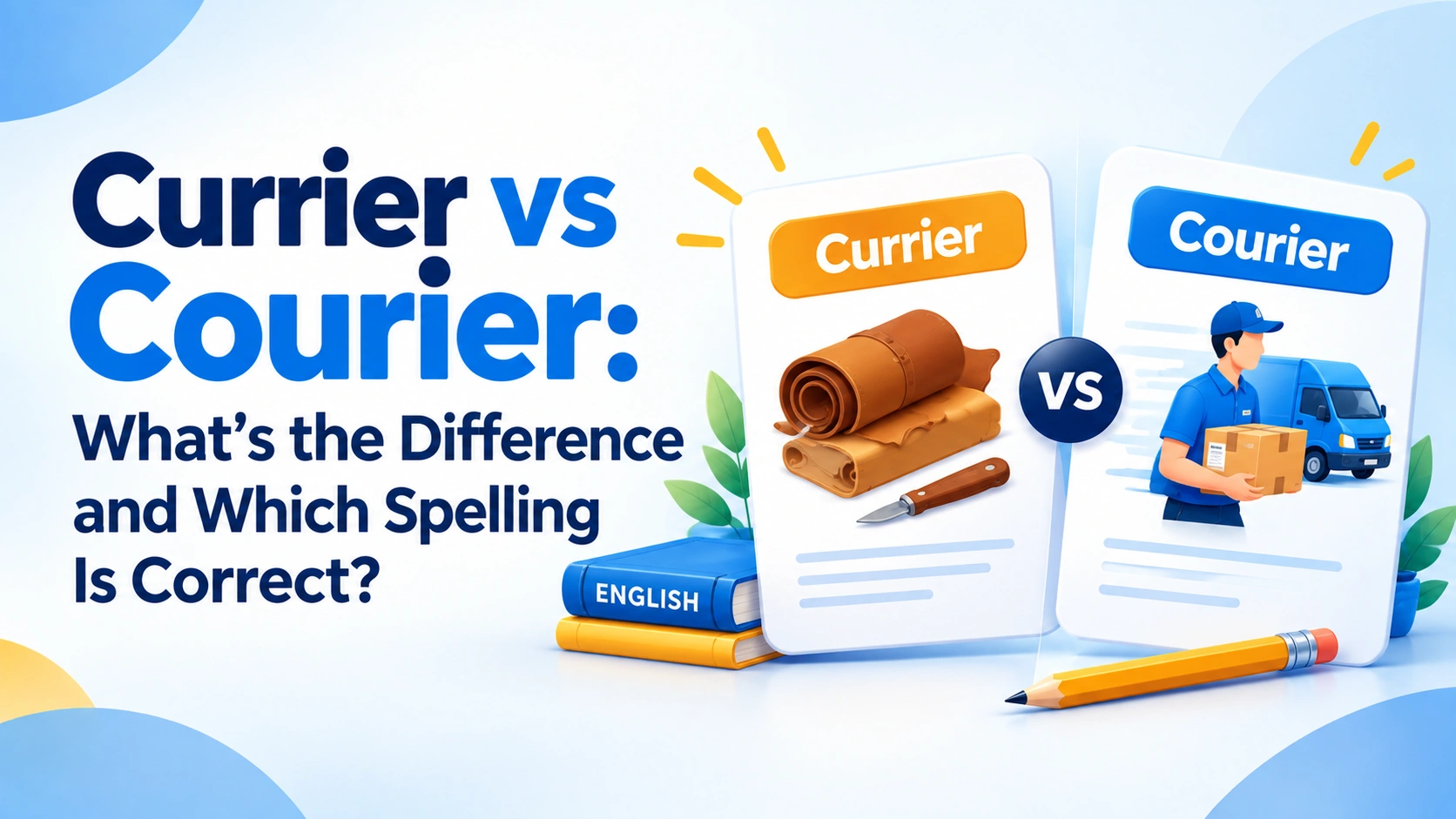
Currier vs courier can be confusing because the two words look and sound remarkably similar, yet they refer to completely different things. If you are talking about someone who delivers a package, document, or message, courier is the word you want. Currier, meanwhile, is a legitimate but much less common word for someone who prepares and finishes leather after it has been tanned.
The confusion is understandable. Most modern readers encounter courier regularly through shipping, e-commerce, business deliveries, and document services, while currier is usually encountered in historical, occupational, or leatherworking contexts. That difference in everyday exposure makes currier look like a possible spelling mistake when it is actually a separate English word with its own history and meaning.
In this guide, you will learn the exact difference between currier and courier, when each word is correct, how the two words developed, and how to avoid confusing them in your writing. You will also see practical examples, pronunciation guidance, common mistakes, and a simple memory trick that makes the distinction much easier to remember.
Currier vs Courier: The Quick Answer
The simplest distinction is this:
Courier = someone or a company that carries and delivers messages, documents, or packages.
Currier = someone who prepares and finishes tanned leather.
A courier can be a person, a delivery worker, or, in modern business English, a company or service responsible for collecting and delivering items. Cambridge also records courier as a verb meaning to send something using a courier.
A currier is a specialist in leather processing. Traditionally, the currier worked on hides after the tanning stage, preparing the leather for later uses. Major dictionaries define the word in terms of dressing, finishing, or otherwise preparing tanned leather.
Currier vs Courier at a Glance
| Word | Meaning | Typical context | Frequency in modern everyday English |
| Courier | A person or company that carries or delivers messages, documents, or packages | Shipping, logistics, business, delivery | Common |
| Currier | A person who prepares and finishes tanned leather | Leatherworking, history, traditional trades | Uncommon/specialized |
So, if your sentence is about a parcel being delivered, use courier. If it is about someone working with tanned leather, currier may be the correct word.
What Does “Courier” Mean?
A courier is a person or service responsible for carrying something from one place to another, particularly messages, documents, or packages.
Cambridge defines a courier in modern business usage as a person or company whose job is to collect and deliver packages or documents. The word can also refer to someone who carries messages or documents for another person.
Courier in Modern English
Today, courier is strongly associated with delivery and logistics.
You might encounter the word when discussing:
- Parcel delivery
- E-commerce orders
- Business documents
- Legal papers
- Medical materials
- Express delivery
- Same-day delivery
- International shipments
- Courier services
For example:
The courier delivered my package before noon.
We sent the signed contract by courier.
The company uses a local courier for urgent documents.
The word can describe the individual doing the delivery or, depending on context, the business providing the service.
“Courier” as a Verb
One useful detail that is often overlooked is that courier can also function as a verb.
For example:
The replacement documents were couriered to the office.
Cambridge records this business use as meaning to send a package or document using a courier.
That makes courier more versatile in modern English than many learners realize.
Other Meanings of “Courier”
The word has also had broader meanings historically. A courier was traditionally a messenger who traveled quickly to deliver letters or dispatches. Historical dictionaries record older uses involving messengers, postal travel, and diplomatic communication.
There is also a travel-related British English sense in which a courier may be a person employed by a travel company to assist a group of travelers.
These meanings share an underlying idea: someone who travels or carries something on behalf of another person or organization.
What Does “Currier” Mean?
A currier is a person who works with leather, particularly tanned leather that needs further dressing, finishing, or coloring.
The American Heritage Dictionary defines a currier as someone who prepares tanned hides for use, while Collins describes the occupation as working with tanned leather.
This is a specialized occupational term, which explains why many modern English speakers recognize courier immediately but rarely encounter currier.
What Does a Currier Actually Do?
A currier traditionally worked on leather after tanning.
At a simplified level, the distinction looks like this:
Raw hide → tanning → currier’s finishing work → usable finished leather
The currier’s work could involve processes intended to improve the leather’s appearance, flexibility, consistency, and suitability for later use. Historical and dictionary sources describe the currier as a specialist who dressed and colored leather after tanning.
The finished material could then be used by other trades, including makers of footwear, saddlery, gloves, and other leather goods.
Currier vs Tanner
This is an important distinction if you encounter currier in historical writing.
A tanner and a currier were not necessarily performing the same stage of leather production.
| Occupation | Main role |
| Tanner | Processes hides to turn them into leather through tanning |
| Currier | Further prepares, dresses, and finishes tanned leather |
| Leatherworker/craftsman | Uses prepared leather to make finished goods |
The exact division of labor varied by period and place, so these occupations should not be treated as perfectly rigid modern job descriptions. Historical sources show that tanning and currying were recognized as related but distinct crafts. For example, the Yorkshire Historical Dictionary records regulations distinguishing the curious craft from other occupations in medieval and early modern York.
Examples of “Currier” in Sentences
The currier prepared the tanned hides for further use.
His ancestor worked as a currier in the leather trade.
The historical document lists a currier among the town’s craftsmen.
Notice how the surrounding vocabulary—hides, tanned, leather, craftsman, trade—makes the meaning clear.
Currier vs Courier: The Key Difference
The difference is meaning, not simply spelling.
Courier belongs primarily to the world of messages, transportation, delivery, and logistics.
Currier belongs primarily to the world of leather processing and traditional craftsmanship.
That means neither word is inherently “more correct” than the other. The correct choice depends on what you mean.
Compare These Two Sentences
The courier delivered the package.
This is correct because the person is delivering a package.
The currier prepared the leather.
This is correct because the person is working with leather.
Now consider:
The currier delivered the package.
If currier is intended to mean a delivery person, this is incorrect. The appropriate word is courier.
But:
The courier prepared the leather.
This would also be wrong if you mean the traditional leatherworking occupation. The appropriate term is currier.
A Simple Context Test
When you are uncertain, look at the nouns and verbs around the word.
| If the sentence mentions… | Choose… |
| Package | Courier |
| Parcel | Courier |
| Delivery | Courier |
| Documents | Courier |
| Shipment | Courier |
| Message | Courier |
| Leather | Currier |
| Tanned hides | Currier |
| Leatherworking | Currier |
| Dressing leather | Currier |
This is more reliable than trying to remember the spelling alone.
Why Do People Confuse Currier and Courier?
There are several reasons the words are easy to mix up.
They Look Almost Identical
Both words contain the familiar sequence cur-/cour- followed by -rier/-rier. To someone reading quickly, the difference can be easy to overlook.
They Sound Similar
The pronunciation also contributes to the confusion. Cambridge gives several accepted pronunciations for courier, including forms beginning roughly like “KUR-ee-er” or “KOO-ree-er,” depending on variety.
Currier is pronounced approximately “KUR-ee-er” in American English, with British pronunciation also varying by accent.
Because pronunciation varies, hearing the word is not always enough to identify the spelling.
“Currier” Is Much Less Familiar
This is probably the biggest practical reason for modern confusion.
Most people regularly encounter couriers through deliveries. Far fewer encounter curiers unless they read historical material, study occupations, research family history, or work with traditional leathercraft.
As a result, a reader may see currier and assume that the writer accidentally changed the spelling of courier.
That assumption is not justified. Currier is a genuine English word.
The Origins of “Courier” and “Currier”
Interestingly, the words have different etymological histories, even though their modern forms are similar.
Where “Courier” Comes From
Courier ultimately traces back through French and Italian forms to Latin currere, meaning “to run.” Historical sources connect the word with swift movement, runners, and messengers.
The historical connection makes intuitive sense: an early courier was essentially someone who traveled quickly to carry a message or dispatch.
The meaning gradually developed into the modern concept of a person or service responsible for carrying messages, documents, and goods.
Where “Currier” Comes From
Currier has a different history. It comes through Middle English and Old French forms ultimately connected with Latin coriarius, associated with leather, from corium, meaning hide or leather.
So although courier and currier look like close relatives, their etymologies point in different directions.
A useful conceptual shortcut is:
- Courier → movement and messages
- Currier → leather and hides
Courier vs Currier: Examples in Real Situations
The easiest way to master the distinction is to see how each word behaves in context.
Situation 1: Online Shopping
Your order will be delivered by courier tomorrow.
Courier is correct because the sentence concerns delivery.
Situation 2: Sending Legal Documents
The solicitor sent the signed documents by courier.
Again, the courier is correct because documents are being transported.
Situation 3: Historical Leather Trade
The town’s records mention several curriers among its craftsmen.
Curriers is correct because the sentence concerns the leather trade.
Situation 4: Historical Occupation
His ancestor was a currier who worked with tanned hides.
The context clearly identifies the leatherworking occupation.
Situation 5: A Spelling Error
❌ The currier is expected to deliver your parcel.
✅ The courier is expected to deliver your parcel.
The first sentence uses the leatherworking term where the delivery term is intended.
Common Mistakes With Currier and Courier
Mistake 1: Treating “Currier” as a Misspelling
This is the most important mistake to avoid.
Currier is not simply a misspelled form of courier. It is a dictionary-recognized noun with a specialized meaning.
Mistake 2: Assuming “Courier” Is Always About Packages
A courier can carry messages and documents, not only parcels. Historically, the word was strongly associated with messengers and dispatches.
So:
She sent the confidential letter by courier.
is perfectly natural.
Mistake 3: Choosing by Sound Alone
Because pronunciations overlap considerably, listening for the vowel is not a dependable way to choose the spelling.
Instead, determine what the person is doing.
Are they delivering something? → courier
Are they preparing leather? → currier
Mistake 4: Modernizing a Historical Text Incorrectly
If you are editing or interpreting an old document, do not automatically replace every occurrence of currier with courier.
Historical occupations matter. A record describing a currier’s shop, for example, may genuinely be referring to a leatherworking establishment. Historical dictionaries and regional sources document the occupation extensively.
How to Remember the Difference
A simple memory trick is:
Courier carries. Currier works with leather.
Think of courier = delivery.
Think of currier = leather.
Another useful approach is to remember that currier is connected historically with currying leather, while courier developed around the idea of a runner or messenger. Their histories therefore reinforce their modern meanings rather than merely providing arbitrary spelling differences.
Quick tip: If you could replace the word with “delivery person,” you almost certainly mean courier. If you could replace it with “leather worker,” currier is the relevant word.
Is “Currier” Still Used Today?
Yes, but it is far less common in everyday English than “courier.”
The word remains useful when discussing the history of leatherworking, traditional trades, occupational records, historical documents, and specialized craftsmanship. Dictionaries continue to recognize currier as a current English noun.
It can also appear as a surname or in proper names. One famous example is Nathaniel Currier, the American lithographer associated with Currier & Ives; this is a proper name rather than the occupational noun.
The important point is that uncommon does not mean incorrect.
A word can become specialized or relatively rare without disappearing from the language.
When Should You Use “Courier”?
Use courier when you mean:
- A person who delivers packages
- A company that transports documents or parcels
- Someone carrying a message or dispatch
- A delivery service
- Someone responsible for transporting something on another person’s behalf
Examples
We hired a courier to deliver the contract.
The courier service collected the parcel this afternoon.
A courier brought the documents to the embassy.
The replacement part will be couriered to the customer.
When Should You Use “Currier”?
Use currier when you are specifically referring to:
- A leather-processing specialist
- A person who dresses tanned leather
- A traditional leatherworking occupation
- A historical leather trade
Examples
The currier prepared the hides for the next stage of production.
The museum exhibit explains how a medieval currier worked.
His family had been curriers for several generations.
If the context has nothing to do with leather, currier is probably not the word you want.
Courier vs Currier vs Carrier
One additional word deserves attention: carrier.
Because carrier is also used in delivery contexts, writers sometimes confuse all three terms.
| Word | Core meaning | Example |
| Courier | Person/service that carries or delivers messages, documents, or packages | The courier delivered the parcel. |
| Carrier | Person/company/vehicle that transports something | The carrier transported the shipment. |
| Currier | Specialist who prepares tanned leather | The currier dressed the leather. |
Courier and carrier can overlap in logistics contexts, but they are not automatically interchangeable in every sentence.
Currier, however, belongs to an entirely different semantic field.
A Practical Editing Checklist
If you are proofreading an article, email, essay, historical document, or business message, use this quick check:
- Is someone delivering a package? → courier
- Is someone delivering a document? → courier
- Is someone carrying a message? → courier
- Is the sentence about a delivery company? → courier
- Is someone preparing tanned leather? → currier
- Is the text describing a historical leather trade? → currier
- Does “currier” appear in a historical occupational record? → Do not automatically change it
- Are you unsure? → Look at the surrounding context rather than choosing based on spelling
The most useful editing principle is simple: identify the meaning before correcting the spelling.
Conclusion:
The difference between currier vs courier becomes straightforward once you stop treating the words as competing spellings. Courier is the everyday word for someone or a service that carries or delivers packages, documents, or messages. Currier is a legitimate, specialized term for someone who prepares or finishes tanned leather. Their similar appearance is mainly what creates the confusion; their meanings and etymological histories are distinct.One final actionable tip: before correcting either spelling, read the entire sentence and identify the job or action being described. Delivery points to courier; leatherworking points to currier.A common mistake to avoid: never change currier to courier simply because the former looks unfamiliar. In a historical or leatherworking context, currier may be exactly the word the writer intended.
FAQs
Q1. Is “Currier” a correct spelling of “Courier”?
Yes, but currier and courier are different words. Courier refers to someone or a service that carries or delivers messages, documents, or packages. Currier refers primarily to someone who prepares or finishes tanned leather. Neither is a misspelling of the other when used in its proper context.
Q2. Is a currier the same as a courier?
No. A currier works with leather, particularly tanned hides, while a courier carries or delivers messages, documents, or packages. Their similar spellings can cause confusion, but their meanings and historical origins are different.
Q3. How do you pronounce “courier”?
Pronunciation varies by English variety. Cambridge lists American pronunciations including forms such as /ˈkʊər.i.ər/ and /ˈkɜr.i-/, while British pronunciation is commonly represented around /ˈkʊəriə/. Regional accents can therefore make the word sound different.
Q4. Is “currier” an obsolete word?
Not exactly. Currier is uncommon and specialized, but it remains a recognized English word. It is particularly relevant when discussing leatherworking, historical occupations, genealogy, or traditional crafts. Its lower frequency in everyday conversation does not make the word obsolete or incorrect.
Q5. What is the easiest way to remember currier vs courier?
Use the meaning-based rule: courier = carries; currier = leather. If the sentence involves parcels, documents, messages, or delivery, choose courier. If it involves tanned hides or leather finishing, choose currier. Context is more reliable than trying to memorize the spellings in isolation.