

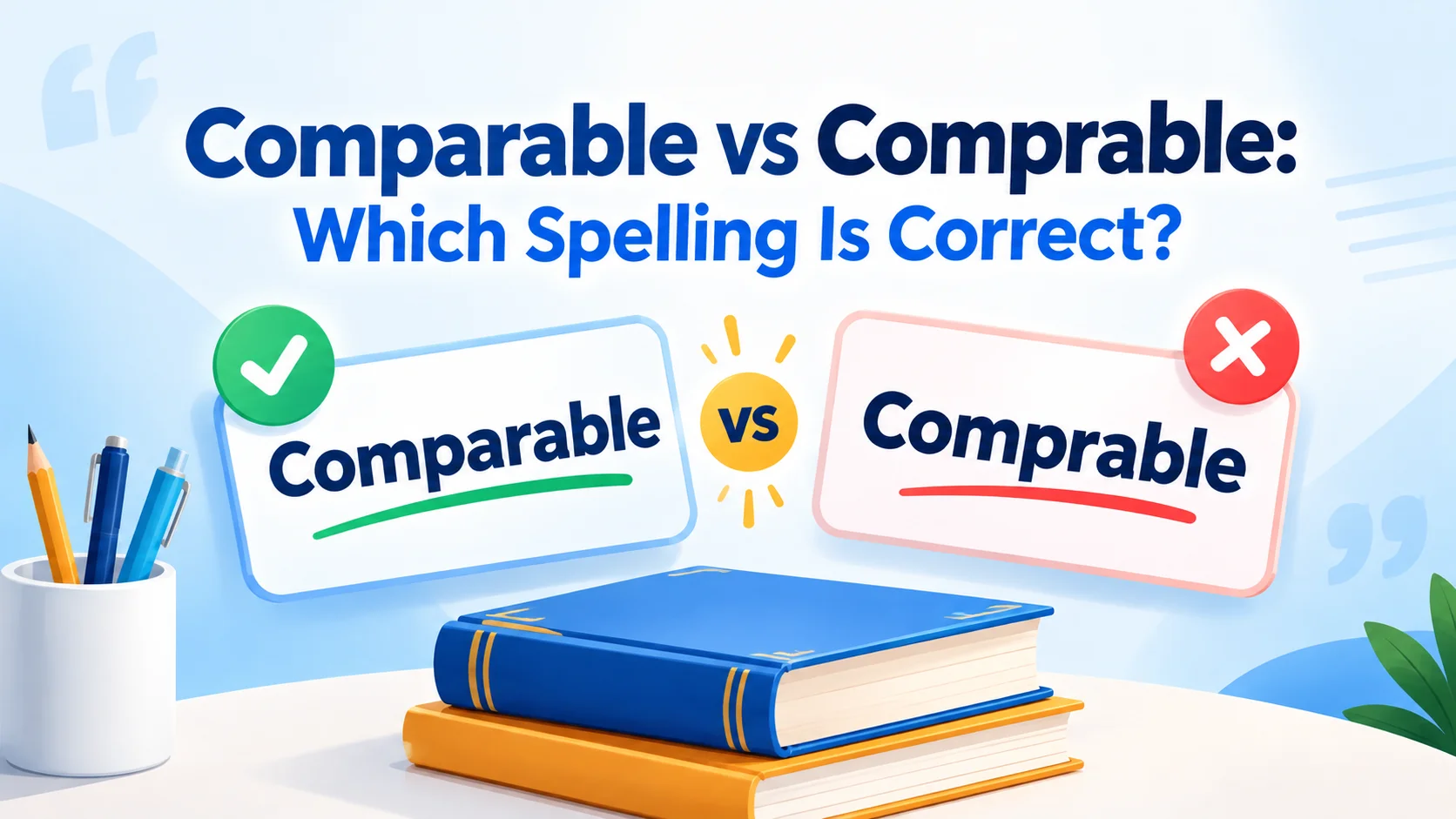
Comparable vs comprable is a surprisingly common spelling confusion, especially because both forms look as though they could belong in standard English. The correct spelling is comparable, with an a after the “p”: comparable. The form comprable is a misspelling in standard English. Once you connect the word to compare, the spelling becomes much easier to remember. In this guide, you will learn what comparable means, why comprable looks plausible, how to pronounce the word, how to use it naturally, and how it differs from words such as similar, equivalent, and comparative.
The confusion is not simply a matter of forgetting one letter. Comparable has several unstressed syllables, so its pronunciation does not always make every part of the spelling obvious. Writers may also mentally shorten compare + able into a form that resembles comprable. That is why a quick spelling check is useful, particularly in academic writing, business communication, reports, product descriptions, and professional documents. Knowing the word’s structure gives you a more reliable solution than memorizing the correct spelling in isolation.
There is also a useful meaning distinction hiding behind this spelling question. Comparable does not mean identical, and it does not always mean that two things are similar in every respect. It normally indicates that two things are sufficiently alike in a relevant way to make a meaningful comparison. That subtlety matters in professional and academic writing. By the end of this article, you will know not only how to spell comparable, but also when to use it, which prepositions work naturally with it, and when another word would be more precise.
The Quick Answer: “Comparable” Is Correct
The standard English spelling is:
Comparable ✓
The following spelling is incorrect in standard English:
Comprable ✗
For example:
- Correct: The two laptops offer comparable performance.
- Correct: Her salary is comparable to the industry average.
- Correct: The two studies produced comparable results.
- Incorrect: The two laptops offer comprable performance.
- Incorrect: Her salary is comprable to the industry average.
The easiest way to remember the spelling is to start with compare:
compare → comparable
The word keeps the central a from comparing. The spelling is not comprable because the adjective is historically and structurally connected to compare, not to a shortened form such as compr.
Comparable vs. Comprable at a Glance
| Form | Correct? | What it means |
| comparable | Yes | Similar enough to be meaningfully compared |
| comprable | No | Nonstandard misspelling of comparable |
| compare | Yes | To examine two or more things for similarities and differences |
| comparison | Yes | The act or result of comparing |
| comparative | Yes | Relating to comparison |
If you are writing an email, essay, report, application, or article, use comparable.
What Does “Comparable” Mean?
Comparable is an adjective used when two or more things are sufficiently similar in a relevant respect that they can be meaningfully compared.
For example:
The two houses are comparable in size and price.
This does not mean the houses are identical. One might have a larger garden while the other has a newer kitchen. The important point is that their size and price provide a reasonable basis for comparison.
A dictionary definition commonly describes comparable in terms of being similar in size, amount, or quality to something else.
Comparable Means “Suitable for Comparison”
Consider these examples:
- The two smartphones have comparable battery life.
- The candidates have comparable levels of experience.
- The new model provides comparable performance at a lower price.
- The researchers collected data under comparable conditions.
In each case, the writer identifies something that can reasonably be compared.
Comparable Does Not Mean Identical
This is one of the most important points to understand.
If two products are identical, they are the same in all relevant respects. If they are comparable, they are similar enough for a particular comparison.
For example:
The two cameras are comparable in image quality.
They might still differ in:
- price
- weight
- design
- battery life
- lens options
The word comparable therefore allows for differences.
Expert tip: When precision matters, specify what is comparable. “The products are comparable” is less informative than “The products are comparable in price, durability, and performance.”
Why Do People Spell “Comparable” as “Comprable”?
The misspelling comprable looks believable because English spelling does not always mirror pronunciation perfectly.
The Missing “A” Is the Main Problem
A reader may see:
compare → comparable
but mentally simplify the middle of the word and produce:
comprable
The result looks compact and familiar, even though it is not the standard spelling.
Pronunciation Can Contribute to the Mistake
Comparable contains several syllables, and some of its vowel sounds are less prominent than others in natural speech. When people hear or say the word quickly, they may not consciously notice every written vowel.
This is a common reason why spelling by sound can be unreliable.
Fast Typing Makes the Error Easier
When typing quickly, writers often omit letters from longer words without realizing it. A missing vowel can be particularly difficult to notice when the resulting form still looks like a plausible English word.
For example:
“The two options are comparable.”
At a glance, the sentence may look completely normal. The error becomes obvious only when you slow down and inspect the word.
The Better Strategy: Remember the Word Family
Instead of memorizing comparable as a random sequence of letters, connect it with:
- compare
- comparison
- comparative
- comparably
- comparability
That network gives you several spelling clues.
How to Spell “Comparable” Correctly
A useful way to remember the spelling is to divide the word conceptually:
compare + able → comparable
This is a spelling aid rather than a claim that modern speakers consciously build the word every time they use it.
The crucial visual sequence is:
compar-a-ble
The a must remain.
The Word-Family Method
If you already know how to spell compare, you have a strong starting point for comparable.
| Word | Example |
| compare | We compare the two products. |
| comparison | The comparison was useful. |
| comparable | The products are comparable. |
| comparative | The study used a comparative approach. |
| comparably | Both teams performed comparably well. |
This is more reliable than trying to remember the spelling from pronunciation alone.
A Five-Second Spelling Check
When you hesitate between comparable and comprable, ask:
“What is the base word?”
The answer is compare.
Then write:
compare → comparable
That simple association eliminates the missing-letter problem.
How Do You Pronounce “Comparable”?
Pronunciation varies somewhat between British and American English, but both varieties retain the standard spelling comparable.
Cambridge gives British pronunciations including /ˈkɒm.pər.ə.bəl/ and /kəmˈpær.ə.bəl/, and American pronunciations including /ˈkɑːm.pər.ə.bəl/ and /kəmˈper.ə.bəl/.
For learners, the most useful lesson is not to force every letter into a strong spoken sound. The word contains several relatively light syllables.
Why Pronunciation Can Cause the Spelling Error
English learners often expect every vowel to be equally noticeable. In longer words, that expectation can lead to spelling mistakes.
When comparable is spoken naturally, some of its syllables are less prominent. A listener may therefore remember the overall sound without retaining the exact sequence of letters.
That is why this approach is risky:
“I will spell it exactly as it sounds.”
Instead, use pronunciation and word structure together.
An Easy Pronunciation Trick
Start with the familiar word:
compare
Then extend it:
compare → comparable
Do not try to invent the spelling from the spoken word each time.
How to Use “Comparable” in a Sentence
The most common uses of comparable describe similarity in a specific quality, measurement, standard, or characteristic.
“Comparable to”
This is a very common construction:
The new model is comparable to the previous version.
More examples:
- The quality is comparable to that of a premium product.
- Her results were comparable to those of the other students.
- The cost is comparable to what we paid last year.
- The experience was comparable to working with a specialist.
“Comparable with”
Comparable with is also possible, particularly when the writer is emphasizing comparison between things. Cambridge examples and usage information show that both comparable to and comparable with occur.
For general writing, however, comparable to is often the most straightforward choice:
The results are comparable to those from the earlier study.
There is no need to avoid comparable with simply because comparable to is common.
“Comparable in”
Use comparable in when you want to identify the specific characteristic being compared.
Examples:
- The two houses are comparable in size.
- The products are comparable in quality.
- The candidates are comparable in experience.
- The two machines are comparable in performance.
This construction can make professional writing much more precise.
“Of Comparable…”
The word can also appear before a noun:
- products of comparable quality
- businesses of comparable size
- students of comparable ability
- properties of comparable value
This form is especially useful when making formal comparisons.
Comparable vs. Similar: Are They the Same?
Comparable and similar overlap, but they are not interchangeable in every sentence.
Similar generally means that two things are alike in some way.
Comparable emphasizes that the things are sufficiently alike in a relevant respect to make a meaningful comparison.
Compare:
The two paintings are similar.
This makes a broad statement about resemblance.
Now consider:
The two paintings are comparable in value.
This tells us that their value provides a meaningful basis for comparison.
Cambridge defines similar as being almost, but not exactly, the same. Comparable is more focused on the relationship that makes comparison reasonable.
A Practical Difference
Imagine two jobs.
The jobs are similar.
This could refer to duties, schedules, workplaces, or general responsibilities.
The jobs offer comparable salaries.
Now the writer has identified a specific dimension: salary.
| Word | Main focus | Example |
| similar | General resemblance | The designs are similar. |
| comparable | Meaningful basis for comparison | The designs are comparable in cost. |
| equivalent | Similar value, function, or effect | The two treatments are considered equivalent for this purpose. |
| identical | Exactly the same | The two copies are identical. |
Choosing the right word makes your writing more precise.
Comparable vs. Compare vs. Comparative
These words belong to the same family, but they perform different grammatical jobs.
Compare: The Verb
Compare is a verb.
We compared the two proposals.
It describes the action of examining similarities and differences.
Comparison: The Noun
Comparison is a noun.
The comparison revealed several important differences.
It names the act or result of comparing.
Comparable: The Adjective
Comparable is an adjective.
The two proposals are comparable.
It describes the things being considered.
Comparative: The Adjective
Comparative is also an adjective, but its meaning is different.
The report provides a comparative analysis of the two markets.
Here, comparative means related to or involving comparison.
A simple way to keep them separate is:
Compare = do the comparing
Comparison = the comparison itself
Comparable = suitable for comparison
Comparative = relating to comparison
When Is Something Actually Comparable?
This is where careful writing matters most.
Two things do not become comparable merely because someone places them side by side. There needs to be a reasonable basis for comparison.
Comparable in One Respect, Different in Another
Consider two smartphones.
They may be:
- comparable in price
- comparable in processing power
- comparable in camera quality
Yet one may have a much larger screen.
The correct statement is not necessarily:
These phones are comparable in every way.
A more accurate statement would be:
These phones are comparable in performance and price.
Context Determines Comparability
The same two objects can be comparable for one purpose and not comparable for another.
For example, two universities might be comparable in:
- tuition
- student population
- research output
but not necessarily in:
- location
- campus design
- degree offerings
That is why professional writers often specify the dimension of comparison.
Best practice: If a reader could reasonably ask “Comparable in what way?”, add the relevant characteristic.
Where “Comparable” Commonly Appears
The word is particularly useful when writers need to make careful, measured comparisons.
Business and Finance
Examples include:
- comparable companies
- comparable sales
- comparable performance
- comparable costs
- comparable growth
A business report might say:
Revenue increased while remaining comparable with the previous reporting period.
Real Estate
Real-estate professionals often use comparables as a noun for properties used as reference points when evaluating another property’s value.
For example:
The agent examined several comparable properties before estimating the home’s market value.
Here, comparables has developed a specialized business meaning.
Shopping and Product Reviews
You may see:
This model offers comparable features at a lower price.
This wording is useful because it avoids claiming that two products are exactly the same.
Academic and Scientific Writing
Researchers frequently need to determine whether results, groups, measurements, or experimental conditions can reasonably be compared.
Examples:
- comparable data
- comparable populations
- comparable conditions
- comparable results
- comparable measurements
In these contexts, comparability can be an important methodological consideration.
Common Phrases With “Comparable”
Learning common combinations is often more useful than memorizing isolated definitions.
Common Patterns
| Pattern | Example |
| comparable to | The results are comparable to earlier findings. |
| comparable with | The figures are comparable with those reported previously. |
| comparable in size | The buildings are comparable in size. |
| comparable in quality | The alternatives are comparable in quality. |
| comparable in price | The products are comparable in price. |
| comparable results | Both methods produced comparable results. |
| comparable performance | The device offers comparable performance. |
| comparable value | The service provides comparable value. |
| comparable conditions | The tests were conducted under comparable conditions. |
| comparable level | The students reached a comparable level of proficiency. |
These patterns also reveal something important: comparable often works best when the writer identifies the particular feature being compared.
Real-World Examples of “Comparable”
In Everyday Conversation
“Is there anything comparable to this?”
The speaker is looking for an alternative that is sufficiently similar for the comparison to be useful.
At Work
“The two positions have comparable responsibilities.”
The statement suggests that the responsibilities are similar enough in relevant respects.
While Shopping
“I’m looking for a cheaper option with comparable features.”
This is especially useful when the writer does not want to claim that the cheaper product is identical.
In Education
“The two classes achieved comparable results.”
The results were sufficiently similar to justify comparison.
In Research
“The researchers needed comparable data from both groups.”
The word implies that the data must be sufficiently alike in relevant characteristics for a valid comparison.
In Real Estate
“The agent selected comparable properties in the same general market.”
Here, the comparison is being used for a practical valuation purpose.
Comparable in Formal and Professional Writing
Comparable is particularly useful in formal writing because it can express similarity without exaggerating it.
Compare these sentences:
The new product is the same as the old one.
and:
The new product offers comparable performance to the previous model.
The second sentence makes a narrower and often more defensible claim.
Why Professionals Use “Comparable”
Professional writing frequently needs to distinguish between:
- exact equality
- approximate similarity
- functional equivalence
- suitability for comparison
Comparable occupies a useful middle ground. It allows a writer to say that two things can be compared without claiming that they are identical.
Make the Comparison Measurable When Possible
Instead of:
The systems have comparable performance.
Prefer:
The systems have comparable processing speeds under the tested conditions.
The second version tells the reader what was compared and under what circumstances.
Common Mistakes With “Comparable”
Mistake 1: Writing “Comprable”
This is the central spelling error.
✗ The results were comprable.
✓ The results were comparable.
Remember:
compare → comparable
Mistake 2: Assuming Comparable Means Identical
Comparable things can differ significantly outside the characteristic being discussed.
The two cars are comparable in fuel efficiency.
This does not mean they have the same design, price, engine, or safety features.
Mistake 3: Using Comparable Without Explaining the Basis
In casual conversation, this may be perfectly acceptable:
“The two are comparable.”
In technical or professional writing, it can be vague.
A stronger sentence may be:
“The two products are comparable in price and battery life.”
Mistake 4: Confusing Comparable With Comparative
These words are related but not interchangeable.
✓ The products have comparable prices.
✓ The report contains a comparative analysis.
Mistake 5: Treating Similar and Comparable as Exact Synonyms
They overlap, but comparable often carries a more specific implication: the comparison itself is meaningful or appropriate.
Comparable vs. Similar vs. Equivalent vs. Identical
These four words can create very different impressions.
| Word | Basic meaning | Strength of claim |
| similar | alike in some respects | Broad |
| comparable | sufficiently alike for meaningful comparison | Context-dependent |
| equivalent | equal or interchangeable in a relevant respect | Stronger |
| identical | exactly the same | Strongest |
Consider two software tools.
The tools are similar.
This is broad.
The tools are comparable in functionality.
This identifies a basis for comparison.
The tools are equivalent for this task.
This suggests they can serve the same purpose under the stated conditions.
The tools are identical.
This claims there is no relevant difference.
The right choice depends on the evidence you actually have.
Comparable Synonyms and Near-Synonyms
Depending on context, possible alternatives include:
- similar
- akin
- analogous
- equivalent
- corresponding
- alike
But substitution should not be automatic.
For example:
The two situations are similar.
works naturally when discussing general resemblance.
The two situations are comparable.
places more emphasis on whether a meaningful comparison can be made.
Likewise, equivalent usually makes a stronger claim than comparable. If two things merely share certain characteristics, comparable may be more accurate.
Antonyms of Comparable
Common contrasting terms include:
- incomparable
- dissimilar
- different
- unrelated
- unequal
The most interesting is incomparable because it does not always mean “bad” or “inferior.”
It can mean that two things are too different to compare meaningfully:
The two studies used such different methods that their results are not directly comparable.
It can also appear in promotional or literary language to mean exceptionally distinctive:
The artist’s influence was considered incomparable.
Context determines the intended sense.
Is “Comprable” Ever Correct?
In ordinary standard English, comprable is not the accepted spelling of the adjective.
If you are writing:
“The two options are ___.”
the correct completion is:
comparable
not:
comprable
You may occasionally encounter a misspelling online, in informal user-generated text, or when someone is specifically discussing spelling errors. Seeing the form in print does not make it a standard dictionary spelling.
For schoolwork, professional communication, formal documents, and published content, use comparable.
A Simple Trick to Remember “Comparable”
The most dependable memory trick is:
COMPARE has an A, and COMPARABLE keeps it.
Think of the word family:
compare → comparable
Then reinforce it with:
comparison → comparative → comparably
If you see yourself typing:
comprable
stop and ask:
“Where did I go?”
That tiny mental check can prevent the error immediately.
A Visual Reminder
You can mentally highlight the important part:
compARable
Or remember:
compar + able = comparable
The exact visual method does not matter. What matters is connecting the adjective to compare rather than memorizing comparable as an unrelated sequence of letters.
Quick Reference Guide
| Question | Answer |
| Which spelling is correct? | Comparable |
| Is “comprable” standard English? | No |
| What part of speech is comparable? | Adjective |
| What does comparable mean? | Similar enough to be meaningfully compared |
| What is its base word? | Compare |
| Common preposition | Comparable to |
| Can you use “comparable in”? | Yes |
| Does comparable mean identical? | No |
| Is similar always interchangeable with comparable? | No |
| Is comparative the same as comparable? | No |
| Useful spelling trick | compare → comparable |
Conclusion
When choosing between comparable vs. comprable, the answer is clear: comparable is the correct standard spelling. The easiest way to remember it is to connect the adjective with compare, preserving the important a in the word family. More importantly, understand what the word actually communicates. Comparable means that things are sufficiently alike in a relevant respect to make a meaningful comparison; it does not mean they are identical. One final actionable tip: when writing professionally, specify what is comparable—price, quality, size, performance, or another measurable feature. A common mistake to avoid is using comparable as though it automatically means the same. Precise comparisons make stronger writing, and accurate spelling makes those comparisons easier to trust.
FAQs
Q1. Is “comprable” a real English word?
Comprable is not the standard spelling of the adjective in modern English. The correct form is comparable. If you see comprable in ordinary prose, it is generally a spelling error. Use comparable in academic, professional, business, and formal writing.
Q2. What is the correct spelling: comparable or comprable?
The correct spelling is comparable, with an a after the “p.” A useful way to remember it is to connect the adjective with its base word: compare → comparable. The spelling comprable leaves out part of that established word pattern.
Q3. Why do people spell comparable as comprable?
The error can arise because comparable is relatively long and contains lightly pronounced syllables. When people hear or type the word quickly, the internal vowel may be overlooked. Remembering the relationship between compare and comparable is more reliable than spelling it from sound.
Q4. Is “comparable to” or “comparable with” correct?
Both comparable to and comparable with are established constructions. Comparable to is especially common in everyday and professional writing. Use comparable in when identifying a specific dimension, such as “comparable in price,” “comparable in size,” or “comparable in quality.”
Q5. Does comparable mean the same as similar?
Not exactly. Similar describes things that are alike in some respect, while comparable emphasizes that they are sufficiently alike for a meaningful comparison. Two products can therefore be comparable in price or performance without being similar in every characteristic or identical overall.