

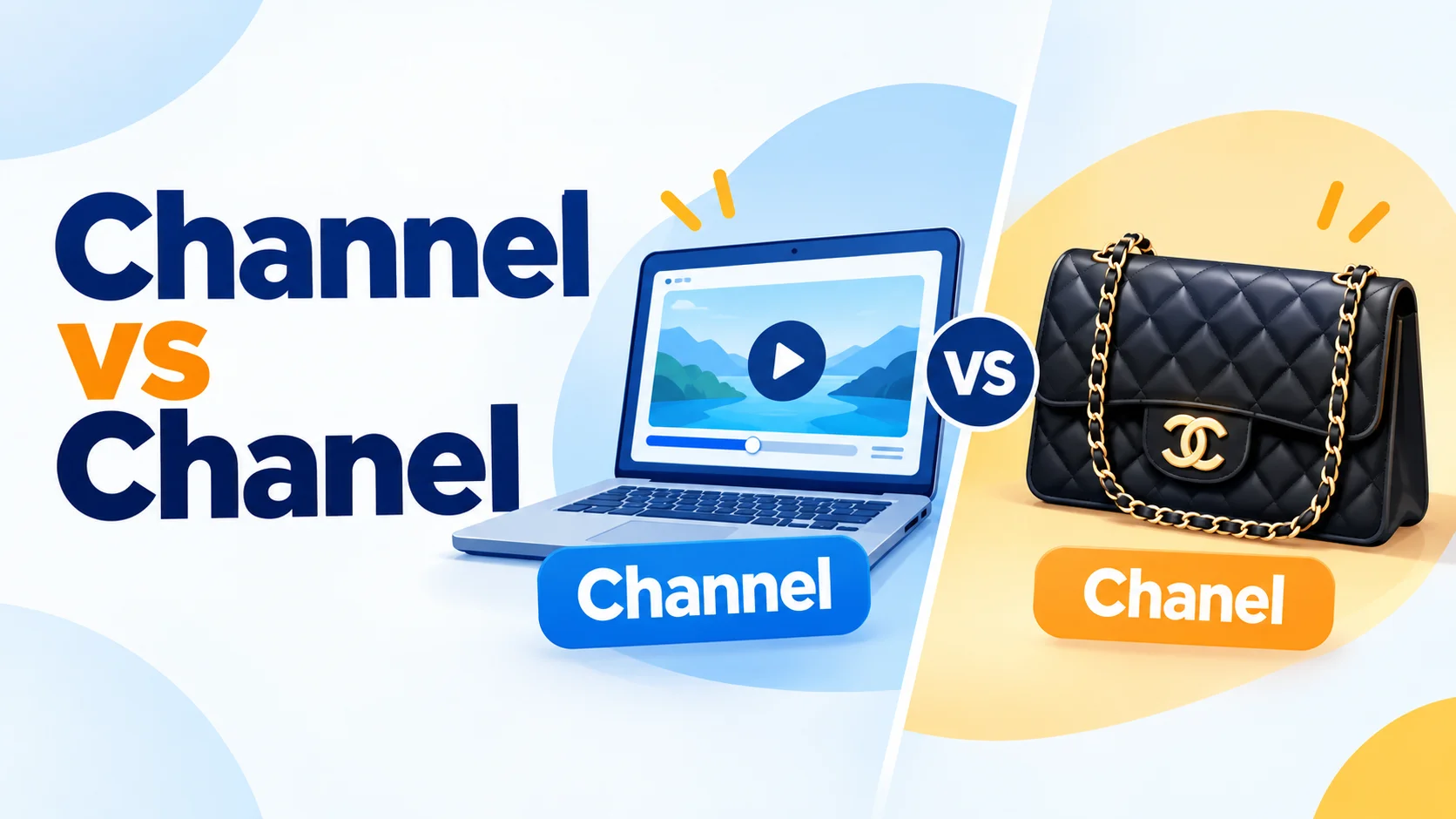
Channel vs Chanel is an easy pair to mix up because the words look and sound remarkably similar, yet they have completely different meanings. Channel is an ordinary English word that can describe a route, medium, pathway, or method, while Chanel is primarily a proper name, most famously associated with the French luxury fashion house and its founder, Coco Chanel. Knowing that distinction makes the spelling much easier to remember. If you have ever typed “YouTube Channel,” wondered whether “channel” needs a capital letter, or hesitated over the name of the fashion brand, the difference is simpler than it first appears.
The confusion usually comes from one missing letter: channel has two n’s, whereas Chanel has one. That tiny spelling difference completely changes the word’s identity. A channel can refer to a television station, a waterway, a communication method, a marketing route, or even the act of directing something toward a particular purpose. Chanel, by contrast, functions as a name or brand. Understanding how each word behaves in real sentences is more useful than memorizing an isolated spelling rule, because context often tells you which one belongs.
This guide breaks the distinction down from several angles: meaning, spelling, capitalization, pronunciation, grammar, context, and everyday usage. You will see why “YouTube channel” is correct, why “Chanel perfume” is different, how the word channel works in technology and marketing, and which mistakes commonly appear in writing. By the end, you should be able to choose the right word almost automatically—and recognize the difference even when the two sound similar in conversation.
Channel vs Chanel: The Difference at a Glance
The fastest way to understand the distinction is to look at what each word names.
| Feature | Channel | Chanel |
| Word type | Common noun and verb | Proper noun |
| Main meaning | A route, pathway, medium, or method | A person’s name and luxury brand |
| Capitalization | Usually lowercase | Usually capitalized |
| Spelling | C-h-a-n-n-e-l | C-h-a-n-e-l |
| Double “n”? | Yes | No |
| Common contexts | TV, YouTube, communication, marketing, waterways, technology | Fashion, fragrance, beauty, Coco Chanel |
| Example | “Subscribe to the YouTube channel.” | “She bought Chanel perfume.” |
There is an important grammatical distinction here. Channel is a regular English vocabulary word, so it can appear in many grammatical constructions and can even function as a verb. Chanel is normally a proper name, so its use is much more restricted.
Quick rule: If you mean a route, medium, pathway, or method, use a channel. If you mean the fashion brand or the name Chanel, use Chanel.
Why Do People Confuse Channel and Chanel?
The confusion is understandable. These words are close enough visually and phonetically to cause mistakes, particularly when someone encounters them through speech rather than writing.
The Nearly Identical Spelling
Both words begin with chan-, contain an e, and end with an l. The crucial difference is the middle:
- Channel → nn
- Chanel → n
That extra n is not cosmetic. It separates two different words.
A useful visual trick is to associate the longer spelling with the broader, everyday English concept:
chan + n + el = channel
Similar Pronunciation
The words can sound similar enough in ordinary conversation that a listener may not know which spelling is intended.
English spelling is not perfectly phonetic, so hearing a word is not always enough to reconstruct its written form. This is particularly true when a speaker has an accent in which the distinction between the two pronunciations is less noticeable.
Familiarity With the Chanel Brand
Chanel is a globally recognizable name. People encounter it in advertisements, fashion coverage, perfume descriptions, and product listings.
That familiarity can create an unusual spelling trap: someone who knows the brand may accidentally transfer Chanel into an unrelated sentence such as “What TV Chanel is it?”
The correct sentence is:
“What TV channel is it?”
Capitalization Can Help
In standard writing, Chanel normally begins with a capital letter because it is a proper name.
By contrast:
“The television channel changed its schedule.”
Here, channel is a common noun and remains lowercase.
Capitalization is not an absolute solution—brand names can occur in many grammatical contexts—but it provides a useful clue.
What Does “Channel” Mean?
Channel has several related meanings, but most of them share one central idea: a route through which something travels, moves, communicates, or is directed.
That “route” idea connects meanings that may initially seem unrelated.
Channel as a Physical Passage or Route
A channel can be a physical passage through which water or another substance moves.
For example:
- “The boat entered the narrow channel.”
- “The river has carved a deep channel.”
- “The water flows through the channel.”
In geography and navigation, a channel may describe a deeper or navigable part of a body of water.
The underlying concept remains the same: something has a path through which movement occurs.
Channel as a Means of Communication
A communication channel is a way information travels from one person or system to another.
Examples include:
- Telephone
- Messaging platforms
- Face-to-face communication
- Radio
- Written correspondence
You might say:
“Email is our main communication channel.”
Here, channel does not mean a physical tunnel. It means a medium or route for information.
Channel in Television and Broadcasting
In broadcasting, a channel identifies a particular television service or frequency allocation, depending on the technical context.
Examples:
- “Which channel is showing the news?”
- “Switch to another channel.”
- “The channel announced a new program.”
A television channel is therefore another kind of information pathway: it delivers audiovisual content to viewers.
Channel in Digital Media
The word has naturally extended into online communication.
A YouTube channel is a creator’s or organization’s publishing space on YouTube.
Similarly, people may talk about channels on messaging or collaboration platforms.
For example:
“Our company created a separate channel for customer support.”
The meaning is still fundamentally about a dedicated route for communication or content.
Channel in Marketing
A marketing channel is a route a business uses to reach customers or distribute its products and messages.
Examples include:
- Search advertising
- Email marketing
- Social media
- Retail stores
- Direct sales
- Websites
- Partnerships
For instance:
“The company is testing email as a new marketing channel.”
This does not mean the company has created a single advertisement. The channel is the medium through which marketing activity reaches an audience.
Channel in Technology and Electronics
In technical contexts, a channel can mean a distinct pathway through which a signal or information is transmitted.
You may encounter the term in:
- Telecommunications
- Wireless communication
- Audio engineering
- Data transmission
- Electronics
For example, an audio system might have separate left and right channels.
Again, the underlying idea is a distinct path for transmitting something.
Channel as a Verb
Channel is also a verb.
To channel something means to direct it toward a particular destination, activity, or purpose.
Examples include:
- “She channeled her frustration into writing.”
- “The system channels water into a storage tank.”
- “He channeled his energy into the project.”
This figurative use is especially common in everyday English.
The concept is still recognizable: something is being directed along a particular route.
What Does “Chanel” Mean?
Chanel is primarily a proper name.
Most English-language readers encountering the word today will associate it with Chanel, the French luxury fashion house founded by Gabrielle “Coco” Chanel.
It can also refer to the founder herself, depending on the context.
Chanel as a Proper Name
Unlike channel, Chanel is not an ordinary English word meaning a route or communication medium.
You would therefore write:
“Chanel released a new fragrance.”
not:
“Channel released a new fragrance.”
The second sentence changes the word from a brand name into the ordinary noun channel, producing a completely different meaning.
Chanel as a Luxury Fashion House
Chanel is associated with several areas of luxury goods, including:
- Fashion
- Fragrance
- Beauty
- Handbags
- Accessories
That is why sentences containing words such as perfume, couture, handbag, fashion, or fragrance can provide an immediate clue that Chanel is the intended spelling.
Coco Chanel
Gabrielle “Coco” Chanel was the designer whose name became associated with the fashion house.
You may therefore see Chanel used in historical or biographical contexts:
“Coco Chanel had a major influence on twentieth-century fashion.”
Here, Chanel is a surname and therefore a proper name.
Common Things Referred to as Chanel
Depending on the sentence, Chanel may refer to:
- The company or fashion house
- Its fashion collections
- Its fragrances
- Its beauty products
- Its accessories
- Coco Chanel herself
The exact reference comes from context.
Channel vs Chanel: Spelling, Capitalization, and Pronunciation
| Question | Channel | Chanel |
| How many n’s? | Two | One |
| Capitalized? | Usually no | Yes, when referring to the name/brand |
| Common pronunciation | Often roughly “CHAN-uhl” | Commonly “shuh-NEL” |
| What does it describe? | A route, medium, pathway, or method | A name/brand |
| Can it be a verb? | Yes | No, not in its ordinary brand/name use |
| Example | “Open another channel.” | “She likes Chanel.” |
How to Spell “Channel”
The correct spelling is:
C-H-A-N-N-E-L
The easiest feature to remember is the double n.
If you are writing about a TV station, YouTube, communication, marketing, a waterway, or a method of directing something, that double n belongs in the word.
How to Spell “Chanel”
The brand/name is:
C-H-A-N-E-L
There is only one n.
Because it is a proper name, it is normally written with an uppercase C:
Chanel
How to Pronounce “Channel”
A simple English approximation is:
CHAN-uhl
The second syllable is generally unstressed.
How to Pronounce “Chanel”
The name is commonly pronounced approximately:
shuh-NEL
The final syllable receives the stronger emphasis.
Actual pronunciation can vary somewhat by speaker and language background, but it is generally distinguishable from the ordinary English word channel.
Why Pronunciation Alone Is Not Enough
When two words sound close, spelling must be learned independently.
This is a common pattern in English. Homophones and near-homophones frequently require writers to use meaning and context, not sound alone, to select the correct written form.
When Should You Use Channel vs Chanel?
The choice becomes straightforward when you ask what the word represents.
Use “Channel” When You Mean a Route, Medium, or Method
Use channel for things such as:
- A TV channel
- A YouTube channel
- A communication channel
- A marketing channel
- A water channel
- An audio channel
- A data channel
- A way of directing something
Examples:
“The company uses several social media channels.”
“Please contact us through the official support channel.”
Use “Chanel” When You Mean the Brand or Name
Use Chanel when referring to:
- The fashion house
- Chanel products
- Chanel fragrances
- Coco Chanel
- The Chanel brand
Example:
“Chanel is known for its fashion and fragrances.”
A Simple Decision Rule
Ask:
Am I describing a path, medium, route, or method?
If yes, choose a channel.
Am I referring to a person, fashion house, or brand?
If yes, choose Chanel.
That distinction solves most cases immediately.
Channel vs Chanel in Sentences
Seeing the words in natural sentences makes the difference easier to internalize.
Correct Examples With “Channel”
- “Which channel is broadcasting the match?”
- “Please use the official communication channel.”
- “She started a cooking channel on YouTube.”
- “The river channel becomes narrower downstream.”
- “Email is an important marketing channel.”
- “He channeled his energy into the project.”
Correct Examples With “Chanel”
- “She bought a Chanel fragrance.”
- “The article discusses Chanel fashion.”
- “Coco Chanel became an influential designer.”
- “The store sells Chanel beauty products.”
Incorrect Examples and Corrections
| Incorrect | Correct | Why? |
| “Subscribe to my YouTube Chanel.” | “Subscribe to my YouTube channel.” | A YouTube publishing space is a channel. |
| “Which Chanel is showing the movie?” | “Which channel is showing the movie?” | A TV station/service is a channel. |
| “She bought a Channel perfume.” | “She bought a Chanel perfume.” | Chanel is the brand name. |
| “Our communication Chanel is email.” | “Our communication channel is email.” | Email is a communication medium. |
| “Coco Channel was a designer.” | “Coco Chanel was a designer.” | Chanel is her surname. |
Channel vs Chanel: Common Writing Mistakes
Writing “Chanel” When You Mean “Channel”
This is probably the most recognizable mistake in digital writing:
❌ “Follow our YouTube Chanel.”
✅ “Follow our YouTube channel.”
The mistake is especially easy to make because the reader understands the intended meaning even though the spelling is incorrect.
Writing “Channel” When You Mean “Chanel”
The reverse error appears in brand-related writing:
❌ “She is wearing Channel perfume.”
✅ “She is wearing Chanel perfume.”
Here, the channel has nothing to do with fragrance.
Forgetting the Capital Letter in Chanel
A brand or person’s name normally takes a capital letter:
❌ “She bought chanel perfume.”
✅ “She bought Chanel perfume.”
The capitalization helps identify the word as a proper name.
Adding an Extra “n” to Chanel
A common visual mistake is writing:
❌ Chanell
The correct brand spelling is:
✅ Chanel
There is only one n and one l at the end.
Assuming Similar Spelling Means Similar Meaning
This is the biggest conceptual mistake.
Channel and Chanel are not two versions of the same word. Their meanings developed independently, and their similarity is primarily a spelling/pronunciation trap.
Channel vs Chanel in Different Contexts
Context can often tell you the correct spelling before you consciously think about the rule.
| Context clue | Correct word | Example |
| YouTube | Channel | “Her channel has thousands of subscribers.” |
| Television | Channel | “Change the channel.” |
| Communication | Channel | “Use another communication channel.” |
| Marketing | Channel | “Social media is one marketing channel.” |
| Water/navigation | Channel | “The ship entered the channel.” |
| Audio | Channel | “Adjust the left audio channel.” |
| Directing energy | Channel | “She channeled her creativity into art.” |
| Perfume | Chanel | “He gave her Chanel perfume.” |
| Fashion | Chanel | “The article covers Chanel fashion.” |
| Coco | Chanel | “Coco Chanel was a French designer.” |
The surrounding noun is often enough to make the answer obvious.
If you see YouTube, TV, communication, or marketing, channel is overwhelmingly the natural choice. If you see perfume, fashion, or Coco, Chanel is the obvious candidate.
Channel vs Chanel in Digital Marketing and Business
The word channel has become particularly important in business vocabulary.
What Is a Marketing Channel?
A marketing channel is a route through which a business reaches an audience or customer.
For example, a company might use:
- Search engines
- Social media
- Retail stores
- Websites
- Direct sales
- Partnerships
A company could say:
“We are testing email and social media as marketing channels.”
The individual advertisement is not necessarily the channel. The medium through which the marketing reaches people is the channel.
Channel vs Campaign: A Useful Distinction
These terms are related but not interchangeable.
A campaign is a coordinated marketing effort with a particular objective.
A channel is one of the routes used to distribute or communicate that effort.
For example, a company might run one product-launch campaign across:
- Search advertising
- Its website
The campaign is the broader initiative; those platforms and media can function as its channels.
Multichannel vs Omnichannel
Multichannel marketing means a business uses multiple channels.
Omnichannel marketing focuses on creating a connected customer experience across those channels.
This is another example of how broadly the ordinary English word channel has developed.
Channel vs Chanel in Technology and Communication
The technical uses of channels all preserve the idea of a distinct pathway.
Communication Channels
A communication channel is the medium through which information passes.
For example:
“The team switched to a private communication channel.”
Radio and Television Channels
In broadcasting, channels can identify a particular service or frequency allocation.
This is why “change the channel” is such an ordinary expression.
Audio Channels
In sound technology, a channel represents a separate audio signal path.
A stereo recording, for instance, commonly contains left and right channels.
Data and Telecommunications Channels
In telecommunications, engineers use channels for a path or medium over which information is transmitted.
The details become highly technical in fields such as wireless communications and information theory, but the basic concept remains familiar:
A channel provides a path for information to travel.
Channel vs Chanel: A Quick Memory Trick
You do not need a complicated mnemonic.
Remember the Double “N” in Channel
Channel = double N
The extra letter can remind you that channel is the longer, ordinary English word used for routes, pathways, and communication methods.
Remember Chanel as a Name
Chanel = name/brand
Think of the capital C and the single n.
The One-Sentence Test
A channel carries, connects, directs, or broadcasts; Chanel names a person or luxury brand.
If you can substitute route or medium, you almost certainly need a channel.
If you are referring to Coco Chanel or the fashion house, you need Chanel.
How Context Helps You Choose the Correct Word
Context is often the fastest proofreading tool.
If You See “YouTube,” Use Channel
“She created a YouTube channel.”
A YouTube account used for publishing videos is a channel.
If You See “TV,” Use Channel
“The news is on another channel.”
If You See “Marketing,” Use Channel
“Email is an effective marketing channel.”
If You See “Communication,” Use Channel
“We need a reliable communication channel.”
If You See “Perfume” or “Fashion Brand,” Use Chanel
“She prefers Chanel perfume.”
If You See “Coco,” Use Chanel
“Coco Chanel influenced twentieth-century fashion.”
This context-first approach is especially useful for proofreading because it allows you to catch errors even when spellcheck does not flag them.
Conclusion:
The difference between channel vs Chanel is small on the page but significant in meaning. Channel is the everyday English word for a route, pathway, medium, or method, whether you are discussing television, YouTube, communication, marketing, waterways, or technology. Chanel, with one “n,” is a proper name associated with Coco Chanel and the luxury fashion house. Once you connect the spelling to the meaning, the distinction becomes much easier to remember.One final actionable tip: when proofreading, look at the word immediately after the disputed term. If you see YouTube, TV, communication, or marketing, you probably need a channel. If you see perfume, fashion, or Coco, you probably need Chanel. A common mistake to avoid is treating Chanel as an alternate spelling of channel. They are separate words—and context makes the correct choice clear.
FAQs
Q1. What is the difference between channel and Chanel?
Channel is an English word meaning a route, pathway, medium, or method, while Chanel is a proper name associated with Coco Chanel and the luxury fashion house. Their similar spelling causes confusion, but they are completely different words with different meanings and grammatical functions.
Q2. Is Chanel the correct spelling of channel?
No. Chanel is not an alternative spelling of channel. If you mean a TV station, YouTube publishing space, communication method, waterway, or other pathway, the correct spelling is channel, with two n’s. Chanel refers to a name or brand.
Q3. Is Chanel pronounced the same as channel?
Not usually. Channel is commonly pronounced approximately “CHAN-uhl,” while Chanel is commonly pronounced approximately “shuh-NEL.” Accent and individual speech can affect the exact sounds, but the two have distinct standard pronunciations.
Q4. How do you remember whether to spell it channel or Chanel?
Use two simple clues: channel has two n’s, and Chanel has one n. Then connect each spelling to its meaning. A route or communication medium is a channel; the fashion name or brand is Chanel.
Q5. Is “YouTube Chanel” correct?
No. The correct expression is “YouTube channel.” Here, channel refers to the space where a creator publishes videos. Chanel would refer to the fashion brand or the name, so using it in this context changes the meaning and creates a spelling error.