

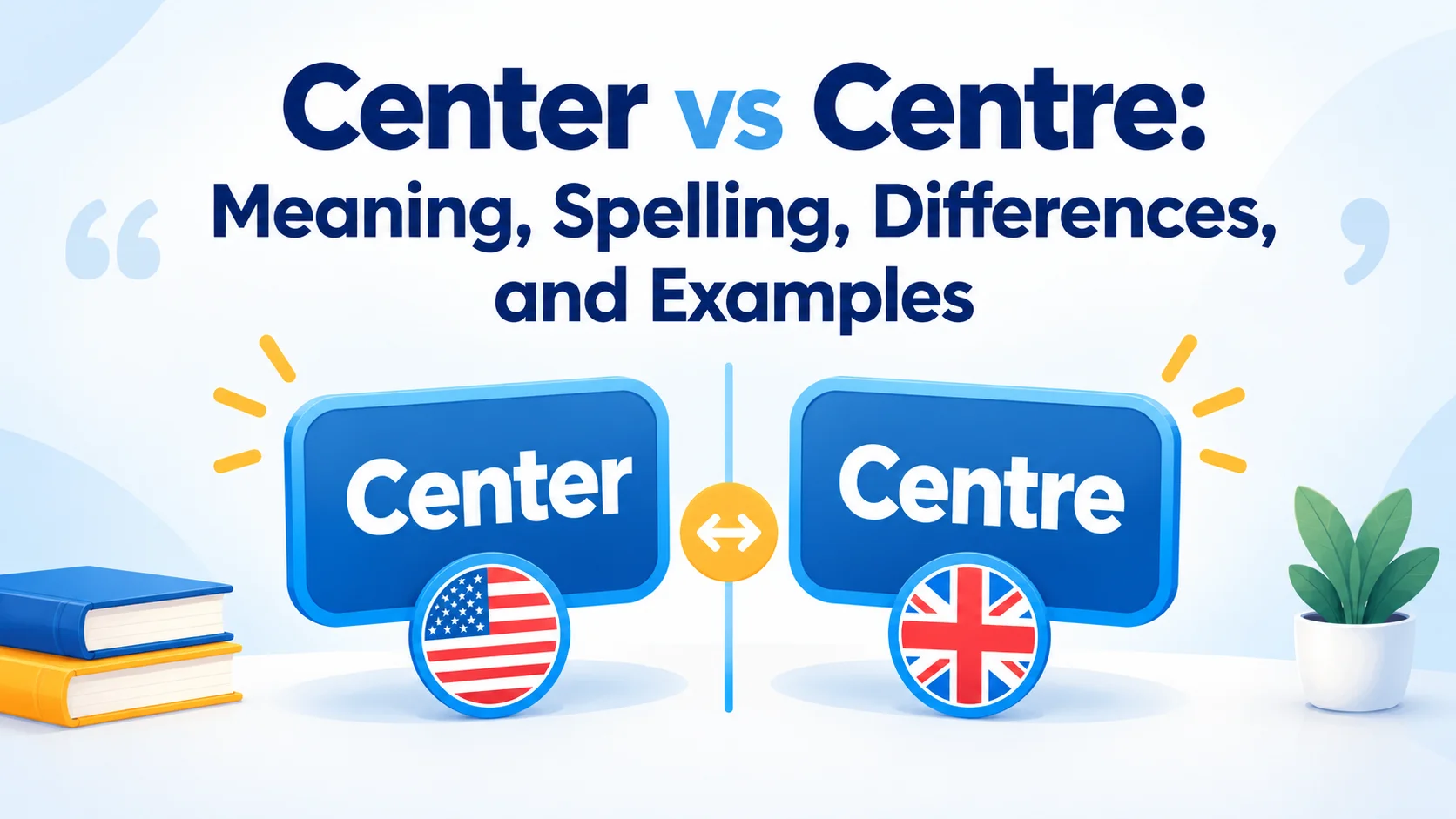
Center vs centre is a common spelling question for English learners, students, editors, and professionals who want their writing to look accurate and consistent. The good news is that both spellings are correct. The main difference is regional: center is standard in American English, while centre is standard in British English and several other varieties. Neither spelling changes the word’s meaning or usual pronunciation. Once you understand which spelling your readers expect, choosing the right one becomes straightforward, whether you are writing an academic paper, a business email, or a website article.
The distinction matters most when you are writing for a specific audience. An American newspaper will generally use a shopping center, while a British publication will usually write about a shopping centre. Canadian, Australian, and New Zealand English also generally favor centre, although their spelling conventions do not match British English in every respect. Related forms can differ, too: American writers use centered and centering, whereas British writers typically use centred and centring. These patterns are worth learning because consistent spelling makes professional documents easier to read and helps them follow the expectations of their intended audience.
In this guide, you will learn what center and centre mean, where each spelling is used, how to choose between them, and how the difference carries over into related words. You will also find practical sentence examples, comparisons of common expressions, and guidance for academic, business, and online writing. Rather than memorizing two spellings in isolation, you will learn a simple decision-making rule you can apply whenever the issue arises. By the end, you should be able to choose confidently, avoid common regional spelling mistakes, and keep your writing consistent without second-guessing every occurrence.
What Does Center or Centre Mean?
The words center and centre can function as nouns and verbs. Their meanings depend on the sentence, but the spelling choice follows regional English conventions rather than a difference in definition. Cambridge Dictionary identifies center as the US spelling of centre and describes meanings that include a middle point and a place where a particular activity takes place.
Center/Centre as the Middle Point of Something
The most literal meaning is the middle of a space, shape, object, or area. The center of a circle, for example, is the point equally distant from its circumference. In everyday writing, the word can describe the middle of a room, a page, a playing field, or a gathering.
Examples:
- American English: The lamp sits in the center of the table.
- British English: The lamp sits in the centre of the table.
- American English: Write the date at the center of the page.
- British English: Write the date at the centre of the page.
The meaning stays the same in all four sentences. Only the regional spelling changes.
Center/Centre as a Place for a Particular Activity
The word can also refer to a building, facility, or location organized around a specific purpose. These places may provide services, support research, host events, or accommodate sports and recreation.
Examples:
- The city opened a new community center.
- She works at a medical centre.
- The researchers visited a climate research center.
- We booked a room at the conference centre.
Common compounds include shopping center/centre, health center/centre, sports center/centre, and data center/centre. The intended meaning is clear from the word that comes before center or centre.
Center/Centre as the Main Focus of Attention
Both spellings also describe something that attracts attention or plays a central role in a situation. This use is often figurative rather than physical.
Examples:
- Education is at the center of the campaign.
- The proposal is at the centre of the current debate.
- She became the center of attention at the event.
- The investigation centers on three major concerns.
Notice the verb in the last example. Centers means that the investigation focuses on particular concerns. In British-style spelling, the same sentence would use centres.
Center/Centre as a Verb
As a verb, the word means to place something in the middle or to focus something around a particular subject.
- Center the heading above the paragraph. — American English
- Centre the heading above the paragraph. — British English
- The documentary centers on a small coastal community. — American English
- The documentary centres on a small coastal community. — British English
A useful editing distinction: center the heading describes physical placement, while the documentary centers on a community describing the subject or focus. The spelling rule is the same in both cases.
What Is the Difference Between Center and Centre?
The difference is primarily regional spelling. Both forms have the same core meaning and are generally pronounced alike within a given accent. The choice depends on the English variety you are following, the audience you are addressing, and any style requirements imposed by a school, publisher, employer, or organization.
American English vs. British English Spelling
American English generally uses center, while British English uses centre. This is part of a wider spelling pattern in which some words ending in -re in British English end in -er in American English.
| American English | British English |
| center | centre |
| theater | theatre |
| meter | metre |
| liter | litre |
| fiber | fibre |
These pairs are not different words with separate definitions. They are regional spellings of the same words, although some pairs can have additional specialized distinctions in particular contexts. For example, meter is a measuring device in American English, while metre is the unit of length in British English.
Important: Do not assume that every English word ending in -re changes to -er in American English, or that every word ending in -er has a British equivalent ending in -re. Spelling conventions have exceptions, so check a reliable dictionary when uncertain.
Which Spelling Is Used in Canada, Australia, and Other English Varieties?
Although the American–British distinction is the easiest starting point, English spelling is not divided into just two perfectly uniform systems.
- Canada: Centre is generally standard, as in city centre and community centre.
- Australia: Centre is the usual spelling.
- New Zealand: Centre is generally preferred.
- United States: Center is standard.
- United Kingdom: Centre is standard.
Canadian English, Australian English, and New Zealand English each have their own conventions. They often share centre with British English but may differ from British usage in other spelling choices.
For example, a Canadian organization might write community centre but use other spellings that do not exactly match a British publication. For formal work, the safest approach is to consult the relevant local dictionary or the organization’s style guide rather than treating “British spelling” as a universal rule for every country outside the United States.
Are Center and Centre Pronounced Differently?
Generally, no. The difference in spelling does not ordinarily signal a different pronunciation. Cambridge Dictionary provides pronunciation information for both forms, with differences in phonetic notation reflecting American and British accents rather than a distinct sound created by the letters -er or -re.
A simple pronunciation guide is SEN-ter. Depending on the speaker’s accent, the final sound may vary slightly.
If you are learning English, focus on these points:
- Learn the spelling used in your target variety.
- Listen to examples from speakers of that variety to understand local pronunciation.
- Do not try to pronounce centre differently simply because its final letters are reversed.
Center vs. Centre at a Glance
| Feature | Center | Centre |
| Standard variety | American English | British English |
| Common use elsewhere | Used in US-focused writing | Common in Canadian, Australian, and New Zealand English |
| Core meaning | Middle point, central place, or main focus | Middle point, central place, or main focus |
| Pronunciation | Generally the same as centre within the same accent | Generally the same as center within the same accent |
| Related forms | centered, centering | centred, centring |
| Best choice | US audience or US style guide | UK or other audience whose standard uses centre |
Examples of Center in American English
The best way to become comfortable with center is to see how it works in different sentence structures. The following examples use standard American spelling and cover everyday, professional, and figurative contexts.
Center as the Middle of a Place or Object
- Please place the chair in the center of the room.
- A small fountain stands at the center of the courtyard.
- The designer positioned the logo in the center of the page.
- Draw a circle and mark its center with a dot.
In each example, the center identifies a physical middle point. If you were writing for a British audience, you would generally replace it with centre without changing the rest of the sentence.
Center as a Building or Institution
- The community center offers free workshops for residents.
- My appointment is at the health center on Friday.
- The company opened a new data center outside the city.
- The university’s research center studies renewable energy.
Here, the word describes a place where a service or activity is provided. The words before center help readers understand the facility’s purpose.
Center in Figurative Expressions
- Customer satisfaction is at the center of our strategy.
- The disagreement became the center of public discussion.
- Her presentation centered on practical ways to reduce waste.
- The new evidence brought the issue back to the center of the debate.
These sentences do not necessarily refer to a physical middle. Instead, the center communicates importance, attention, or focus.
Common American Expressions with Center
| Expression | Meaning | Example |
| Shopping center | A group of shops in one location | We stopped at the shopping center after lunch. |
| Community center | A facility for local activities and services | The community center hosts weekend classes. |
| Medical center | A facility providing medical care | She works at a regional medical center. |
| Data center | A facility housing computer systems and related infrastructure | The company expanded its data center. |
| Center of attention | The person or thing receiving the most attention | The award winner was the center of attention. |
| Center on | To focus on a subject | The report centers on employee safety. |
Examples of Centre in British English
The same meanings and sentence structures apply in British English. The following examples use centre and its related forms.
Centre as the Middle of a Place or Object
- The statue stands in the centre of the square.
- Fold the paper along the centre line.
- The target has a red circle in its centre.
- Place the title in the centre of the page.
These examples describe the physical middle of something. In American English, the same sentences would use center.
Centre as a Building or Institution
- The children attend activities at the local leisure centre.
- The new health centre serves several nearby villages.
- The company moved its customer service team to a larger centre.
- The university established a centre for environmental research.
The spelling remains centre in these compounds when following British English conventions.
Centre in Figurative Expressions
- The issue lies at the centre of the disagreement.
- The town is an important centre for regional trade.
- The discussion centred on the cost of the proposal.
- The new policy places families at the centre of its approach.
The word can describe a focal point, a major hub of activity, or the main subject of a discussion.
Common British Expressions with Centre
| Expression | Meaning | Example |
| Town centre | The central commercial area of a town | The hotel is a short walk from the town centre. |
| Shopping centre | A place containing multiple shops | The shopping centre closes at six. |
| Leisure centre | A facility for sports and recreational activities | They swim at the leisure centre every Saturday. |
| Health centre | A facility providing health services | The nurse works at the local health centre. |
| Centre of attention | The person or thing receiving the most attention | The guest of honour was the centre of attention. |
| Centre on | To focus on a particular subject | The report centres on transport policy. |
Center vs. Centre in Related Word Forms
Choosing center or centre correctly is only part of the job. When the word changes form, the spelling usually changes with it. This is particularly important in longer documents, where inconsistent spelling can be easy to overlook.
Centered vs. Centred
Both forms are past-tense or past-participle forms of the verb center/centre. They can also function as adjectives.
- American: The photograph is centered above the text.
- British: The photograph is centred above the text.
- American: The discussion centered on the main proposal.
- British: The discussion centred on the main proposal.
Centering vs. Centring
The present participle and gerund follow the same regional pattern:
- American: She is centering the text in the document.
- British: She is centring the text in the document.
- American: Centering the design improved its balance.
- British: Centring the design improved its balance.
The difference is not a change in tense or meaning. It is a difference in spelling convention.
American and British Forms Compared
| Word form | American English | British English |
| Base form | center | centre |
| Past tense | centered | centred |
| Past participle | centered | centred |
| Present participle | centering | centring |
| Example phrase | centered text | centred text |
Editing tip: When checking a document, search for all the forms—not just center and centre. A page that uses centre throughout but contains centered in a caption may need a quick consistency edit.
When Should You Use Center or Centre?
The right choice depends on the audience and the writing requirements. A spelling can be correct in one context and inconsistent in another, so the goal is not to memorize a universal “correct” form. It is to identify the convention your document should follow.
Use Center for American English Writing
Choose center when writing for a US audience or following an American English style guide. This applies to:
- School assignments that require American spelling.
- Business reports and professional emails for US organizations.
- US-focused websites and product documentation.
- Publications edited according to American English conventions.
Example: Our new customer support center opens in November.
If the same organization uses center in its official name, preserve that spelling even when referring to it in a context where another spelling might otherwise be expected.
Use Centre for British English Writing
Choose centre when writing for a UK audience or following a style guide that specifies British English. It is also generally used in Canadian, Australian, and New Zealand English.
Typical contexts include:
- British academic and professional writing.
- Public information aimed at UK residents.
- Australian or Canadian business communication.
- Publications that consistently use centre, centred, and centring.
Example: The new community centre will open to the public next month.
When writing for a particular institution, follow its published conventions rather than assuming that every organization in a country follows exactly the same house style.
What If You Are Writing for an International Audience?
International readers do not necessarily need a neutral spelling. They need a consistent one. Choose the variety that best matches your main audience, then apply it throughout the article, report, or website.
Use this quick decision process:
- Identify the audience. Are most readers in the United States, the United Kingdom, or another English-speaking region?
- Check the required style. A university, publisher, or employer may specify a spelling standard.
- Choose one convention. Use center or centre consistently, including in related forms.
- Proofread for exceptions. Preserve official names, direct quotations, and titles as they are written in their original sources.
For example, a US company publishing a report about a British partner might use the center in its own prose while retaining the Community Centre if that is the partner’s official name. Consistency does not mean altering proper names to fit your preferred spelling.
Center vs. Centre in Academic, Business, and Digital Writing
Academic Writing
Academic writing values accuracy and consistency, but there is no single spelling choice that applies to every English-language institution. A US university will commonly expect American English, while a UK university will generally expect British English. International journals may specify their own editorial standards.
Before submitting an essay, thesis, or research paper:
- Review the assignment instructions or journal guidelines.
- Check whether the institution specifies US or UK English.
- Apply the chosen spelling to the main text, tables, figures, and captions.
- Use proofreading tools as a final check, not as a substitute for understanding the style requirement.
If a paper discusses both regional varieties, using both spellings may be necessary when illustrating the difference. In that case, the contrast should be deliberate rather than accidental.
Business and Professional Communication
In professional writing, spelling consistency helps a document look carefully edited. A company may use American English internally but follow a different convention for material prepared by an overseas branch.
Consider these examples:
- US company: The training center will host the workshop.
- UK organization: The training centre will host the workshop.
Neither sentence is inherently more professional. The relevant issue is whether the spelling matches the organization’s preferred style and audience.
For a shared document written by several people, agree on the spelling convention before editing begins. This is more efficient than correcting individual words repeatedly at the end.
Websites and SEO Content
For website content, regional spelling can be part of effective audience targeting. A page written for US readers should normally use center, while a page aimed at UK readers will generally use centre.
However, do not switch spellings just to include more keywords. If a page compares the two forms, mention both naturally and explain their regional usage. On other pages, use the form appropriate to the target audience.
For international websites, localization may involve more than spelling. Terminology, examples, dates, and references may also need adjustment to feel natural to readers in a particular region.
Common Mistakes to Avoid with Center and Centre
Assuming One Spelling Is Always Wrong
Neither spelling is universally incorrect. The mistake is using a spelling that conflicts with the convention expected in your document.
Incorrect for standard US spelling: The town centre is busy on weekends.
Standard US version: The town center is busy on weekends.
Standard UK version: The town centre is busy at weekends.
The first sentence is understandable, but it may look inconsistent in a document that otherwise follows American English.
Mixing American and British Spellings
A document that alternates between center, centre, centered, and centred without a reason can appear poorly edited.
For example:
The new community centre is centrally located. The building’s main hall is centered around a large stage.
If this passage follows British English, changing centered to centred would improve consistency. If it follows American English, the center would generally become center.
Treating the Words as Different in Meaning
There is no general rule that center means a physical midpoint while centre refers to a building, or vice versa. Both spellings can describe the middle of something, a facility, or a figurative focus.
Choose between them based on regional spelling, not the type of place or idea being described.
Changing Official Names or Direct Quotations
Consistency rules do not require changing a proper name, organization name, or direct quotation.
If an organization officially calls itself the Riverside Community Centre, retain that name even in an American English document. The same principle applies when quoting a source that uses a different regional spelling.
How to Remember the Difference Between Center and Centre
Use these practical reminders when writing or proofreading:
- Center = US spelling. Remember the -er ending used in American English.
- Centre = British-style spelling. The -re ending also appears in British forms such as theatre and metre.
- Follow the audience. Choose the spelling expected by your main readers.
- Check related forms. Use centered/centering in American English and centred/centring in British English.
- Respect official names. Do not alter a name simply to make its spelling match the rest of your document.
A useful final check is to search your document for both center and centre. Review each occurrence in context, including headings, captions, tables, and quoted material. A spelling checker can help identify inconsistencies, but it may not know whether a particular spelling is part of an official name.
Conclusion:
The difference between center vs centre is straightforward once you identify the English variety you need. Center is standard in American English, while centre is standard in British English and generally preferred in Canadian, Australian, and New Zealand English. Both spellings share the same core meaning and usual pronunciation, so neither is inherently better than the other.One final actionable tip: Before submitting an essay, publishing an article, or sending a professional report, check your spelling against the style guide your audience expects. Review related forms such as centered and centring as well.A common mistake to avoid is treating one regional spelling as universally correct. Good writing respects context. Choose the appropriate form, use it consistently, and let clarity—not regional preference—guide the rest of your writing.
FAQs
Q1. Is center or centre correct in English?
Both center and centre are correct English spellings. Center is standard in American English, while centre is standard in British English and several other varieties. Choose the spelling that matches your audience, publication requirements, or preferred regional style.
Q2. Is centre British or American spelling?
Centre is the standard British spelling; center is the American equivalent. The British-style form is also generally used in Canadian, Australian, and New Zealand English. However, these varieties have their own spelling conventions, so they should not be treated as identical in every respect.
Q3. Does center mean the same thing as centre?
Yes. Both words can refer to the middle of an object or area, a facility devoted to a particular activity, or the main focus of attention. The difference is regional spelling, not a separate definition. Their related verb forms follow the same regional pattern.
Q4. Is it center or centre in Canada?
Centre is generally the standard Canadian spelling, as in shopping centre and community centre. Canadian English shares some conventions with British English and others with American English. For formal Canadian writing, follow the relevant organization’s style guide or a trusted Canadian dictionary.
Q5. Is it centered or centred?
Use centered in standard American English and centred in standard British English. The same pattern applies to the present participle: centering in American English and centering in British English. Choose one convention and apply it consistently throughout your document.