

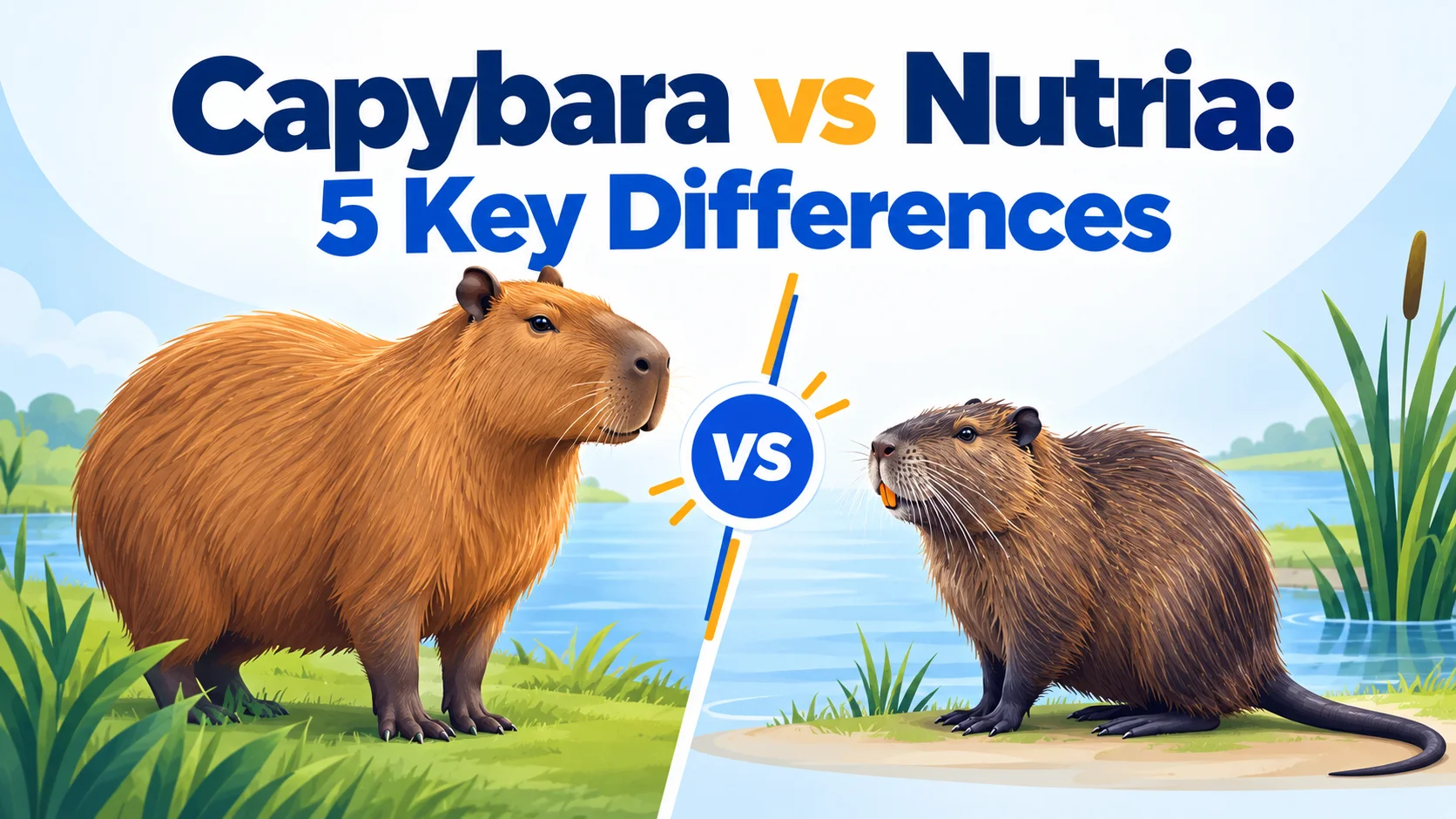
Capybara vs nutria comparisons are surprisingly useful because both animals are large, semi-aquatic rodents that spend considerable time around rivers, marshes, ponds, and other wetlands. At a glance, their rounded bodies and swimming ability can make them seem like close relatives. They are not. A capybara is substantially larger, has an almost invisible tail, and is famous for its highly social lifestyle, while a nutria is smaller, more rat-like, and has a distinctive long, rounded tail.
The confusion becomes even easier to understand when you see either animal in the water. Both can swim well, both have adaptations for aquatic life, and both feed heavily on vegetation. Yet their physical proportions, geographic distributions, social behavior, and effects on wetland ecosystems are quite different. Knowing what to look for—especially the tail, body size, teeth, and habitat—makes identification much easier.
In this guide, we will compare capybaras and nutrias across five major differences: size, habitat and range, appearance, behavior, and diet. We will also examine how their swimming adaptations differ, why nutria are considered invasive in some regions, whether either animal is dangerous, and how to distinguish them from other semi-aquatic rodents such as beavers. By the end, you should be able to recognize the difference without relying on a single feature.
Capybara vs Nutria at a Glance
The easiest way to separate these animals is to think in terms of overall shape rather than color. Both can have brownish fur, and both may be seen partially submerged, so color alone is unreliable.
| Feature | Capybara | Nutria |
| Scientific name | Hydrochoerus hydrochaeris | Myocastor coypus |
| Animal group | Rodent | Rodent |
| Adult weight | About 35–66 kg (77–145 lb) | About 5–10 kg (11–22 lb), with variation |
| Body shape | Large, barrel-shaped | Smaller, robust and somewhat rat-like |
| Tail | Very short and inconspicuous | Long, rounded, sparsely haired |
| Feet | Partially webbed | Strongly webbed hind feet |
| Teeth | Large rodent incisors, usually less obvious at a distance | Prominent orange-yellow incisors |
| Native range | South America | South America |
| Typical habitat | Wetlands, flooded grasslands, river edges, marshes | Marshes, lake edges, slow streams, canals and other wetlands |
| Social behavior | Strongly social; often lives in groups | Social, but group structure differs |
| Main food | Grasses and aquatic vegetation | Aquatic and terrestrial vegetation, including roots and tubers |
| Ecological concern | Generally a native component of South American ecosystems | Invasive and damaging in many introduced regions |
The single most useful field clue is the tail. A capybara’s tail is so short that the animal can appear almost tailless. A nutria has a conspicuous, rat-like tail that trails behind it.
Capybara vs Nutria: 5 Key Differences
1. Size and Weight
Size is the first major difference—and one of the most dramatic.
The capybara is the largest living rodent. Adult capybaras commonly weigh roughly 35 to 66 kilograms and can reach around 1.2 meters in body length. Their heavy, barrel-shaped bodies give them a distinctly substantial appearance.
Nutrias are large rodents too, but they are nowhere near capybara size. Adults commonly fall around 5 to 10 kilograms, although individual weights vary. In practical terms, a full-grown nutria is often closer to the size of a large dog than to a capybara-sized animal.
That difference matters when identifying them from photographs. A capybara standing beside another animal, person, fence, or familiar object can look unmistakably enormous. A nutria may look impressive when swimming because only its head and upper body are visible, but its actual body mass is much smaller.
Identification tip: If the animal looks exceptionally bulky and heavy, with a broad barrel-shaped body, think capybara. If it has a noticeably smaller body and a long tail, nutria is a stronger possibility.
Size should not be used alone, however. Young capybaras can be considerably smaller than adults, and photographs can distort scale. When size is uncertain, combine it with the tail and facial features.
2. Habitat and Geographic Range
Both species are strongly associated with water, but their distributions are not identical.
Capybaras are native to South America and are particularly associated with places where reliable water and grazing vegetation occur. Flooded grasslands, marsh edges, river margins, wetlands, and other areas with abundant vegetation provide the combination they need: food on land and water for cooling, escape, and shelter.
Nutrias are also native to South America, where they occupy marshes, lake edges, sluggish streams, and other aquatic environments. They favor places with abundant vegetation along the water’s edge.
The important distinction appears when you look beyond their native ranges.
Nutria have been introduced into numerous regions outside South America, often historically because of the fur trade. Escaped or released animals established wild populations in parts of North America and Europe, among other areas.
In the United States, this distinction is especially important. The U.S. Department of Agriculture identifies nutria as an invasive species and reports established populations in multiple states. Their feeding and burrowing can damage wetlands, crops, banks, levees, and other infrastructure.
Capybaras, by contrast, are primarily encountered within their native South American range, although isolated introduced or non-native populations can occur in unusual circumstances.
Why water matters to both animals
Water is not simply a place where these rodents find food. It is part of their survival strategy.
For capybaras, water provides relief from heat and a refuge from predators. For nutrients, waterways provide food, travel routes, shelter, and suitable places for burrowing and resting.
That is why habitat can be a useful identification clue—but not a definitive one. Seeing a large rodent beside a pond does not automatically make it a capybara.
3. Appearance and Physical Features
This is where the comparison becomes much easier.
Capybaras have a large, blocky, barrel-shaped body, relatively short legs, a broad head, and small ears positioned high on the head. Their eyes and nostrils are also positioned in ways that help them remain alert while much of the body is submerged.
Their most obvious visual oddity is their tail—or lack of one. A capybara has only a tiny tail, which is easily overlooked.
Nutrias have a different silhouette. Their bodies are smaller and more elongated, their heads have a somewhat rat-like appearance, and their long, rounded tail is immediately noticeable when visible.
Their teeth provide another strong clue. Nutrias have large incisors with a characteristic orange-yellow coloration. Those incisors are not merely decorative; like other rodent incisors, they continue growing and must be worn down through use.
| Identification feature | Capybara | Nutria |
| Overall silhouette | Heavy and barrel-shaped | Smaller and more elongated |
| Head | Broad, blunt appearance | Large, somewhat triangular/rat-like |
| Tail | Very short | Long and rounded |
| Incisors | Large but usually less conspicuous from a distance | Orange-yellow incisors are distinctive |
| Hind feet | Partially webbed | Strongly webbed |
| Fur | Coarse, generally reddish-brown to brown | Dense underfur with coarser guard hairs |
| Eyes/nostrils | Positioned high on head for aquatic life | Also positioned high for swimming |
The tail test
If you remember only one identification trick, remember this:
Short, almost invisible tail = capybara.
Long, rounded, rat-like tail = nutria.
This is particularly useful when the animal is swimming away from you.
There is one caveat: cold conditions can damage nutria tails, and unusual individuals may not show the classic appearance perfectly. Identification should therefore rely on several characteristics when possible.
4. Behavior and Social Life
Capybaras are famously social. They commonly live in groups containing multiple adults and young, and larger aggregations can form when environmental conditions concentrate animals around water.
Group living gives capybaras several advantages. More individuals can watch for predators, and young animals benefit from the presence of multiple adults. Capybaras also communicate using a range of vocalizations and scent signals.
If a capybara detects danger, it may produce an alarm call that alerts other members of the group. The group can then move toward the water, where the animals are highly capable swimmers.
Nutrias can also be social. They may occur in family groups or small groups, although their social organization is not simply a smaller version of capybara society. Nutrias can also spend considerable time feeding, grooming, swimming, and moving around their local habitat.
One useful behavioral difference is activity timing. Nutrias are commonly described as predominantly nocturnal, whereas capybaras often show strong activity around dawn and dusk, although their activity patterns can change according to temperature, predators, habitat, and local conditions.
That means a nighttime sighting near water does not prove that the animal is a nutria. Behavior is a supporting clue, not a substitute for physical identification.
Why capybaras are often seen in groups
For capybaras, social living is not simply a personality trait. It is deeply connected with survival.
A group can detect threats more effectively than a solitary animal, and young capybaras receive protection from multiple adults. During hot periods, water also becomes an important gathering point.
This is why a photograph showing several large, rounded rodents resting together near water is especially suggestive of capybaras.
5. Diet and Feeding Habits
Both animals are primarily herbivorous, but they do not feed in exactly the same way.
Capybaras are principally grazers. Grasses and aquatic plants make up much of their diet, with other plant material consumed when available. Their digestive system is adapted to handling fibrous vegetation, and capybaras also practice coprophagy—re-ingesting certain fecal material to extract additional nutrients from plant foods.
Nutrias also depend heavily on vegetation, particularly plants growing in or around water. Their diet can include stems, leaves, roots, rhizomes, tubers, and bark.
This difference in feeding behavior has major ecological consequences in places where nutria have been introduced.
Nutria do not merely clip the leafy parts of wetland plants. Their feeding and digging can remove roots and other underground plant structures that help hold wetland soils together. When intense feeding destroys vegetation and its root mat, the resulting bare areas can become vulnerable to erosion and changes in wetland structure.
That is one reason nutria are considered an important invasive-species problem in several regions.
How to Tell a Capybara and Nutria Apart in the Wild
When identification matters, do not try to make the decision from one feature. Use a four-step visual check.
Check 1: Look at the tail
This should be your first move.
- Tiny or almost invisible tail: strongly suggests capybara.
- Long, rounded tail: strongly suggests nutria.
The tail is often more reliable than fur color because both animals can appear brown.
Check 2: Estimate the body size
Ask yourself what the animal is comparable to.
A capybara has the mass of a very large rodent, while a nutria is much smaller. If there is a nearby object of known size—such as a railing, paving stone, or familiar animal—it can provide useful scale.
Avoid estimating size from a cropped photograph. A close-up image can make a nutria appear enormous.
Check 3: Look at the face
If you can see the face clearly, check the shape of the head and teeth.
Nutria often have conspicuous orange-yellow incisors, especially when they are feeding. Their long whiskers can also be prominent.
Capybaras have a broader, heavier-looking head and lack the conspicuous long tail that defines nutria.
Check 4: Consider location and behavior
Finally, ask:
- Where was the animal found?
- Was it alone or with several similar animals?
- Was it active during daylight, twilight, or nighttime?
- Was it grazing, swimming, burrowing, or feeding on aquatic vegetation?
These clues help confirm an identification, but they should come after physical features, not before them.
Best practice: Identify the animal from multiple independent clues. A tail plus body shape is much more reliable than guessing from color or habitat alone.
Are Capybaras and Nutrias Related?
They are related in the broad sense that both are rodents, but they are not simply two forms of the same animal.
The capybara belongs to the family Caviidae, the family that also includes guinea pigs and related cavities. The nutria belongs to the genus Myocastor and is classified separately from capybaras.
Their similarities are therefore a good example of how different animals can develop comparable adaptations when they use similar environments.
✅Both live around water. Both eat vegetation. Both benefit from swimming ability. ✅ Both have anatomical features that allow them to spend time partially submerged.
In other words, their similar lifestyles can explain some of their similarities without requiring them to be close relatives.
Why do they look somewhat alike?
The answer is largely shared ecological pressures.
An animal living around water benefits from:
- Efficient swimming
- Water-resistant fur
- Eyes and nostrils positioned to remain useful near the surface
- Strong hind limbs
- Access to aquatic vegetation
- The ability to use water as an escape route
These adaptations can appear in unrelated or distantly related animals. The same general principle helps explain why beavers, muskrats, nutria, and capybaras can all look superficially similar despite having important anatomical and evolutionary differences.
Capybara vs Nutria: Swimming, Running, and Survival Adaptations
Which is the better swimmer?
Both are excellent swimmers.
Capybaras have partially webbed feet and bodies well suited to moving through water. They can submerge themselves when threatened and may keep only their eyes and nostrils above the surface.
Nutrias are also highly aquatic. Their hind feet are strongly adapted for swimming, and they can remain underwater for several minutes.
So this is not a useful tie-breaker. If you see a large rodent swimming, you still need to examine its body size and tail.
Which is faster on land?
Neither species is best identified by running speed. Their locomotion is strongly influenced by terrain, vegetation, temperature, and the situation.
Capybaras can move effectively on land despite their heavy bodies, while nutrias are capable of traveling between water and nearby feeding or shelter areas.
For identification, focus on shape rather than speed. Speed figures found online can also be misleading because reported maximum speeds vary by source and circumstance.
How do they avoid predators?
Water is particularly important to capybaras because they can escape into it and remain partially or completely submerged. Their social groups also provide many eyes to detect danger.
Nutrias use water as an escape route too, but they also make use of burrows and dense vegetation. Their ability to dig gives them another form of shelter that is especially important around riverbanks and marsh edges.
Capybara vs Nutria: Diet, Teeth, and Feeding Ecology
The two species overlap strongly in their dependence on plants, but their feeding strategies have different ecological consequences.
What do capybaras eat?
Capybaras mainly consume:
- Grasses
- Aquatic plants
- Leaves and other vegetation
- Some bark and fruit when available
Their grazing can influence vegetation, particularly because they are large herbivores that may consume substantial quantities of plant material.
What do nutrias eat?
Nutrias consume a broad range of plant material, including:
- Aquatic plants
- Stems
- Leaves
- Roots
- Rhizomes
- Tubers
- Bark
The inclusion of underground plant structures is particularly significant.
Why can nutria damage wetlands?
In regions where nutria are invasive, their feeding and digging can remove vegetation that stabilizes wetland soils. Their burrowing can also weaken banks, levees, canals, and other structures.
USDA Wildlife Services describes nutria as causing damage to wetlands, agricultural crops, and infrastructure in the United States. The agency notes that intense feeding can remove roots, rhizomes, and tubers and contribute to the conversion of vegetated marsh areas into open water.
This is a crucial distinction: being herbivorous does not automatically make an animal ecologically harmful. The ecological effect depends on where the species occurs, how abundant it is, what plants it consumes, and how the surrounding ecosystem responds.
Where Do Capybaras and Nutrias Live Today?
Capybara distribution
Capybaras are native to much of South America. They are particularly associated with habitats that provide reliable water and abundant vegetation.
They can occur in:
- Flooded grasslands
- Marshes
- River margins
- Swamps
- Wet forest environments
- Other areas close to permanent or seasonal water
Their distribution is therefore closely tied to access to both food and water.
Nutria distribution
Nutria are also native to South America, but their history outside that continent is very different.
Fur farming and intentional introductions helped establish populations in several parts of the world. Escapes and releases subsequently allowed some populations to become established in the wild.
In the United States, USDA currently describes nutria as invasive and reports established populations in 17 states. Their distribution and management status can change, so local wildlife authorities are the appropriate source for current information about a particular location.
Why were nutria introduced?
Historically, the answer was largely fur production.
Nutria fur was commercially valuable, and animals were transported beyond their native range for farming. Once animals escaped or were deliberately released, some populations were able to survive and reproduce in suitable wetlands.
This history explains why a species native to South America can now be encountered far beyond its original geographic range.
Capybara vs Nutria: Are They Dangerous?
Do capybaras attack people?
Capybaras are generally not regarded as aggressive toward people, but they remain wild animals. A calm appearance should not be interpreted as an invitation to approach, touch, feed, or corner one.
A large adult has powerful jaws and incisors, and any wild animal can react defensively when frightened.
The safest approach is simple: observe from a respectful distance and allow the animal an unobstructed escape route.
Can nutria be aggressive?
Nutria can defend themselves when threatened or cornered. Their large incisors are capable of causing injuries, so attempting to catch or handle a wild nutria is unwise.
There is another reason to avoid handling wild nutria: wildlife can carry pathogens and parasites. In areas where nutria are invasive, local wildlife agencies may also have specific rules governing reporting, trapping, or management.
Wildlife rule: If you think you have found a nutria causing property or wetland damage, contact the appropriate local wildlife or animal-control authority rather than attempting to capture it yourself.
Common Misidentifications and Myths
“Nutria are just small capybaras.”
No. They are different species with different evolutionary histories and classifications.
Their similar semi-aquatic lifestyles explain some of their superficial resemblance, but the long nutria tail, much smaller body, and distinctive teeth separate it from the capybara.
“Any large rodent near water is a capybara.”
This is one of the easiest mistakes to make.
Beavers, muskrats, nutria, and capybaras can all occur in aquatic environments. Geographic location should immediately influence your identification.
The tail is especially useful:
- Beaver: broad, flat tail
- Muskrat: laterally flattened tail
- Nutria: long, rounded, rat-like tail
- Capybara: extremely short tail
“They are both basically giant rats.”
That description is convenient but biologically misleading.
Both are rodents, but “rodent” includes an enormous range of mammals with very different anatomy and evolutionary relationships. Calling every large aquatic rodent a giant rat hides the characteristics that actually make identification possible.
Capybara vs Nutria vs Beaver: How Are They Different?
Because beavers are another common source of confusion, this three-way comparison is useful.
| Feature | Capybara | Nutria | Beaver |
| Typical adult size | Very large | Medium-large | Large |
| Tail | Tiny | Long and rounded | Broad and flat |
| Teeth | Rodent incisors | Orange-yellow incisors | Prominent orange incisors |
| Feet | Partially webbed | Webbed hind feet | Strongly webbed hind feet |
| Native region | South America | South America | North America/Eurasia, depending on species |
| Main habitat | South American wetlands and grasslands | Wetlands and waterways | Rivers, ponds, lakes and streams |
| Build dams? | No | No | Yes |
| Burrowing | Limited compared with nutria | Common | Yes, depending on species and habitat |
| Key identification clue | Huge body + tiny tail | Long rat-like tail | Broad paddle-shaped tail |
The tail shape is the quickest three-way separator. If you remember that distinction, many confusing wildlife photographs become much easier to interpret.
Conclusion
The easiest way to remember the capybara vs nutria difference is to picture their silhouettes. A capybara is the much larger, barrel-shaped rodent with a tiny tail, while a nutria is smaller, more rat-like, and unmistakable when its long, rounded tail is visible. Their habitats and diets overlap because both are adapted to life around water, but their social behavior, geographic histories, and ecological roles are not interchangeable.One final actionable tip: when identifying one in the field or from a photograph, use at least three clues—tail, body size, and head/teeth—before deciding. Habitat and behavior can then confirm your conclusion.A common mistake to avoid is assuming that every large brown rodent beside water is a capybara. Check the tail first. That single feature can turn a confusing sighting into a surprisingly easy identification.
FAQs
Q1. Is a nutria the same as a capybara?
No. A nutria and capybara are separate rodent species. Capybaras belong to the family Caviidae, while nutrias are classified in the genus Myocastor. Their shared semi-aquatic lifestyle explains some similarities, but their size, body shape, tails, and social ecology differ substantially.
Q2. Which is bigger, a capybara or a nutria?
The capybara is much bigger. Adult capybaras commonly weigh around 35–66 kilograms, whereas nutria generally weigh around 5–10 kilograms. That makes an adult capybara several times heavier than a typical nutria, even though both are considered large rodents.
Q3. What is the easiest way to tell a capybara from a nutria?
Check the tail first. Capybaras have an extremely short, inconspicuous tail, while nutrias have a long, rounded, sparsely haired tail. Then confirm your identification by checking body size: capybaras are dramatically heavier and more barrel-shaped.
Q4. Why do nutria have orange teeth?
Nutria have large rodent incisors with orange-yellow pigmentation on the front surfaces. Like other rodent incisors, they grow continuously and are maintained through regular use. The unusual coloration is therefore a useful identification feature rather than a sign that the animal is unhealthy.
Q5. Are nutria invasive everywhere they live?
No. Nutria are native to South America, so describing them as invasive everywhere would be incorrect. They are considered invasive where human introduction has allowed them to establish populations outside their native range and produce ecological or economic damage. In the United States, USDA classifies them as invasive.