

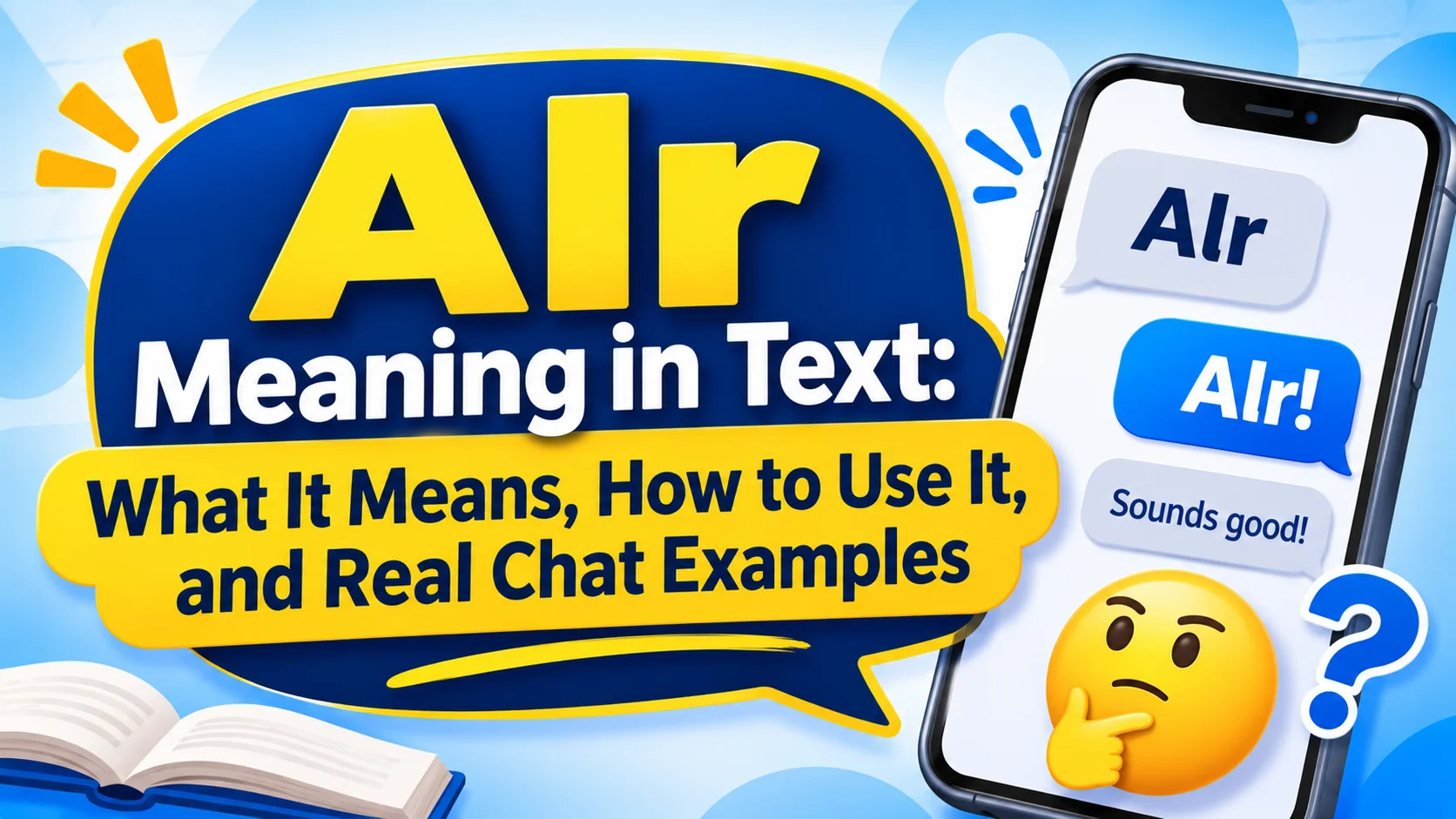
If someone sends you “alr” in a text message, they are most likely saying “alright.” This short form appears in everyday chats, social media comments, and quick replies when people want to agree, acknowledge information, or confirm something without typing the complete word. Although its meaning is usually straightforward, the tone can be less obvious. A simple “alr” might communicate agreement, sound neutral, or seem a little distant depending on the conversation. Understanding how people use it makes it easier to interpret messages without reading too much into a short response.
The abbreviation is particularly common in informal digital communication, where speed and convenience often matter more than standard spelling. You might see it in a WhatsApp conversation about weekend plans, an Instagram direct message, a Snapchat reply, or a TikTok comment. In most of these situations, alr works like “okay,” “sure,” or “got it.” However, there is another possible interpretation: some people use it as a shortened form of “already.” The sentence usually makes the intended meaning clear, so it helps to consider the surrounding words rather than interpreting the abbreviation in isolation.
This guide explains the ALR meaning in text, its common uses, and the differences between “alr,” “alright,” and “already.” You will also find realistic chat examples, advice on responding, and explanations of how punctuation and context influence its tone. Whether you received the abbreviation from a friend or noticed it in a social media comment, you will learn how to understand it naturally. Most importantly, you will see when ALR is appropriate, when it might cause confusion, and when writing the complete word is the better choice.
What Does ALR Mean in Text?
In texting, ALR usually means “alright.” It is an informal shortened spelling that people use to communicate agreement, acceptance, understanding, or acknowledgment.
For example:
Person A: Are we still meeting at 5?
Person B: Alr, see you there.
Here, “alr” means “alright.” The sender is confirming the arrangement and indicating that the plan works.
The abbreviation can replace several everyday expressions depending on the situation:
- Okay: “Alr, I understand.”
- Sure: “Alr, I can help.”
- Sounds good: “Alr, let’s do that.”
- I agree: “Alr, you’re right.”
- Got it: “Alr, thanks for letting me know.”
The precise meaning depends on what the other person said before it. A standalone “alr” is usually an acknowledgment, while “alr, let’s go” communicates agreement followed by action.
Is ALR an Acronym or an Abbreviation?
ALR is generally a shortened spelling of “alright,” not an acronym.
An acronym is formed from the initial letters of separate words, such as NASA or ASAP. ALR does not normally work that way. Instead, it is a compact, informal representation of an existing word.
This distinction matters because online slang lists sometimes present short expressions as acronyms even when they are simply abbreviations or clipped spellings.
| Term | Type | Meaning |
| ALR | Informal abbreviation | Alright |
| LOL | Initialism | Laughing out loud |
| BRB | Initialism | Be right back |
| IDK | Initialism | I don’t know |
| ASAP | Acronym | As soon as possible |
In everyday conversation, people may call ALR an acronym casually. However, abbreviation is the more accurate description.
What Does ALR Mean in Different Conversations?
Although “alright” is the main meaning, ALR can perform several conversational functions. The situation determines whether someone is agreeing, accepting a change, acknowledging information, or simply ending an exchange.
1. ALR to Show Agreement
People often use ALR when they accept an idea or agree with a suggestion.
Example:
Friend 1: Let’s watch a movie after dinner.
Friend 2: Alr, sounds good.
The reply communicates that the suggestion is acceptable. It is similar to saying, “Okay, I’m in.”
You might also see:
- “Alr, I’m down.”
- “Alr, let’s do it.”
- “Alr bet.”
- “Alr, that works for me.”
In these examples, ALR helps the conversation move forward without requiring a longer response.
2. ALR to Confirm Plans
A short acknowledgment can be useful when people are arranging a meeting, discussing schedules, or confirming details.
Example:
Person A: I’ll call you around 7 tonight.
Person B: Alr.
The sender is confirming that they understand the arrangement.
Other examples include:
- “Meet me outside the library.” — “Alr.”
- “I’ll send you the address.” — “Alr, thanks.”
- “Don’t forget the meeting tomorrow.” — “Alr, I won’t.”
Practical tip: If a plan involves an important time, location, or responsibility, a more complete reply is safer. “Alr, I’ll be there at 7” confirms the details more clearly than a one-word response.
3. ALR to Acknowledge Information
Sometimes a person does not need to agree with a message. They simply need to show that they have received and understood it.
Example:
Friend: The class has been moved to Room 12.
You: Alr, thanks for telling me.
Here, ALR means “I understand” or “I’ve got the information.”
This use is common in quick conversations because it avoids unnecessary explanations.
4. ALR to Accept a Change or Decision
Plans do not always work out as expected. Someone might use ALR to show that they accept a change, even if it is not their first choice.
Example:
Person A: Can we move our study session to Saturday?
Person B: Alr, Saturday works.
The response indicates acceptance. Depending on the surrounding conversation, it may sound enthusiastic or simply practical.
5. ALR to Wrap Up a Conversation
ALR can also appear near the end of a casual exchange. It may signal that the person has understood the final point and is ready to leave the conversation.
Example:
Friend 1: I’ll message you when I get home.
Friend 2: Alr, talk later.
In this case, the phrase helps close the exchange naturally. It does not necessarily mean the sender is bored or annoyed.
ALR Meaning: Alright or Already?
One source of confusion is that some people also use alr as an informal shortening of “already.” This is less dependable than the main meaning, so readers should not assume it automatically.
The easiest way to distinguish the two is to examine the sentence.
- When ALR is used as a response or introduces an acknowledgment, it usually means alright.
- When it appears in a sentence describing something that has happened, it may mean already.
Compare these examples:
Example 1:
“Alr, I’ll send the picture.”
Meaning: “Alright, I’ll send the picture.”
Example 2:
“I alr sent the picture.”
Meaning: “I already sent the picture.”
In the first example, ALR introduces an agreement. In the second, replacing it with “alright” would not make grammatical sense.
Comparison: ALR as Alright vs. Already
| Feature | ALR = Alright | ALR = Already |
| Frequency in casual texting | Main, widely recognized meaning | Less common, informal use |
| Typical position | Standalone reply or beginning of a sentence | Within a sentence about an action |
| Main purpose | Agreement or acknowledgment | Indicating that something happened before now |
| Example | “Alr, I’ll come.” | “I alr ate.” |
| Best interpretation | Okay or understood | Already |
A useful rule: If “alright” makes sense in the message, it is probably the intended meaning. If the sentence describes a completed action and “already” fits better, that may be what the sender means.
When the distinction affects an important detail, ask the person to clarify instead of guessing.
How Tone and Punctuation Change the Meaning of ALR
ALR generally has a neutral meaning, but its presentation can influence how a message feels. Because text conversations do not include a person’s voice or facial expressions, readers sometimes rely on punctuation, emojis, and surrounding words to interpret tone.
Consider these variations:
| Text version | Possible tone | Example interpretation |
| alr | Casual or neutral | Okay, got it. |
| Alr! | Enthusiastic | Sounds good! |
| Alr 😊 | Friendly or reassuring | Okay, no problem. |
| Alr. | Brief or matter-of-fact | Alright. |
| Alr then | Neutral or final | Okay, that’s settled. |
| Alrrr | Playful or expressive | Okayyy! |
These interpretations are possibilities, not fixed rules. A period does not automatically mean someone is angry, and an exclamation mark does not always indicate excitement.
Can ALR Sound Dry or Rude?
Yes, it can sometimes come across as dry, distant, or dismissive, particularly when someone expects a more thoughtful response.
For example:
You: I spent a lot of time preparing everything for tomorrow.
Friend: Alr.
Depending on your relationship and the previous conversation, that reply might feel uninterested. However, it could simply reflect the sender’s usual texting style.
Before assuming a negative meaning, consider:
- Does the person usually send short messages?
- Were they responding to a simple question?
- Was the conversation already ending?
- Did they include other words or an emoji?
- Does their response make sense in the context?
A short message alone is not enough to determine someone’s feelings. Context is more reliable than punctuation by itself.
ALR Meaning on WhatsApp, Instagram, TikTok, and Snapchat
ALR does not have a completely different definition on every social media platform. Its main meaning remains “alright.” What changes is the type of conversation in which people use it.
ALR on WhatsApp
On WhatsApp, ALR commonly appears in private messages and group chats. People use it to confirm arrangements, acknowledge updates, or respond quickly to friends and family.
Example:
Friend: I’ll share the notes in the group tonight.
You: Alr, thanks!
The sender acknowledges the information without writing a longer reply.
ALR on Instagram
Instagram users may write ALR in direct messages, story replies, and comments. It works as a casual acknowledgment or agreement.
Example:
Person A: I posted the pictures. Check them out!
Person B: Alr, I’ll have a look.
It may also appear in comments when someone reacts to a suggestion or responds to another user’s statement.
ALR on TikTok
On TikTok, ALR appears in comments, captions, and conversations between users. It generally means “alright,” just as it does in ordinary texting.
You might see:
- “Alr, I see what you mean.”
- “Alr, that’s actually funny.”
- “Alr bet.”
- “Alr, fair enough.”
The meaning still depends on the surrounding words. A comment containing ALR is not automatically a special TikTok expression.
ALR on Snapchat
Snapchat conversations often involve quick replies, so short forms such as ALR fit naturally into the platform’s informal messaging style.
Example:
Friend 1: Send me the picture when you get a chance.
Friend 2: Alr.
The reply simply acknowledges the request.
Does ALR Have a Different Meaning on Each Platform?
| Platform | Common use | Example |
| Confirming messages or plans | “Alr, see you tomorrow.” | |
| Replying to DMs or comments | “Alr, I’ll check.” | |
| TikTok | Reacting to comments or captions | “Alr, that’s fair.” |
| Snapchat | Quick acknowledgments | “Alr 👍” |
The platform may influence how informal the conversation feels, but the surrounding message—not the app—usually determines the meaning.
What Does ALR Mean in Phrases Like “ALR Bet” and “You Alr”?
ALR often appears alongside other words. These combinations can provide more information than the abbreviation alone.
What Does “ALR Bet” Mean?
“Alr bet” combines two informal expressions.
- Alr: Alright or okay.
- Bet: An informal way to express agreement or acceptance.
Together, “alr bet” usually means something like “Okay, sounds good” or “I’m in.”
Example:
Friend: Want to play a game later?
You: Alr bet.
The response indicates that you accept the suggestion.
What Does “You Alr?” Mean?
In some informal conversations, “You alr?” is a shortened way of asking “Are you alright?” or “Are you okay?”
Example:
Friend: You haven’t said much today. You alr?
You: Yeah, I’m good. Just tired.
Here, the sender is checking on someone’s well-being. The question mark and sentence structure make this interpretation clear.
What Does “Alr Then” Mean?
“Alr then” usually means “Alright then.” It can acknowledge a decision or bring a conversation to a close.
Example:
Person A: I’ll see you next week instead.
Person B: Alr then, take care.
Depending on the situation, it may sound neutral, friendly, or slightly final.
What Does “Alr Fine” Mean?
“Alr fine” generally means “Alright, fine.” It can express acceptance, but the tone may depend on the conversation.
For example:
Friend: Can we start the game now?
You: Alr fine, let’s go.
This could be playful agreement or reluctant acceptance. The surrounding exchange provides the clue.
ALR vs. Other Texting Expressions: Which One Should You Use?
ALR is only one of several ways to acknowledge a message. Other expressions may communicate a more specific feeling or intention.
| Expression | Meaning | Best used when |
| ALR | Alright | You want a quick, casual acknowledgment |
| OK | Okay | You want a simple, neutral response |
| K | Okay | You want a very short reply, although it may sound abrupt |
| Bet | Agreed or sounds good | You enthusiastically accept a suggestion |
| Aight | Alright | You want a relaxed, slang-style response |
| Sure | Yes or certainly | You want to accept a request |
| Got it | I understand | You want to confirm that you received information |
| FR | For real | You want to express agreement or emphasize something |
| NGL | Not gonna lie | You want to introduce an honest opinion |
ALR vs. OK
Both ALR and OK can communicate agreement or acknowledgment. However, OK is more widely recognized and works in a broader range of situations.
ALR: “Alr, I’ll be there.”
OK: “OK, I’ll be there.”
Both are understandable, but ALR feels more like informal texting shorthand.
ALR vs. K
K is an extremely brief form of acknowledgment. Depending on the relationship, it can sound neutral or somewhat abrupt.
K may feel less warm than “Alr, thanks!” because it offers less conversational detail.
If you want to avoid sounding dismissive, adding a few words can help.
ALR vs. Aight
Aight is an informal, pronunciation-based spelling of “alright.” It often has a more conversational or slang-heavy feel.
Alr is a shortened written form, while aight reflects a casual spoken-style pronunciation.
Neither is a good choice for formal writing.
When Should You Use ALR—and When Should You Avoid It?
ALR works best when the conversation is relaxed and both people are comfortable with texting abbreviations. It saves a little typing and can make ordinary exchanges feel quick and natural.
However, not every message benefits from a shortened response.
Good Situations for Using ALR
Use ALR when:
- Replying to a friend’s suggestion.
- Confirming a casual plan.
- Acknowledging a simple update.
- Responding to a familiar person in a group chat.
- Keeping an informal conversation moving.
Example:
Friend: I’ll meet you near the entrance.
You: Alr, see you there.
This is clear because the message is casual and the meaning is easy to understand.
Situations Where You Should Avoid ALR
Avoid using ALR when:
- Writing a formal email.
- Communicating with a teacher or employer in a professional setting.
- Responding to an important instruction that needs a clear confirmation.
- Discussing a serious or sensitive matter.
- Messaging someone who may not recognize internet slang.
For example, if a teacher gives you an important assignment instruction, replying only “alr” may seem too casual. A complete response such as “Understood, thank you” is more appropriate.
Choosing the Right Response
| Situation | Better response | Why |
| Friend suggests watching a movie | “Alr, sounds good!” | Relaxed and friendly |
| Someone shares a simple update | “Alr, thanks.” | Acknowledges the information |
| Teacher explains an assignment | “Understood, thank you.” | More respectful and clear |
| Group member confirms a deadline | “Got it. I’ll finish it by Friday.” | Confirms understanding and responsibility |
| Someone shares a personal concern | “I’m listening. What’s going on?” | More considerate than a brief acknowledgment |
Expert recommendation: Match your wording to the importance of the message. A short abbreviation is convenient for everyday conversation, but clarity and consideration matter more when the subject is important.
How to Reply When Someone Says ALR
Your response should depend on what the person is acknowledging. In many cases, you do not need to reply at all. If the conversation requires another message, keep it natural and relevant.
Casual Replies
Use these when chatting with friends:
- “Cool!”
- “Sounds good.”
- “Bet.”
- “See you then.”
- “Okay, no worries.”
Example:
You: I’ll send you the details later.
Friend: Alr.
You: Cool!
Friendly Replies
If you want to keep the conversation warm, add a little more information.
- “Thanks for understanding.”
- “Great, talk soon!”
- “Perfect, see you there.”
- “Awesome, appreciate it.”
Example:
Friend: I can help you with the project tomorrow.
You: Alr.
Friend: Great, thanks for helping!
Funny or Playful Replies
When the conversation is already playful, a light response can work:
- “Alrrr, it’s a plan.”
- “Say less!”
- “Deal!”
- “We got this.”
Use these only when they fit the relationship and the conversation. A joke may feel out of place if someone is discussing something serious.
If You Are Unsure What They Mean
If ALR appears in a sentence where both “alright” and “already” seem possible, ask a simple clarification:
- “Do you mean alright?”
- “Are you saying you already did it?”
- “Just checking—are we still meeting?”
There is no need to guess when a quick question can prevent a misunderstanding.
Common Misunderstandings About ALR
A few assumptions can make a simple abbreviation seem more complicated than it is.
Mistake 1: Assuming ALR Is Always an Acronym
ALR is generally a shortened spelling of “alright,” not a phrase made from three separate words. Calling it an acronym is common in casual explanations, but it is not the most accurate linguistic description.
Mistake 2: Thinking ALR Is Automatically Rude
A one-word reply may feel abrupt, but ALR does not inherently express anger or disrespect. Some people simply prefer short messages.
Look at the conversation and the sender’s usual communication style before interpreting it negatively.
Mistake 3: Assuming ALR Always Means Already
Although some people use ALR as an informal shortening of “already,” that is not the main meaning in ordinary texting. A standalone response such as “Alr” is usually best understood as “alright.”
Mistake 4: Believing ALR Has a Special Meaning on Every App
The abbreviation does not normally change its definition between WhatsApp, TikTok, Instagram, and Snapchat. Platform culture may influence how people use it, but context remains the strongest clue.
Mistake 5: Treating Every Short Reply as a Sign of Disinterest
A brief answer does not necessarily reveal someone’s mood. They may be busy, multitasking, or simply communicating in their usual style. Avoid drawing conclusions from three letters alone.
Does ALR Have Other Meanings?
In ordinary texting, “alright” is the safest interpretation of ALR. However, the same three letters can represent unrelated terms in specialized settings.
For example, ALR may appear as an abbreviation or set of initials in technical, legal, organizational, or professional documents. Those uses have no necessary connection to texting slang.
You may also encounter claims that ALR stands for “A Little Respect.” This is an alternative interpretation reported in some online slang references, but it is not the standard meaning to assume in an everyday chat.
The subject of the conversation is important:
- In a casual exchange about plans, ALR probably means “alright.”
- In a sentence about something completed, it may mean “already.”
- In a technical document, it may represent a field-specific term.
- In an unusual slang phrase, the surrounding words may establish a different meaning.
Do not force a specialized definition onto an ordinary text message. Start with the common meaning and consider alternatives only when the context supports them.
Is ALR Still Popular in Texting?
ALR continues to appear in online conversations, particularly in informal messages and social media interactions. Its use fits a broader pattern of shortening familiar words to make digital communication faster.
However, popularity varies by age group, social circle, platform, and personal texting habits. Not everyone uses the same abbreviations, and a term that feels familiar in one online community may be unfamiliar in another.
ALR is also easy to understand once someone recognizes its connection to “alright.” That simplicity helps explain why it works in different kinds of casual conversations.
Rather than treating it as a trend with one fixed level of popularity, it is more useful to understand it as an established informal texting shortcut. You may see it frequently in one group chat and rarely in another.
Conclusion:
The most common ALR meaning in text is “alright.” It is a convenient informal abbreviation for agreeing, confirming plans, acknowledging information, or accepting a suggestion. Although some people also use it to mean “already,” that interpretation depends on sentence structure and is less common. Its tone can be friendly, neutral, or occasionally abrupt, so consider the full conversation before judging a short reply. One final actionable tip: when you receive ALR, replace it with “alright” first and see whether the message makes sense. If the sentence suggests a completed action, consider “already” instead. A common mistake to avoid is assuming that a brief response automatically means someone is annoyed. In digital conversations, context matters more than three letters.
FAQs
Q1. What does ALR mean from a girl or a guy in a text?
When a girl or a guy sends ALR, it usually means “alright.” The abbreviation itself does not reveal romantic interest, frustration, or any particular feeling. Read the surrounding conversation and consider the person’s usual texting style before interpreting the response.
Q2. What does ALR mean when someone replies with just one word?
A standalone “alr” usually acknowledges your message or confirms that the person understands. It may mean “okay,” “sure,” or “got it.” Whether it sounds friendly or distant depends on the situation, not simply on the fact that it is short.
Q3. Is ALR the same as alright or all right?
In casual texting, ALR represents “alright,” which is commonly used with the meaning of “all right.” In formal writing, however, it is better to write the complete expression. “All right” is the more traditional standard form, while “alright” is also widely used.
Q4. What does ALR mean in a sentence like “I told you alr”?
In this sentence, ALR may mean “already.” The intended message is “I told you already.” This is an informal use, and not everyone writes the abbreviation this way. If clarity matters, spelling out “already” is the better option.
Q5. Can I use ALR in school or work messages?
You can use ALR in casual conversations with people who understand the abbreviation, but it is best avoided in formal school or workplace communication. Expressions such as “Understood,” “Okay,” or “Thank you for letting me know” sound clearer and more professional.