

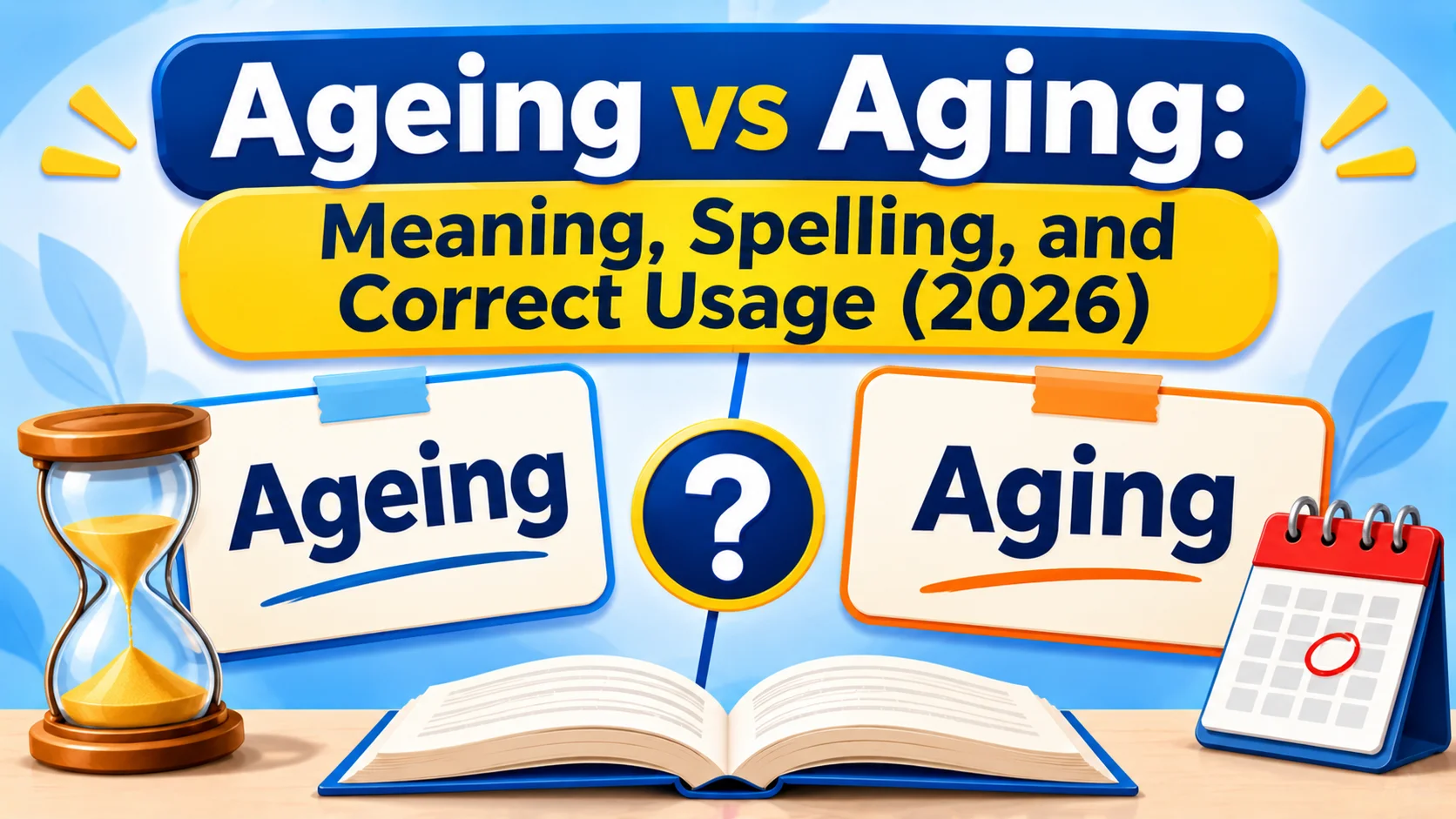
Ageing vs. aging is a spelling question that often catches writers off guard. You may see ageing in a British newspaper and aging in an American research paper, even though both words describe exactly the same process. Does one spelling have a different meaning? Is one grammatically incorrect? The short answer is no: both forms are correct, but their preferred use depends largely on the variety of English you are writing in. Knowing that distinction helps you avoid unnecessary corrections and choose the form your readers expect.
The difference becomes more important when you are preparing academic papers, business documents, website content, or professional reports. A writer might correctly use ageing population in a British English article but choose aging population for an American audience. The same regional preference applies when discussing people, animals, buildings, technology, materials, and biological processes. Although spell-checking software may flag one version, that does not automatically make it wrong. It may simply be checking against a different regional dictionary.
This guide explains what ageing and aging mean, where each spelling is preferred, and how the word works as a noun, verb form, and adjective. You will also find practical sentence examples, a comparison table, guidance for international writing, and answers to common questions. By the end, you should be able to select the appropriate spelling confidently, understand why both versions exist, and keep your writing consistent without treating a regional spelling preference as a universal grammar rule.
Ageing vs. Aging: The Quick Answer
Ageing and aging have the same meaning and pronunciation. Both refer to the process of becoming older or showing the effects of time.
The main difference is regional spelling:
- Ageing is traditionally preferred in British English.
- Aging is the standard spelling in American English.
- Aging is also the preferred form in Canadian government writing, although ageing is accepted in Canada.
- In Australian English, ageing is commonly preferred, but both forms appear. Follow the dictionary or style guide used by your organisation.
For example:
- British English: The ageing population needs better access to healthcare.
- American English: The aging population needs better access to healthcare.
Neither sentence is incorrect. The spelling changes to match the intended variety of English, not the meaning of the sentence.
What Does Ageing or Aging Mean?
The word ageing or aging describes the process of growing older or becoming older over time. It can refer to living things, physical materials, equipment, buildings, organisations, and even systems that are becoming outdated.
The exact meaning depends on the subject.
1. Ageing or Aging in People and Animals
When used for people or animals, the word describes the natural process of growing older. It may refer to physical changes, changes in abilities, or the passage of time.
Examples:
- Regular health check-ups can help older adults manage some challenges associated with ageing.
- Researchers are studying how aging affects memory and mobility.
- The shelter provides special care for ageing dogs.
- Her grandparents are approaching retirement, but they remain active and independent.
In health and social research, the term often appears in expressions such as healthy ageing, age-related changes, and population ageing. These expressions describe different aspects of growing older; they do not represent separate spellings or meanings.
2. Ageing or Aging in Objects and Materials
The word also applies to things that change through use, exposure, or the passage of time. A material may become weaker, discoloured, brittle, or otherwise altered as it ages.
Examples:
- The ageing wooden furniture needs careful restoration.
- Sunlight can accelerate the aging of certain plastics.
- The building’s ageing roof requires professional inspection.
- The museum protects paintings from environmental conditions that may affect their aging.
In this context, the word does not necessarily mean that an object is useless. It simply indicates that time has affected its condition.
3. Ageing or Aging in Technology and Systems
Businesses and institutions also use the word to describe equipment, infrastructure, or systems that are becoming outdated or less effective.
Examples:
- The city plans to replace its ageing water pipes.
- The company is upgrading its aging computer network.
- An ageing railway system may require significant investment.
- The hospital is replacing several pieces of aging equipment.
Here, ageing or aging can suggest a need for maintenance, replacement, or modernisation. The surrounding sentence makes the intended meaning clear.
Ageing vs. Aging: Main Differences at a Glance
The following table shows how the two spellings compare.
| Feature | Ageing | Aging |
| Meaning | Becoming older | Becoming older |
| Pronunciation | /ˈeɪ.dʒɪŋ/ | /ˈeɪ.dʒɪŋ/ |
| British English | Traditionally preferred | Also understood |
| American English | Less common | Standard |
| Canadian English | Accepted | Preferred |
| Australian English | Commonly preferred | Also used |
| Grammatical role | Noun, adjective, verb form | Noun, adjective, verb form |
| Correctness | Correct | Correct |
The important point is that the spelling does not change the definition, pronunciation, or grammatical function. Your choice should reflect the audience and style guide.
Is Ageing or Aging Correct in British and American English?
Both spellings are correct, but regional conventions influence which one editors and readers generally expect.
British English: Ageing
In traditional British English, ageing is the preferred spelling. It appears in everyday writing, formal publications, academic discussions, and professional documents.
Examples:
- The government is reviewing support for an ageing population.
- Scientists are investigating the effects of ageing on the human body.
- The company needs to replace its ageing machinery.
- The report examines the challenges of healthy ageing.
If you are writing for a British audience, ageing is usually the natural choice. It also fits a broader British spelling style in which certain words retain letters that American English may omit.
American English: Aging
American English generally uses aging, without the additional e. This spelling is standard in American newspapers, books, educational materials, and professional writing.
Examples:
- The United States has an aging population.
- Researchers are examining the effects of aging on the brain.
- The factory is replacing its aging equipment.
- The study focuses on healthy aging.
For an American audience, choose aging. Using ageing is understandable, but it may look inconsistent with the rest of an American English document.
Canadian English: Aging Is Generally Preferred
Canadian spelling does not always follow either British or American conventions. In this particular case, the Government of Canada’s Language Portal identifies aging as the preferred spelling in Canada and the United States, while noting that British usage favours ageing and that the latter is also accepted in Canada.
For Canadian writing, aging is therefore a sensible default. However, follow the spelling policy of the publication, institution, or organisation if it specifies another form.
Australian and New Zealand English: Check the Local Style
Australian English has a strong British spelling tradition, and ageing is commonly preferred. Nevertheless, aging also appears in Australian publications and professional material.
New Zealand English often follows British-style spelling conventions, making ageing a familiar choice. However, an organisation may adopt its own editorial standards.
The safest approach is to consult a current local dictionary or the publication’s style guide rather than assuming every English-speaking country follows exactly the same rule.
Why Are There Two Spellings?
The difference comes from English spelling conventions, particularly what happens to a final silent e when a suffix is added.
The base word is age. When the suffix -ing is added, writers have two established forms:
- Age + ing = ageing
- Ag(e) + ing = aging, with the final e removed
The spelling aging follows a familiar English pattern: a final silent e is often dropped before a suffix beginning with a vowel. Consider these examples:
| Base word | Form with -ing |
| Make | Making |
| Write | Writing |
| Dance | Dancing |
| Hope | Hoping |
| Age | Aging |
However, ageing has also become an established spelling, particularly in British English. English contains many spelling variations that have developed through regional usage and historical convention. A spelling can remain acceptable even when another version follows a more familiar pattern.
The practical lesson: Do not try to decide between ageing and aging by applying the silent-e rule alone. Both forms are recognised; regional convention determines the usual choice.
How to Use Ageing and Aging in a Sentence
Both spellings can perform the same grammatical jobs. Understanding those roles makes it easier to use the word correctly.
1. As a Noun
When used as a noun, ageing or aging refers to the process of becoming older.
Examples:
- Ageing is a natural part of life.
- Scientists continue to study aging and its effects on health.
- The ageing of wine can influence its flavour.
- The research examines the social effects of population aging.
In these sentences, the word names a process rather than describing a particular person or object.
2. As an Adjective
As an adjective, the word describes a person, object, or system that is becoming older or showing the effects of time.
Examples:
- The ageing population needs accessible public services.
- The organisation is investing in its aging infrastructure.
- They moved into a house with an ageing heating system.
- The laboratory is replacing its aging equipment.
The adjective usually appears before a noun, although it can also follow a linking verb in some constructions.
3. As a Verb Form
Ageing and aging are also the present participle and gerund forms of the verb age.
Examples:
- The cheese is ageing in a controlled environment.
- The leather is aging naturally.
- She is ageing gracefully.
- The materials are aging faster than expected.
The form can also appear in continuous verb tenses:
- The building is ageing rapidly.
- The equipment was aging before the replacement programme began.
- The wine has been ageing for several years.
The spelling follows the same regional preference throughout these examples.
Practical Examples: Ageing vs. Aging in Different Contexts
Seeing the words in realistic situations makes their usage easier to remember.
| Context | British-style example | American-style example |
| Population | The ageing population needs support. | The aging population needs support. |
| Healthcare | Researchers study healthy ageing. | Researchers study healthy aging. |
| Family | He cares for his ageing parents. | He cares for his aging parents. |
| Technology | The company replaced its ageing servers. | The company replaced its aging servers. |
| Infrastructure | The ageing bridge needs repairs. | The aging bridge needs repairs. |
| Food and drink | The cheese is ageing in storage. | The cheese is aging in storage. |
| Materials | The ageing fabric has faded. | The aging fabric has faded. |
| Research | The effects of ageing vary between individuals. | The effects of aging vary between individuals. |
Notice that the meaning remains unchanged in every pair. Only the regional spelling differs.
A Professional Writing Example
Imagine that a company is preparing an annual report about its facilities.
A British English version might say:
The organisation has begun replacing ageing equipment across its regional offices.
An American English version might say:
The organization has begun replacing aging equipment across its regional offices.
Both sentences communicate the same information. The spelling of ageing/aging is one part of a wider regional style choice. The American version also uses organization rather than the British-style organisation.
This is why professional editors check the document’s overall spelling conventions rather than correcting individual words in isolation.
Related Words: Age, Aged, Ageism, and Age-Related
The words associated with ageing and aging can look similar, but they do not all follow the same spelling pattern.
| Word | Meaning | Example |
| Age | The length of time someone or something has existed | Her age is not relevant to the decision. |
| Aged | Having reached a particular age or becoming older | The programme supports aged residents. |
| Ageing | The process of becoming older; British-style spelling | Healthy ageing is a research priority. |
| Aging | The process of becoming older; American-style spelling | Aging is studied across several fields. |
| Ageism | Prejudice or discrimination based on age | The company introduced training to address ageism. |
| Age-related | Connected with or caused by age | The doctor discussed age-related changes. |
| Ageing process | The changes that occur over time | The ageing process affects different materials differently. |
Is It Ageism or Ageingism?
The correct word is ageism, not ageingism or agingism.
Ageism means prejudice, stereotyping, or discrimination based on a person’s age. It is a separate word, and its spelling does not change according to the British or American preference for ageing and aging.
Example:
- Employers should take steps to prevent ageism in the workplace.
This distinction is useful because writers sometimes assume that every word related to age must follow the same spelling pattern. That is not the case.
Common Mistakes to Avoid
Although the choice between ageing and aging is straightforward once you know the regional difference, a few mistakes can make writing look inconsistent or inaccurate.
1. Treating One Spelling as Universally Wrong
A common mistake is assuming that ageing is incorrect because American English uses aging, or that aging is a spelling error because British English traditionally prefers ageing.
Neither assumption is accurate.
Better approach: Identify the variety of English you are using before editing the word.
2. Mixing Regional Spellings Without a Reason
A document might use ageing population in one paragraph and aging infrastructure in another. Both expressions are understandable, but switching between the forms without a clear reason can make the document feel poorly edited.
Better approach: Choose one spelling and use it consistently unless you are reproducing an official title, quotation, or organisation-specific wording.
3. Changing the Spelling Based on the Subject
Some writers believe ageing describes people while aging describes objects, or that one spelling refers to natural ageing and the other to deterioration.
There is no general rule supporting this distinction. Both spellings can describe people, animals, materials, and systems.
Better approach: Choose according to regional style, not the subject of the sentence.
4. Confusing Ageing With Ageism
Ageing describes becoming older. Ageism describes unfair treatment or assumptions based on age.
These terms are related, but they are not interchangeable.
Better approach: Check whether your sentence refers to a process of growing older or discrimination based on age.
5. Relying Only on Spell-Check
A spell-checker may underline ageing in an American English document or aging in a British English document. That does not necessarily mean the word is misspelled in every variety of English.
Better approach: Set your software’s proofing language to the intended regional variety and consult a suitable dictionary when uncertain.
Which Spelling Should You Use? A Practical Decision Guide
The easiest way to choose is to start with your audience. If you know which regional variety your readers expect, the decision is usually simple.
| Your writing situation | Recommended choice |
| A document for readers in the United States | Aging |
| A document following traditional British English | Ageing |
| Canadian government or general Canadian writing | Aging, unless a house style says otherwise |
| Australian writing | Usually ageing; check the organisation’s dictionary |
| New Zealand writing | Usually ageing in British-style house conventions; check local guidance |
| An American academic journal | Follow its style guide, usually aging |
| A British publication | Follow its editorial policy, usually ageing |
| An international website | Select one consistent English variety and apply it throughout |
For Students and Academic Writers
If you are writing an assignment, dissertation, or research paper, use the spelling standard required by your school, university, or journal.
For example, an American-style academic paper will generally use aging, while a publication following British English may prefer ageing. A journal’s author instructions take priority over general assumptions about regional spelling.
For Bloggers and Website Owners
If your website targets a specific country, use the spelling familiar to that audience. A site aimed primarily at American readers should normally use aging. A site written in British English should generally use ageing.
For international websites, consistency is more useful than switching between spellings in an attempt to target every country. Search engines can understand both forms, so there is no need to repeat both versions unnaturally throughout an article.
For Businesses and Professional Teams
Businesses often have documents written by several people. Without a shared style guide, regional spelling differences can appear across reports, presentations, emails, and website pages.
A simple editorial style sheet should record:
- The preferred variety of English.
- The chosen spelling of ageing/aging.
- The dictionary or style guide used.
- Exceptions for official names and direct quotations.
This small step makes proofreading easier and helps maintain a consistent brand voice.
Conclusion
The choice between ageing and aging is not a test of which writer knows English better. Both spellings are established, share the same pronunciation, and communicate the same meaning. What matters is choosing the form that fits your audience: ageing for traditional British-style writing and aging for American English, with local guidance worth checking in countries where usage varies. One final actionable tip: set your document’s language before proofreading and record your preferred spelling in a simple style sheet. A common mistake to avoid is changing the spelling according to the subject or treating one regional form as universally incorrect. Good writing is not about forcing one spelling everywhere; it is about making clear, consistent choices your readers can trust.
FAQs
Q1. Is ageing or aging the correct spelling?
Both ageing and aging are correct spellings of the same word. Ageing is traditionally preferred in British English, while aging is standard in American English. Canadian usage generally prefers aging, although ageing is accepted. Choose according to your audience and maintain consistency.
Q2. Does ageing have a different meaning from aging?
No. There is no difference in meaning or pronunciation between the two forms. Both can describe people becoming older, materials changing over time, or equipment becoming outdated. The distinction is regional spelling, not a difference in the process being described.
Q3. Is it healthy ageing or healthy aging?
Both expressions are correct. Healthy ageing is common in British-style writing, while healthy aging is standard in American English. The expression generally refers to supporting health, wellbeing, and quality of life as people grow older. Follow the spelling convention of your publication or audience.
Q4. Why does aging lose the letter e?
The spelling aging follows the common English pattern of dropping a final silent e before adding a suffix that begins with a vowel. For example, make becomes making. However, ageing is also an established spelling, especially in British English, so both forms remain acceptable.
Q5. Is anti-ageing or anti-aging correct?
Both anti-ageing and anti-aging are used. The preferred form depends on the regional spelling convention: British-style writing commonly uses anti-ageing, while American English uses anti-aging. Product names and official branding may use a particular spelling, so reproduce those names accurately.