

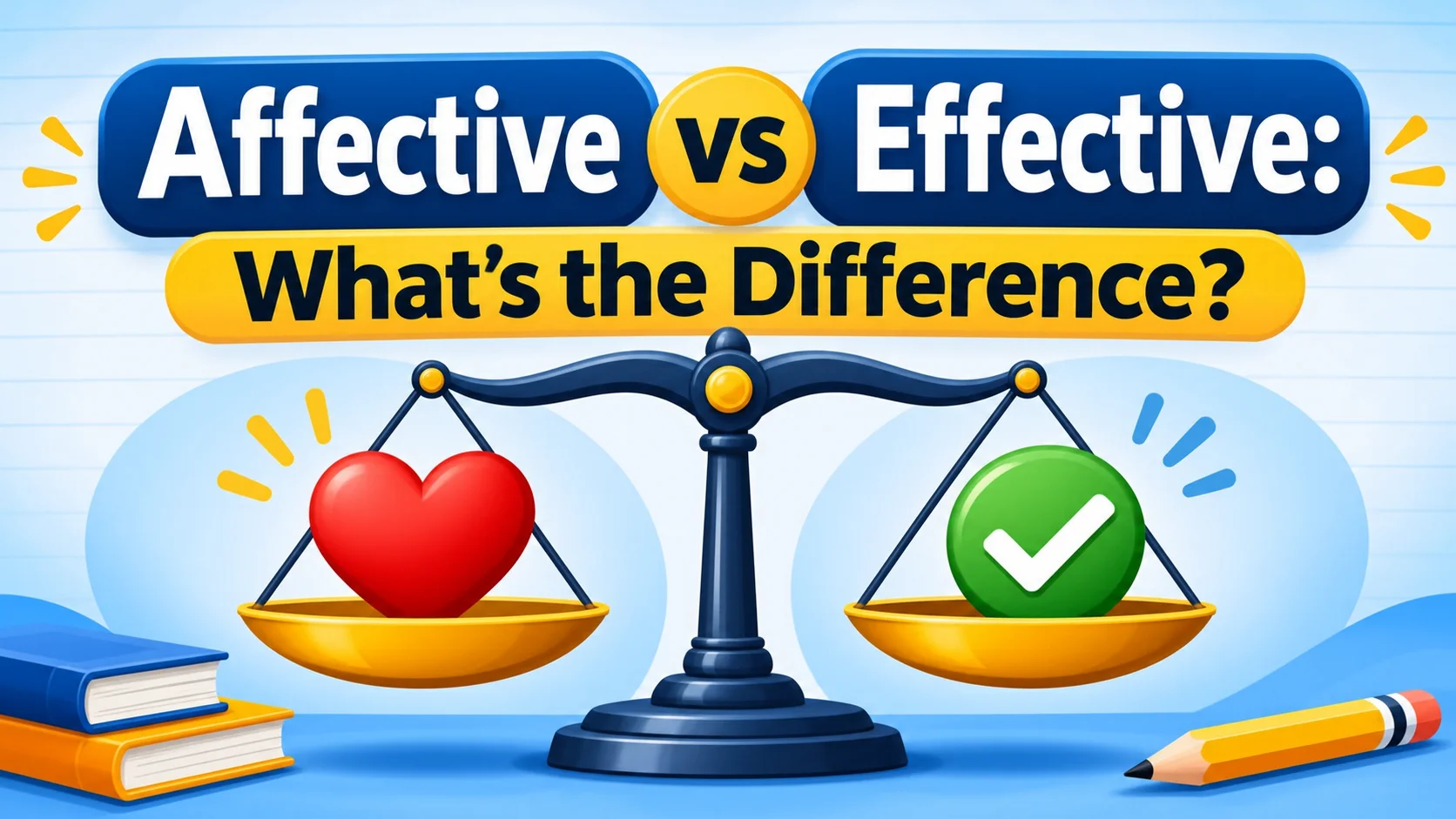
The central distinction is simple: affective relates to emotions and feelings, while effective describes something that produces the result it is supposed to produce. The words look and sound similar, so it is easy to mix them up in writing. Yet they belong to different areas of meaning. An affective response involves a person’s emotions; an effective response successfully addresses a situation. Choosing the right adjective matters because the wrong one can change your sentence’s meaning, especially in academic, professional, psychological, and educational contexts.
You are most likely to encounter affective in discussions about psychology, emotional development, attitudes, and learning. It appears in phrases such as affective behavior, affective needs, and affective domain. Effective, on the other hand, is common in everyday and professional English: people talk about effective communication, effective teaching methods, effective treatments, and effective solutions. Understanding these typical word combinations makes the distinction easier to recognize. It also helps you choose the natural expression instead of relying on guesswork whenever the two adjectives seem interchangeable.
This guide explains both definitions, shows how the words work in sentences, and explores the contexts in which each one is appropriate. You will also learn how affective differs from emotional and affectionate, why effective is not the same as efficient, and what the phrase effective immediately means. Paired examples, comparison tables, and a short practice exercise will help you apply the distinction. By the end, you should be able to identify the right word quickly—and understand why it fits the meaning you want to express.
Affective vs. Effective: The Key Difference
Affective means relating to feelings, emotions, moods, or attitudes. Effective means successful in producing an intended result. Both are adjectives, but they describe different qualities.
Consider these two sentences:
- The teacher considered the students’ affective needs. The focus is on their feelings, attitudes, and emotional well-being.
- The teacher used an effective teaching strategy. The focus is on whether the strategy helped students learn successfully.
The distinction is not about whether something is good or bad. An affective experience can be positive, negative, or neutral. An effective method can also produce a desirable or undesirable result depending on the goal. The key question is whether you are describing an emotional dimension or the success of an action.
Affective vs. Effective at a Glance
| Feature | Affective | Effective |
| Part of speech | Adjective | Adjective |
| Main meaning | Related to emotions, feelings, moods, or attitudes | Producing an intended or desired result |
| Main focus | Emotional experience | Success or performance |
| Common contexts | Psychology, education, emotional development | Work, healthcare, communication, problem-solving |
| Common phrases | Affective response, affective domain, affective needs | Effective strategy, effective treatment, effective communication |
| Simple memory aid | Feelings | Results |
| Common opposite or contrast | Nonaffective (in technical contexts) | Ineffective |
Quick test: If you can replace the word with related to emotions, choose affective. If you can replace it with successful in achieving the goal, choose effective.
What Does Affective Mean?
Affective is an adjective that describes something connected with emotions, feelings, moods, or attitudes. It can refer to an emotional reaction, a person’s emotional state, or the emotional side of learning and behavior.
For example:
- The counselor paid attention to the child’s affective needs.
- The research examined participants’ affective responses to the images.
- Affective development can influence how students relate to others.
In each sentence, the word points to an emotional or attitudinal aspect of a person or experience. It does not mean that something works well.
The adjective is particularly common in psychology and education, where it can be more precise than the everyday word emotional. In ordinary conversation, however, emotional will often sound more natural.
What Does Affective Mean in Psychology?
In psychology, affect is a term associated with observable or experienced emotional states and feelings. The adjective affective describes matters involving that emotional dimension.
You may see it in expressions such as:
- Affective state: A person’s emotional condition at a particular time.
- Affective response: An emotional reaction to an event, person, object, or experience.
- Affective experience: The feeling-related aspect of an individual’s experience.
- Affective symptoms: Symptoms involving changes in mood or emotional expression.
- Affective disorder: A clinical term historically used for disorders involving significant disturbances in mood.
For example, a researcher studying how people respond to stressful photographs might measure their affective responses. The research is concerned with emotional reactions, not whether the photographs are successful at achieving a goal.
A useful distinction is that affective is a broad descriptive term, not a diagnosis by itself. The phrase affective symptoms does not identify a specific condition. Clinical terms need to be interpreted within their proper diagnostic context.
What Does Affective Mean in Education?
In education, the affective domain refers to learning outcomes involving feelings, attitudes, interests, values, motivation, and appreciation. It is commonly discussed alongside the cognitive and psychomotor domains in educational frameworks associated with Bloom’s taxonomy.
These domains describe different dimensions of learning:
- Cognitive: What learners know and how they think.
- Affective: What learners value, feel, and develop attitudes toward.
- Psychomotor: What learners can do through physical or practical skills.
For example, a science lesson may have a cognitive objective of explaining how pollution affects ecosystems. Its affective objective might be encouraging students to value environmental responsibility. A psychomotor objective could involve carrying out a practical experiment.
The affective domain is often described through five levels in the taxonomy developed by David Krathwohl and colleagues:
- Receiving: Being willing to notice or listen to something.
- Responding: Participating or reacting to it.
- Valuing: Showing that it matters to you.
- Organization: Bringing different values together into a coherent system.
- Characterization: Acting consistently in ways guided by those values.
These categories help educators think beyond test scores. A student may understand a subject but still lack confidence, interest, or willingness to engage with it. Recognizing the affective side of learning can help teachers plan activities that support participation and personal development. The framework is a way to classify learning objectives, not a claim that every learner develops in a fixed sequence.
How to Use Affective in a Sentence
Affective usually comes before a noun, where it identifies the emotional or attitudinal aspect being discussed. It can also appear after a linking verb.
| Example | What affective describes |
| The program supports affective development. | Emotional and attitudinal growth |
| The study measured affective responses to music. | Feelings triggered by music |
| Teachers should consider students’ affective needs. | Emotional needs |
| The film had a strong affective impact on its audience. | Its emotional influence |
| Her reaction was primarily affective. | Based mainly on emotion |
In everyday writing, do not use affective simply because you want a more sophisticated alternative to emotional. Choose it when the emotional dimension is genuinely relevant, especially in academic, educational, or psychological discussions.
What Does Effective Mean?
Effective is an adjective meaning successful in producing the result that is wanted or intended. If a method, action, treatment, or person is effective, it achieves its purpose or works well in the circumstances.
Examples include:
- The new revision plan is effective for students who struggle with time management.
- Clear instructions make workplace communication more effective.
- The medicine was effective in reducing the symptoms.
- The team developed an effective way to handle customer complaints.
The word is not limited to situations in which something works perfectly. A method can be effective even if it has some limitations, takes time, or does not produce the same outcome for everyone. Its effectiveness depends on the goal, the conditions, and the evidence available.
What Does Effective Mean in Different Contexts?
The word effective is widely used because almost any action, system, or approach can be judged by whether it achieves a particular purpose.
In everyday language
An effective solution solves a problem or makes a situation better in the way intended.
Example: A simple reminder system proved effective at helping the family remember important appointments.
In business and the workplace
An effective employee, manager, or strategy achieves useful outcomes. An effective leader, for instance, helps a team understand its priorities and make progress toward shared goals.
Example: The manager introduced an effective process for handling urgent requests.
In medicine and healthcare
An effective treatment produces the intended health benefit under the conditions in which it is used. In medical writing, effectiveness should not be confused with safety: a treatment’s ability to work and its potential risks are separate considerations.
Example: The clinical team reviewed whether the treatment was effective for the patient group being studied.
In communication
Effective communication conveys information in a way that helps the audience understand it or take the intended action. It may involve clear wording, appropriate tone, good organization, and attention to the listener’s needs.
Example: The instructions were effective because new employees could follow them without additional explanation.
In education
An effective teaching method helps learners achieve the intended learning outcomes. It may improve understanding, encourage participation, or help students apply what they have learned.
Example: Short practice sessions were an effective way to reinforce the new vocabulary.
What Does “Effective Immediately” Mean?
The word effective has another important meaning in legal, administrative, and business contexts. In phrases such as effective immediately or effective from Monday, it means that a rule, policy, decision, or arrangement begins to apply at the stated time.
Examples:
- The revised attendance policy is effective immediately.
- The new prices will become effective on January 1.
- Her resignation is effective at the end of the month.
Here, effective does not mean successful. It means in force, operative, or officially applicable.
This distinction matters when reading contracts, workplace announcements, policy documents, and official notices. If a notice says a rule is effective from a particular date, that date marks when the rule begins to apply—not necessarily when it was announced or approved.
How to Use Effective in a Sentence
Effective commonly appears before a noun or after a linking verb such as be, seem, or become. It is frequently followed by in or at when explaining what something works well for.
| Sentence pattern | Example |
| Effective + noun | They introduced an effective strategy. |
| Be + effective | The new approach is effective. |
| Effective in + -ing form | This technique is effective in reducing waste. |
| Effective at + noun or -ing form | She is effective at managing large teams. |
| Become effective | The revised policy becomes effective next week. |
Pay attention to the intended meaning. Effective at solving problems describes successful performance; effective from Monday identifies when something starts to apply.
Affective vs. Effective: Examples in Sentences
Definitions are useful, but the contrast becomes clearer when both words appear in similar situations.
Examples of Affective in Sentences
1. The teacher created an affective learning environment.
The environment supports students’ emotional needs, attitudes, or motivation.
2. The research focused on children’s affective responses to unfamiliar situations.
The researchers examined the children’s feelings and emotional reactions.
3. Music can have a powerful affective influence on memory.
The sentence refers to music’s relationship with emotional experience.
4. The school introduced activities to support students’ affective development.
The activities aim to encourage emotional and attitudinal growth.
5. The counselor considered the client’s affective state during the session.
The focus is on the client’s emotional condition.
Examples of Effective in Sentences
1. The teacher introduced an effective way to explain difficult grammar rules.
The method helped students understand the material.
2. A clear schedule is an effective tool for managing deadlines.
The schedule helps people achieve a practical goal.
3. The treatment was effective in reducing the symptoms.
It produced the intended medical benefit.
4. The company needs an effective strategy for reaching new customers.
The strategy should achieve the company’s objective.
5. The new safety rules become effective next month.
The rules will officially begin to apply next month.
Affective vs. Effective in Similar Sentences
| Affective sentence | Effective sentence |
| The teacher considered students’ affective needs. | The teacher used an effective teaching method. |
| The study examined affective responses to the exercise. | The study tested an effective intervention. |
| The program supports affective development. | The program produces effective learning outcomes. |
| The film had a strong affective impact. | The film was effective at communicating its message. |
| The counselor discussed the client’s affective state. | The counselor used an effective counseling technique. |
Notice that the same subject can be described with either adjective, depending on the point being made. A teaching program can be affective because it addresses students’ attitudes and feelings, and effective because it helps them reach learning goals. The adjectives are not competing labels for the same quality; they describe separate dimensions.
Affective vs. Effective: Grammar and Word Formation
Are Affective and Effective Adjectives?
Yes. Both words are adjectives, meaning they describe nouns or provide information about a subject.
They can be used in two common ways:
Before a noun:
- Affective response
- Affective development
- Effective treatment
- Effective solution
After a linking verb:
- The response was affective.
- The method proved effective.
The grammatical structure is similar, but the meaning is different. Knowing that both words are adjectives will not tell you which one to choose; you still need to consider what you are describing.
Where Do Affective and Effective Come From?
The two adjectives have similar-looking forms and both have Latin roots, but they developed through different word families.
Affective is connected with affect, a word used in psychology and other fields to refer to emotional states or feelings. Affective developed from Medieval Latin affectivus, through the Latin affectus. Its modern use is strongly associated with emotional experience.
Effective comes from Latin effectivus, related to efficere, meaning to accomplish or bring about. This history reflects its modern sense: producing an outcome or achieving a result.
Their shared-looking endings can make them confusing, but their meanings are distinct. A useful way to remember the difference is to connect affective with affect and emotion, and effective with effect and outcome.
Related Words and Word Families
| Word | Meaning | Example |
| Affect (noun, psychology) | An emotional state or feeling | The patient showed a restricted affect. |
| Affect (verb) | To influence or have an impact on something | Lack of sleep can affect concentration. |
| Affective | Relating to emotions or feelings | The lesson included affective objectives. |
| Affectivity | The capacity or tendency to experience feelings and emotions | The research examined affectivity and behavior. |
| Effect (noun) | A result or consequence | The new rule had an immediate effect. |
| Effective | Producing the intended result | The new rule was effective. |
| Effectively | In a way that achieves a result | The team communicated effectively. |
| Effectiveness | The degree to which something achieves its purpose | The review measured the policy’s effectiveness. |
| Ineffective | Not producing the intended result | The outdated process was ineffective. |
One additional distinction is worth knowing: affect is also a common verb meaning to influence. For example, The weather may affect travel plans. That meaning is different from the psychological noun affect. Neither should be confused with effect, which is most often a noun meaning result.
Affective vs. Effective vs. Efficient: What Is the Difference?
A third adjective often enters the discussion: efficient. It is easy to confuse effective and efficient because both describe successful ways of doing something. However, they answer different questions.
- Affective: Does this involve emotions or feelings?
- Effective: Does this achieve the intended result?
- Efficient: Does this achieve the result without wasting unnecessary time, effort, or resources?
Consider a company that needs to process customer orders. A system that accurately completes the orders is effective. If it completes them accurately while using less time and fewer resources, it is also efficient. If the company introduces a program that addresses employees’ emotional well-being, that program has an affective focus.
Compare All Three With Examples
| Word | Main focus | Example | What it tells you |
| Affective | Emotions and attitudes | The training addressed employees’ affective needs. | It considered feelings and attitudes. |
| Effective | Achieving the intended goal | The training was effective in improving performance. | It achieved a desired outcome. |
| Efficient | Minimizing wasted resources | The training used an efficient online format. | It made economical use of time and resources. |
Something can be effective without being efficient. For example, a lengthy training program may help employees master a skill, but a shorter program might achieve the same result with less time. Both may be effective; the shorter one may be more efficient.
Likewise, an approach can be efficient but ineffective if it saves resources while failing to achieve its purpose. Efficiency does not compensate for a lack of results.
Common Mistakes When Using Affective and Effective
1. Using Affective When You Mean Effective
This is the central mistake. Writers sometimes use affective when they want to say that a method is successful or useful.
Incorrect: The company needs an affective marketing strategy.
Correct: The company needs an effective marketing strategy.
The corrected sentence means that the strategy should achieve its marketing goals. Use affective only if you specifically mean that the strategy relates to or influences emotional responses.
2. Using Effective When You Mean Affective
The reverse error happens when a writer wants to describe feelings but chooses effective.
Incorrect: The counselor explored the client’s effective response to the loss.
Correct: The counselor explored the client’s affective response to the loss.
The second sentence refers to the client’s emotional reaction. If you are writing for a general audience, emotional response may be a more familiar alternative.
3. Confusing Affective With Affectionate
These words look alike, but they do not mean the same thing.
- Affective: Related to emotions or feelings.
- Affectionate: Showing fondness, warmth, or love.
For example:
- The study examined affective responses to family photographs.
- The child gave her grandmother an affectionate hug.
An affectionate gesture may involve positive emotion, but affectionate specifically describes the expression of fondness or care. Affective is broader and often more technical.
4. Assuming Effective Means Efficient
An effective process achieves its goal. An efficient process uses resources economically while doing so.
Incorrect: The new system is efficient because it achieves the required result.
Better: The new system is effective because it achieves the required result.
If it also uses less time, money, or effort than the previous system, you can describe it as efficient too.
5. Treating Affective as a Synonym for Positive
Affective does not mean happy, kind, or emotionally supportive. It refers to the emotional dimension, which may involve positive, negative, or mixed feelings.
For example, negative affective responses can describe unpleasant emotional reactions. The adjective itself does not tell the reader whether the feelings are desirable.
How to Choose Between Affective and Effective
When you are unsure, focus on the meaning of the sentence rather than the spelling of the two words.
Ask Whether You Mean Feelings or Results
Use this quick decision guide:
What are you trying to describe?
Emotions, moods, attitudes, or feelings?
Choose AFFECTIVE
Example: affective development, affective response, affective needs.
Success, performance, or an intended outcome?
Choose EFFECTIVE
Example: effective strategy, effective treatment, effective communication.
Achieving a goal with minimal waste?
Choose EFFICIENT
Example: an efficient process, an efficient use of time.
Check the Noun Being Described
Some nouns commonly appear with one adjective rather than the other. These combinations are useful clues:
| If you mean… | Natural expression |
| Emotional growth | Affective development |
| Emotional reaction | Affective response |
| Feelings and attitudes in learning | Affective domain |
| A method that works | Effective method |
| Communication that achieves its purpose | Effective communication |
| A treatment that produces a benefit | Effective treatment |
| A policy that begins to apply | Effective policy / effective immediately |
| A process that saves resources | Efficient process |
These are common patterns, not rigid rules. The right adjective still depends on the meaning you intend.
Use a Simple Substitution Test
Try replacing the adjective with a short explanation:
- If affective can be replaced by related to emotions, it is probably correct.
- If effective can be replaced by successful in achieving the intended result, it is probably correct.
- If efficient can be replaced by using resources without unnecessary waste, it may be the better choice.
For instance:
The activity supported students’ affective development.
Try the substitution: The activity supported students’ emotional and attitudinal development. The meaning remains clear, so affective fits.
Now consider:
The activity was effective.
Try: The activity was successful in achieving its intended purpose. Again, the meaning works.
Practice: Affective or Effective?
Choose the correct word for each sentence. Think about whether the sentence refers to feelings or results.
- The school introduced activities to support students’ ______ development.
- The new schedule proved ______ at reducing missed appointments.
- The research measured participants’ ______ responses to the images.
- Clear instructions are essential for ______ communication.
- The counselor considered the client’s ______ needs.
- The revised policy becomes ______ next Monday.
- The teacher wanted to create a more ______ way to explain the topic.
Answer key
- Affective — The sentence concerns students’ emotional and attitudinal development.
- Effective — The schedule successfully reduced missed appointments.
- Affective — The researchers measured emotional reactions.
- Effective — The communication needs to achieve its purpose.
- Affective — The counselor is considering emotional needs.
- Effective — The policy officially begins to apply next Monday.
- Effective — The teacher wants a method that works well.
If you found yourself hesitating, return to the central distinction: affective describes the emotional side of something; effective describes whether it works.
Conclusion:
The difference between affective vs. effective comes down to what you want to describe. Affective relates to emotions, feelings, moods, and attitudes; effective means producing the intended result. That distinction applies whether you are writing about psychology, education, healthcare, communication, or everyday problem-solving. One final actionable tip: before choosing either word, replace it mentally with related to emotions or successful in achieving a goal. The phrase that preserves your intended meaning points to the right adjective. A common mistake to avoid is treating affective as a more formal version of effective. They are not interchangeable. Choose the word that expresses your meaning precisely, and your writing will be clearer.
FAQs
Q1. Does affective mean emotional?
Yes. Affective generally means relating to emotions, feelings, or moods. It is especially common in psychology and education, where it can describe emotional responses, attitudes, and development. In everyday conversation, emotional is usually more familiar, while affective often sounds more technical.
Q2. Is it affective or effective communication?
The usual expression is effective communication when you mean communication that achieves its purpose, such as conveying information clearly or helping people reach an agreement. Affective communication can appear in specialized discussions about emotional expression, but it is not the normal substitute.
Q3. What is the difference between affective and effective learning?
Affective learning concerns students’ attitudes, values, interests, motivation, and emotional development. Effective learning means learning that successfully achieves its intended outcomes. A course can address affective goals while also using effective teaching methods to help students understand and apply knowledge.
Q4. Is affective a positive or negative word?
Neither. Affective is generally neutral: it identifies a connection with feelings or emotional states. An affective response may be positive, negative, or mixed. Words surrounding it—such as positive, negative, strong, or muted—provide more information about the emotional quality.
Q5. Can something be both affective and effective?
Yes. A classroom activity can be affective because it helps students develop confidence and positive attitudes, and effective because it improves their understanding of a subject. The two adjectives describe different qualities, so they can accurately apply to the same activity.