

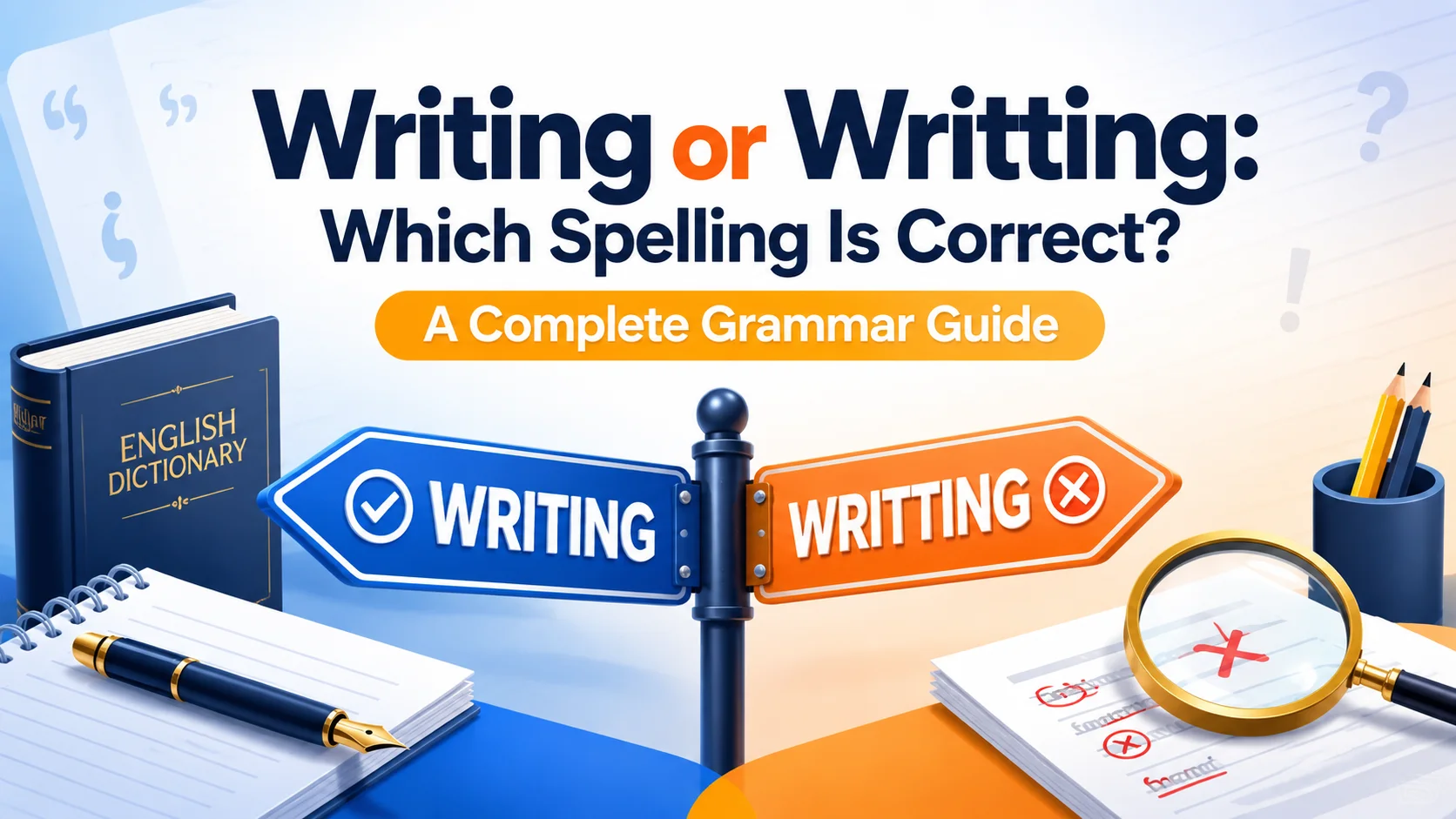
Writing or writting is a spelling question that trips up students, English learners, professionals, and even native speakers. The confusion is understandable because English contains many verbs that double their final consonant before adding -ing, such as run → running and sit → sitting. It seems logical to assume that write should become writting. However, English spelling follows specific rules, and writing is the only correct form. Understanding why this is true is far more valuable than simply memorizing the answer.
Accurate spelling does more than satisfy grammar rules. It shapes how readers perceive your credibility, attention to detail, and professionalism. Whether you’re writing an academic essay, sending a business email, publishing a blog post, or creating website content, using the correct spelling helps your message appear polished and trustworthy. Although search engines can recognize common misspellings, readers—and grammar checkers—still expect standard English.
This guide explains the correct spelling, the grammar rule behind it, and the reasons so many people mistakenly write writting. You’ll also learn when English doubles a final consonant, explore practical examples, compare similar spelling patterns, discover common mistakes to avoid, and find expert proofreading tips that improve your writing beyond this single word. By the end, you’ll understand the rule well enough to apply it confidently to many other English verbs.
Writing or Writting: Which Spelling Is Correct?
The correct spelling is writing.
The spelling writting is incorrect in American English, British English, Canadian English, Australian English, and every other standard variety of modern English. If you’re referring to the act of composing text, taking notes, creating documents, or expressing ideas in written form, writing is always the correct choice.
The confusion usually comes from misunderstanding how English forms present participles and gerunds. Many verbs require the final consonant to be doubled before adding -ing, while others follow an entirely different rule. The verb write belongs to the second group.
Consider the following examples:
- ✅ I am writing an email to my client.
- ✅ She enjoys writing short stories.
- ✅ They are writing a research paper together.
- ❌ I am writting an email.
- ❌ He loves writting poetry.
In every context, writing is grammatically correct, while writting is simply a spelling mistake.
Key Takeaway
If you’re unsure, remember this simple rule: Write → Writing. Never add an extra t.
Why This Mistake Is So Common
Many people assume that write follows the same pattern as verbs like:
- Run → Running
- Sit → Sitting
- Stop → Stopping
Because these verbs double the final consonant, learners often expect:
Write → Writting ❌
However, write follows a completely different spelling rule because it ends with a silent “e.” Instead of doubling the t, English removes the final e before adding -ing.
Quick Comparison: Writing vs. Writting
| Feature | Writing | Writting |
| Correct spelling | ✅ Yes | ❌ No |
| Recognized by dictionaries | ✅ Yes | ❌ No |
| Accepted in academic writing | ✅ Yes | ❌ No |
| Used in professional communication | ✅ Yes | ❌ No |
| Flagged by grammar checkers | ❌ No | ✅ Yes |
| Suitable for publishing | ✅ Yes | ❌ No |
Why Using the Correct Spelling Matters
Choosing the correct spelling isn’t just about following grammar rules—it directly affects how your writing is perceived.
Academic Success
Teachers, professors, and examiners often view repeated spelling mistakes as signs of weak language skills. Even excellent ideas can lose impact when basic spelling errors distract the reader.
Professional Credibility
Business emails, reports, résumés, and proposals should always use writing. A misspelling like writting may suggest a lack of proofreading or attention to detail.
Reader Trust
Readers naturally expect published content to be free from avoidable errors. Correct spelling improves readability and helps establish confidence in your expertise.
Better User Experience
While search engines are capable of recognizing common misspellings, users still prefer content that follows standard English conventions. Clear, accurate writing creates a smoother reading experience and reflects higher editorial quality.
Expert Tip
Don’t memorize writing as an isolated word. Learn the spelling rule behind it. Once you understand why writing becomes writing, you’ll be able to apply the same logic to many other English verbs without second-guessing yourself.
Why “Writing” Is Correct: Understanding the Grammar Rule
Simply memorizing that writing is correct may help in the short term, but understanding why it is correct gives you a lasting advantage. English spelling follows established patterns rather than random conventions. Once you learn the rule behind write → writing, you’ll be able to apply the same logic to many other verbs instead of relying on guesswork.
The confusion usually comes from mixing up two different spelling rules: dropping a silent “e” and doubling the final consonant. Since these rules apply in different situations, it’s important to know which one fits the verb write.
What Happens When a Verb Ends with a Silent “E”?
Many English verbs end with a silent “e.” When these verbs take the suffix -ing, the general rule is straightforward:
Drop the final silent “e” before adding “-ing.”
This rule keeps the spelling clean and avoids unnecessary letters while preserving the word’s pronunciation.
The “Drop the E, Add -ing” Rule
The verb write follows this standard pattern.
Formula:
Verb + Silent E → Remove the E → Add -ing
Examples include:
| Base Verb | Correct -ing Form |
| Write | Writing |
| Make | Making |
| Bake | Baking |
| Drive | Driving |
| Create | Creating |
| Smile | Smiling |
| Hope | Hoping |
| Share | Sharing |
Notice that none of these verbs double their final consonant. They simply lose the silent e before adding -ing.
This rule is one of the first spelling patterns taught in English grammar because it applies to hundreds of commonly used verbs.
Grammar Tip
If a verb ends with a silent “e,” your first instinct should be to drop the “e” before adding -ing, unless the word is an established exception.
;Why “Write” Doesn’t Double the Final “T”
Many learners wonder why writing becomes writing instead of writting, especially when words like running and sitting contain double consonants.
The answer is that write does not meet the conditions required for consonant doubling.
English doubles the final consonant only under specific circumstances—not simply because a word ends with a consonant.
Since write already ends with a silent e, the applicable rule is to remove the silent e, not to double the t.
Compare the two patterns:
| Verb | Rule Applied | Correct Form |
| Write | Drop silent e | Writing |
| Make | Drop silent e | Making |
| Drive | Drop silent e | Driving |
| Run | Double final consonant | Running |
| Sit | Double final consonant | Sitting |
| Stop | Double final consonant | Stopping |
Understanding which rule applies is far more reliable than trying to remember individual spellings.
When English Does Double the Final Consonant
Not every verb follows the same pattern. Some verbs require the final consonant to be doubled before adding -ing, but only when they satisfy specific spelling conditions.
Learning these conditions helps prevent mistakes like writting, runing, or hoping/hopping confusion.
Conditions for Consonant Doubling
In most cases, double the final consonant when all of the following are true:
- The verb has one syllable, or the stress falls on the last syllable.
- The word ends with one vowel followed by one consonant.
- The final consonant is not w, x, or y.
Examples include:
- Run → Running
- Sit → Sitting
- Stop → Stopping
- Plan → Planning
- Swim → Swimming
- Begin → Beginning (stress on the final syllable)
Because write ends with a silent “e”, it does not satisfy these conditions.
Examples of Consonant Doubling
The following examples illustrate when doubling is required.
| Base Verb | Correct Form | Reason |
| Run | Running | One syllable + vowel + consonant |
| Sit | Sitting | One syllable + vowel + consonant |
| Stop | Stopping | One syllable + vowel + consonant |
| Plan | Planning | Final consonant doubled |
| Swim | Swimming | Final consonant doubled |
| Write | Writing | Silent e dropped instead |
Comparing these words side by side makes the difference much easier to remember.
Common Exceptions and Special Cases
Like many aspects of English, spelling rules have exceptions. Fortunately, write is not one of them—it follows the standard drop the silent e rule.
However, learners should be aware of words that appear similar but behave differently.
For example:
| Word | Correct Form |
| Dye | Dyeing |
| Singe | Singeing |
| Age | Ageing (UK) / Aging (US) |
These verbs retain the e because removing it would either change the pronunciation or create confusion with another existing word.
For instance:
- Dyeing keeps the e so it isn’t confused with dying.
- Singing keeps the e to preserve the soft g sound.
These exceptions are relatively rare and exist for reasons of pronunciation or clarity. The verb write does not fall into this category, so the standard rule applies without exception.
Expert Insight
Rather than asking, “Should I double the consonant?” first ask, “Does this verb end with a silent e?” If it does, dropping the e is usually the correct solution. This simple habit will help you spell writing, making, driving, hoping, and many other verbs correctly without hesitation.
Why Do People Misspell “Writing” as “Writting”?
If writing is the only correct spelling, why is writting searched thousands of times every month? The answer lies in how people naturally learn English. Many learners recognize patterns before they understand the grammar rules behind them. Since English contains numerous verbs that double the final consonant before adding -ing, it’s easy to assume that write follows the same pattern.
The mistake isn’t usually caused by carelessness. Instead, it results from applying the wrong spelling rule to the word write. Understanding these common causes will help you avoid not only this error but many similar spelling mistakes as well.
Confusing the Consonant-Doubling Rule
The most common reason people write writting is that they overgeneralize the consonant-doubling rule.
Consider these familiar examples:
- Run → Running
- Sit → Sitting
- Swim → Swimming
- Stop → Stopping
After seeing enough words like these, many learners conclude that every verb ending in t should double its final consonant before adding -ing.
However, English spelling doesn’t work that way. The rule depends on the structure of the entire word, not just its last letter.
Compare the difference below.
| Word | Incorrect Form | Correct Form | Rule Applied |
| Write | Writting | Writing | Drop the silent e |
| Make | Makeing | Making | Drop the silent e |
| Drive | Driveing | Driving | Drop the silent e |
| Run | Runing | Running | Double final consonant |
| Sit | Siting | Sitting | Double final consonant |
| Stop | Stoping | Stopping | Double final consonant |
This comparison highlights an important principle: identify the spelling rule before changing the word. Looking only at the last letter often leads to mistakes.
Pronunciation Doesn’t Always Match Spelling
English spelling is only partly phonetic. In many cases, words are not written exactly as they sound.
When people say writing, the pronunciation may seem to emphasize the middle consonant. This can create the false impression that an extra t belongs in the spelling.
English contains many words where pronunciation and spelling don’t perfectly align, including:
- Separate
- Necessary
- Tomorrow
- Occasion
- Accommodation
These words demonstrate why pronunciation alone isn’t a reliable guide for spelling.
Expert Insight
Good spelling comes from understanding patterns, not simply copying sounds. Professional writers rely on grammar rules and proofreading rather than pronunciation.
The Influence of Similar-Looking Words
Another reason for the confusion is that English contains many words with double consonants.
For example:
- Written
- Sitting
- Getting
- Running
- Beginning
Because learners frequently encounter these spellings, they may subconsciously assume that writing should also contain a double t.
Ironically, the past participle written contributes to the confusion.
Compare the forms:
- Write
- Writes
- Wrote
- Written
- Writing
Since written contains a double t, some learners incorrectly transfer that spelling pattern to writing.
Remember that every verb form follows its own grammatical rule.
Challenges Faced by English Learners (ESL)
For people learning English as a second language, writting is one of the most understandable spelling mistakes.
Many languages have highly predictable spelling systems where words are written almost exactly as they are pronounced. English, however, has evolved from multiple language families over centuries, making its spelling system more complex.
Common areas of difficulty include:
- Silent letters
- Double consonants
- Irregular verbs
- Multiple pronunciation patterns
- Exceptions to standard rules
Experienced English teachers often recommend learning word families and spelling rules rather than memorizing isolated words. This approach makes it easier to recognize correct spellings in unfamiliar situations.
Typing Habits and Autocorrect Can Be Misleading
Modern writing tools catch many spelling mistakes, but they don’t eliminate them completely.
People often type writting because they:
- Type too quickly
- Skip proofreading
- Trust autocorrect too much
- Copy text without reviewing it
- Write in apps with limited spell-check support
Although programs like Microsoft Word, Google Docs, and Grammarly usually flag writting, no automated tool replaces careful proofreading.
Professional editors almost always perform a final manual review before publishing important content.
Pro Tip
Spell-check software should be your last line of defense, not your first. Developing a solid understanding of grammar rules makes your writing more accurate—even when technology isn’t available.
Writing vs. Writting: Side-by-Side Comparison
A quick comparison makes it easy to see why only one spelling is accepted in standard English. While both words may appear in online searches, only writing is recognized by dictionaries, grammar guides, and educational institutions.
At-a-Glance Comparison
| Feature | Writing | Writting |
| Standard English spelling | ✅ Yes | ❌ No |
| Recognized by Oxford, Cambridge, and Merriam-Webster | ✅ Yes | ❌ No |
| Accepted in academic writing | ✅ Yes | ❌ No |
| Appropriate for professional documents | ✅ Yes | ❌ No |
| Passes grammar checkers | ✅ Yes | ❌ Usually flagged |
| Recommended for websites and blogs | ✅ Yes | ❌ No |
| Suitable for exams | ✅ Yes | ❌ No |
Dictionary Recognition
Major dictionaries consistently recognize writing as the correct present participle and gerund of write.
Trusted references include:
- Oxford English Dictionary
- Cambridge Dictionary
- Merriam-Webster
- Collins Dictionary
- Dictionary.com
None of these dictionaries list writting as a standard English word.
Grammar Accuracy
From a grammatical perspective, writing is correct because it follows the standard rule for verbs ending in a silent e.
The transformation is simple:
Write → Writing
There is no grammar rule that produces writting, making it an avoidable spelling error rather than an alternative spelling.
Search Popularity Doesn’t Make a Word Correct
Some people believe that because writting appears in search results or autocomplete suggestions, it must be an acceptable spelling.
That’s a misconception.
Search engines are designed to understand user intent, not validate spelling. When many people make the same typo, search engines learn to recognize it and often redirect users to results for the correctly spelled word.
Popularity does not determine correctness—grammar rules and authoritative dictionaries do.
Key Takeaway
If you’re writing for school, work, publishing, or SEO, always use writing. Although search engines understand the typo writting, readers and grammar checkers expect the correct spelling.
Conclusion
Choosing between writing and writting becomes simple once you understand the grammar rule behind the spelling. Writing is the only correct form because the verb write ends with a silent “e,” which is dropped before adding -ing. This rule applies consistently across British English, American English, and every other standard variety of English, making writting an avoidable spelling mistake rather than an alternative spelling.Instead of memorizing individual words, focus on learning the spelling patterns that govern English verbs. Doing so will improve your writing accuracy, strengthen your grammar skills, and help you avoid similar mistakes in the future. One final actionable tip: whenever you’re unsure about a spelling, verify it using a trusted dictionary or grammar reference rather than relying solely on pronunciation or autocorrect. A common mistake to avoid is assuming every verb ending in “t” requires consonant doubling. Understanding the underlying rule will make your writing more confident, accurate, and professional.
FAQs
Q1. Is writting ever considered correct in English?
No. Writting is not a recognized English word in any standard variety of the language, including American, British, Canadian, or Australian English. Reputable dictionaries and grammar references consistently list writing as the correct present participle and gerund of write, while writting is treated as a spelling mistake.
Q2. Why doesn’t writing become writting like run becomes running?
The difference lies in the spelling rule each verb follows. Writing ends with a silent “e,” so English requires you to drop the “e” before adding “-ing,” resulting in writing. Verbs like run and sit follow the consonant-doubling rule because they end with a single vowel followed by a single consonant.
Q3. Is writing the correct spelling in both British and American English?
Yes. Writing is the standard spelling in British English, American English, Canadian English, Australian English, and other English varieties. Unlike words such as travelling/traveling or labelled/labeled, there is no regional spelling variation for writing.
Q4. Why does Google show results for writting if it’s incorrect?
Search engines recognize that many users accidentally misspell writing as writting. Instead of treating it as a valid word, they use search intent and autocorrection algorithms to display results for the correct spelling. This improves the user experience but does not make the misspelling grammatically acceptable.
Q5. What’s the easiest way to remember the correct spelling of writing?
Remember the simple rule: “Drop the silent ‘e,’ then add ‘-ing.'” Apply this pattern to similar verbs such as make → making, drive → driving, and bake → baking. Learning the rules—not just the word—will help you spell many English verbs correctly with confidence.